

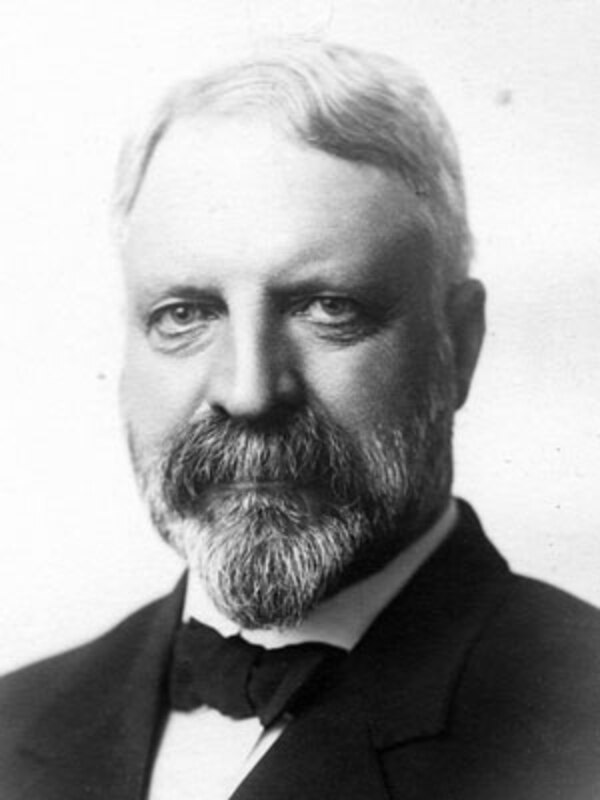
Source: Link
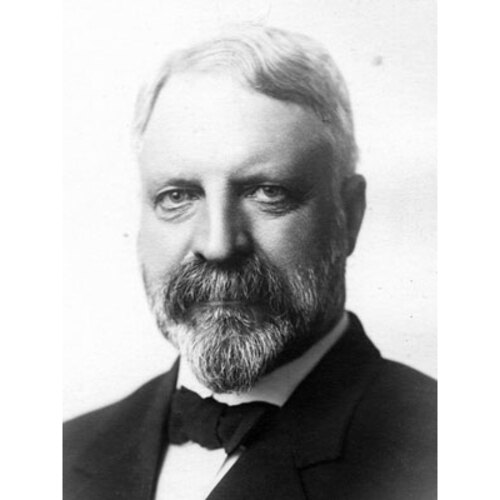
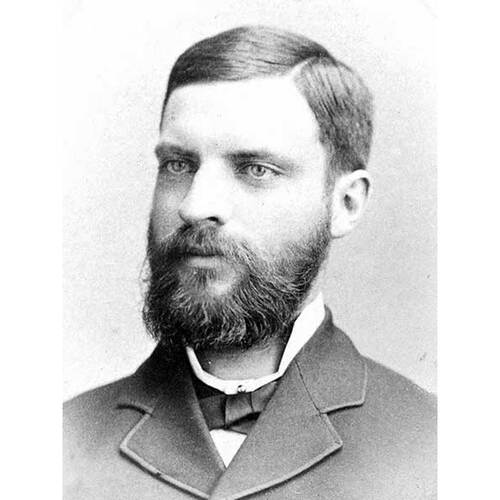
BAIRD, ANDREW BROWNING, Presbyterian minister, university professor, author, school administrator, and United Church minister; b. 6 Oct. 1855 in Motherwell, Upper Canada, eldest of the 12 children of Charles Baird and Agnes Browning; brother of the eminent psychologist John Wallace Baird; m. 20 Sept. 1887 Penelope Campbell Cook (d. 1936) in Galt (Cambridge), Ont., and they had three daughters and one son; d. 22 Sept. 1940 in Winnipeg.
Early life and education
Andrew Browning Baird was born into a community of Scottish-immigrant farmers in Perth County, Upper Canada. In keeping with Kirk tradition, as the eldest son he was destined for ministry. He received his preparatory education at the high school in St Marys and at Toronto’s Upper Canada College. He continued on to the University of Toronto, where before and after graduating with a ba in 1877 (he took his ma three years later), he served as a student missionary for the Presbyterian Church in Canada (PCC), which had been created in 1875. Baird then proceeded to study for three years at Toronto’s Knox College, the church’s principal seminary, where he was appointed a tutor in Greek. He did not graduate from Knox; instead, in 1881 he went to study at the Free Church of Scotland’s New College (part of the University of Edinburgh from 1935), where he was awarded a bachelor of divinity degree that year. He next moved to Germany, where he briefly pursued post-graduate studies at the University of Leipzig.
Mission work in the North-West Territories
Baird seemed well on his way to a career in academe. While in Germany, however, he learned that the PCC had other plans for him. Its superintendent of missions for the North-West Territories, James Robertson*, had appointed him a missionary there. Baird returned to Ontario and in August 1881 was ordained by the Presbytery of Stratford at his family’s church in Motherwell. He then proceeded to Winnipeg, the railhead. It was too late to join a travelling party, so he made the arduous 49-day journey to Edmonton (population 263) by horse and buckboard mostly alone. In November he established the first Presbyterian congregation there, which included fur traders, members of the North-West Mounted Police, and Métis. He began to hold services at Belmont (Edmonton), Fort Saskatchewan, and Clover Bar, among other places. In 1884 his stipend was raised to $700 and he was promoted to minister. Baird was also a member of the Board of Education for the North-West Territories, and he led the establishment of a mission school for Indigenous people on the reserve at Stony Plain in 1885. On behalf of the church’s foreign missions committee, he would later publish a pamphlet titled The Indians of western Canada (Toronto, 1895), which reflects a paternalistic and assimilationist view of Indigenous people.
Move to Winnipeg and university teaching
In 1887 Baird resigned from his post in Edmonton and accepted a position as principal of an industrial school for Indigenous people in Regina. He returned to Ontario that summer to marry Penelope Campbell Cook, to whom he had become engaged on a trip home two years earlier. Construction of the industrial school was delayed, however, so in late 1887 the couple moved to Winnipeg, where Baird was given charge of the newly formed Augustine Church and hired as a lecturer in Old Testament exegesis and oriental language and literature at Manitoba College, a Presbyterian institution that at the time was part of the University of Manitoba [see George Bryce]. In 1891 he was elevated to a professorship and relinquished the pulpit, although he would remain an active member of Augustine Church for the rest of his life.
Continuing church activities and union
Baird continued to serve the PCC after he gave up active ministry in 1891. That year he was clerk of the Synod of Manitoba and the North-West Territories. He would later sit on several of the PCC’s committees, such as those dedicated to foreign missions and religious instruction. In 1903 he was awarded a doctorate of divinity by Knox College.
When the assembly met in Winnipeg in 1916, Baird was elected moderator. The assembly voted that year to bring the church into union with the Methodist Church of Canada and the Congregational Union of Canada. Baird, like most Presbyterian ministers and the professoriate, was a staunch unionist [see Clarence Dunlop Mackinnon] and served on the PCC’s committee on church union. Though he was more irenic than the other Presbyterian leaders of the union movement (he refused to engage in public debate about Protestant interdenominational union), he nevertheless failed in his attempt to conciliate the opposing minority, who in 1916 formed the Presbyterian Church Association to ensure that the PCC would continue no matter what. The Great War and fierce resistance among Presbyterians, especially in Ontario, deferred the consummation of church union for nearly a decade, and the predictable outcome was disruption and schism within the PCC [see Ephraim Scott]. Ironically, Edmonton’s First Presbyterian Church, which Baird had founded, opted not to become part of the United Church. In 1925 he was named inaugural president of the Manitoba Conference of the United Church of Canada. He retired from ministry around 1931.
First World War
Baird was held in high esteem, as evidenced by his appointment as chair of the appeal board for Manitoba under Canada’s Military Service Act of 1917. His experience of the war was personal too: his daughter Agnes Browning served as a nurse, and his only son, Andrew Stuart, a young lawyer who in 1915 had volunteered for active service overseas, was killed in action three months before the end of the war.
Educational career at Manitoba College
Though Baird was prominent in the church before and after union, his principal and proper sphere of activity was Manitoba College. It is evident that education was his first love and true métier. Church history was his forte, and lecturing, rather than writing, his medium. He was a true polymath and pedagogue in the tradition of the old Scottish dominie. In addition to apologetics, church history, and theology, at one time or another he taught Hebrew, Latin, biblical Greek, English, French, German, history, political economy, and New Testament exegesis. He served as the college’s librarian from his arrival in 1887, and as its treasurer and acting principal upon the death of John Mark King* in 1899. From 1888 until about 1938 he was a member of Manitoba College’s board of management and the University of Manitoba’s council. He was again acting principal of Manitoba College from 1910 to 1919. In 1922 the University of Manitoba conferred upon him an honorary lld. He continued teaching at the college until his retirement in 1937. When Manitoba College merged with Wesley College the following year to form United College (which would become the University of Winnipeg in 1967), he gave the inaugural address and served as acting principal of the divinity school. Baird’s wife, Penelope, also involved herself in college life as a member of the Manitoba College Women’s Auxiliary in 1927–28 and 1931–32.
Hobbies
In his spare time Baird was a serious collector of coins; his collection, which was among the most valuable in western Canada, led to his being elected a member of the Royal Numismatic Society in 1907. This avocation provided occasional peaceful escapes from an otherwise exceedingly busy life. He had also served as president of the Historical and Scientific Society of Manitoba from 1893 to 1895 and of the Manitoba Horticultural Society from 1896 to 1899.
Assessment
Among the ministers of the PCC who supported church union, Baird stands out as a missionary pastor, educator, and ecclesiastical statesman who saw in Protestant interdenominational union God’s plan for the renewal of Christianity in Canada. His obituary in the United Churchman includes a quotation by him that sums up his pragmatic idealism and Social Gospel ecclesiology: “The church is freeing itself of too intimate an alliance with capitalism and is delivering its message in a purer and more spiritual form than ever before.” Just as Presbyterian Manitoba was at the forefront of the church-union movement [see Charles William Gordon], so too was Andrew Baird. He was among the most distinguished Presbyterian ministers of the first generation of the United Church of Canada.
Andrew Browning Baird was the author of Notes on introduction to the New Testament (Winnipeg, 1896); no bibliography exists of his published writings, which include pamphlets, articles, and essays. Baird’s papers are extensive, the principal holding being in the UCC, Man. and Northwestern Ont. Conference and All Native Circle Conference (Winnipeg), Rev. Andrew B. Baird fonds; smaller holdings are in the Univ. of Winnipeg Arch., Andrew Browning Baird papers (IN-1), and the AM, Andrew Browning Baird fonds. The Reverend J. A. M. Edwards’s slim biography of Baird, Andrew Baird of Manitoba College (Winnipeg, 1972), published to commemorate the 1971 centenary of Manitoba College, reproduces some original documents from the Baird papers.
Ancestry.com, “Ontario, Canada, marriages, 1826–1942,” Andrew B. Baird and Penelope C. Cook, Galt, 20 Sept. 1887. AM, ATG 0025A (Winnipeg estate files), GR4866, file 28546, Andrew Browning Baird, Q 4923. Edmonton Bulletin, 1881–87. Manitoba Free Press (Winnipeg), 1887–1931. New Outlook (Toronto), 1925–39. Presbyterian Record (Montreal), 1881–1925. United Church Observer (Toronto), 1939–40. United Churchman (Sackville, N.B.), 2 Oct. 1940. Winnipeg Free Press, 1931–40. Winnipeg Telegram, 1894–1920. Winnipeg Tribune, 1890–1940. A. G. Bedford, The University of Winnipeg: a history of the founding colleges (Toronto and Buffalo, N.Y., 1976). J. M. Bumsted, Dictionary of Manitoba biography (Winnipeg, 1999). K. W. Gunn-Walberg, “The church union movement in Manitoba, 1902–1925: a cultural study in the decline of denominationalism within the Protestant ascendency” (phd thesis, Univ. of Guelph, Ont., 1971). Daniel Lahham and C. D. Green, “John Wallace Baird: the first Canadian president of the American Psychological Association,” Canadian Psychology (Ottawa), 54 (2013): 124–32. Hugh McKellar, Presbyterian pioneer missionaries in Manitoba, Saskatchewan, Alberta and British Columbia (Toronto, 1924). J. J. H. Morris, “The Presbyterian Church in Edmonton, northern Alberta, and the Klondike, 1881–1925, largely according to official documents” (mth thesis, Vancouver School of Theology, 1974). Kenneth Munro, First Presbyterian Church, Edmonton: a history (Victoria, 2004). Prairie spirit: perspectives on the heritage of the United Church of Canada in the west, ed. D. L. Butcher et al. ([Winnipeg], 1985). Presbyterian Church in Canada, General Assembly, Acts and proc. (Toronto), 1881–1925. R. C. Russell, “A minister takes the Carlton Trail,” Beaver (Winnipeg), outfit 290 (winter 1959): 4–11. United Church of Can., Year book (Toronto), 1926–40. J. C. Walker, “The early history of the Presbyterian Church in western Canada: from the earliest times to the year 1881” (phd thesis, Univ. of Edinburgh, 1928).
Image Gallery

Cite This Article
Barry Cahill, “BAIRD, ANDREW BROWNING,” in Dictionary of Canadian Biography, vol. 16, University of Toronto/Université Laval, 2003–, accessed February 17, 2026, https://www.biographi.ca/en/bio/baird_andrew_browning_16E.html.
The citation above shows the format for footnotes and endnotes according to the Chicago manual of style (16th edition). Information to be used in other citation formats:
| Permalink: | https://www.biographi.ca/en/bio/baird_andrew_browning_16E.html |
| Author of Article: | Barry Cahill |
| Title of Article: | BAIRD, ANDREW BROWNING |
| Publication Name: | Dictionary of Canadian Biography, vol. 16 |
| Publisher: | University of Toronto/Université Laval |
| Year of publication: | 2026 |
| Year of revision: | 2026 |
| Access Date: | February 17, 2026 |