

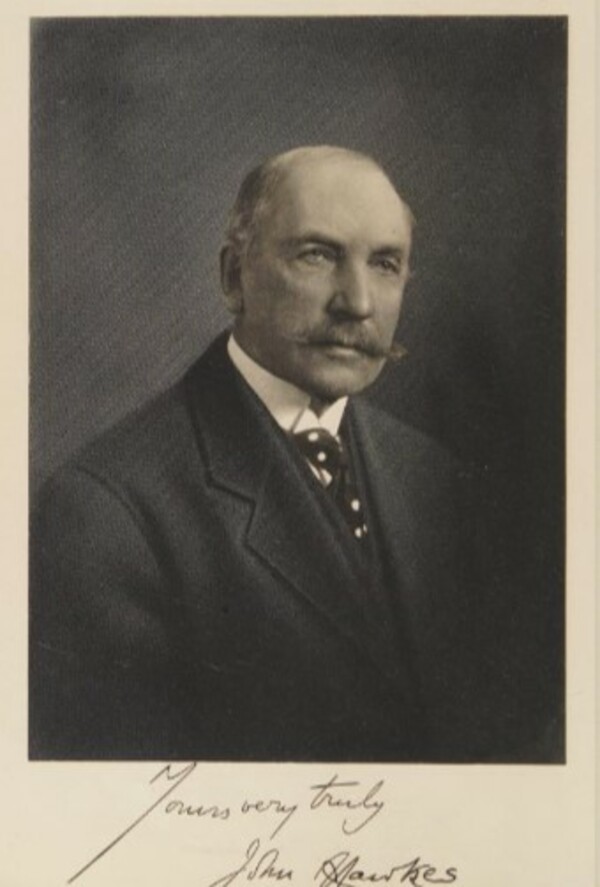
Source: Link
HAWKES, JOHN, labourer, journalist, civil servant, and author; b. 12 Jan. 1851 in Aylesford, England, son of William Hawkes and Sarah Perrin; m. 23 July 1873 Elizabeth Ellen Parsons (1852–1944) in Guildford, England, and they had at least ten children, two of whom predeceased him; d. 26 Feb. 1931 in London, England.
John Hawkes loved a good tale, including his own life story, which he believed to have been packed so full of “experience and adventure” that it would “provide a second Joseph Conrad with material for a whole shelf-full of thrilling tales.” William Hawkes was a farm labourer when his son was born, but he seems to have prospered, becoming a grocer and then a farmer. John was educated at Brunswick House, a private school in Maidstone, and he surprised his father by abandoning his studies at age 14. He would explain this decision in 1905 with this statement: “I wanted to be a newspaper man.” Hawkes trained at an “old Whig paper,” the South Eastern Gazette (Maidstone), and for the rest of his life he worked as a journalist and author with a thirst for adventure and an ear for a good story.
It was the former that led him to North America in 1869 at age 18. Hawkes would write in 1924 that he earned his living as a manual labourer, working up and down the continent. He was employed “first on farms in Scott township, near Uxbridge, Ontario, and, later, on the grading of the Toronto and Nipissing, and the Toronto, Grey, and Bruce Railroads.” He then moved south, again working on railroads and as a “chopper, clearing the right of way through the woods of Kalamazoo to the shore of Lake Michigan.” From the northern United States, Hawkes travelled south, arriving in New Orleans on a steamboat. According to the Cumberland News, he wintered in Arkansas, Louisiana, and Mississippi. There he “took great interest in studying the conditions of the negro population, which had recently been emancipated.” In the spring of 1871 he turned north towards New York, where he embarked for England aboard the Minnesota.
His adventure across North America behind him, Hawkes returned to life as a journalist. He edited the Hereford Evening News, among other “provincial papers,” and worked as a correspondent for the British Press Association and the Times (London). Hawkes married Elizabeth Ellen Parsons in 1873, and two years later they welcomed the first of their children.
By the mid 1880s Hawkes had decided to immigrate to Canada; he arrived in 1885. He went west, where he once more found employment as a labourer, working on a “flying gang” maintenance crew for the Canadian Pacific Railway (CPR), and as the operator of a well-boring machine that was “affectionately known as the ‘mankiller.’” In 1889 he took a homestead near Percival in the North-West Territories (Sask.), not far from Cannington Manor, which was established as a colony for British remittance men. Elizabeth Hawkes later recalled visiting the manor residents via ox-cart to socialize. The family rented out their farm and relocated to Whitewood in 1891 so that their children could attend school. Hawkes would later write in The story of Saskatchewan that “Whitewood was in the eighties the most cosmopolitan point in the west. It came to be a saying that one should know eleven languages to do business.”
Hawkes, who had supported the Conservatives in Britain, despite once working for a Whig paper, retained this civic interest in Canada. Although he was a popular platform speaker, he lost to Alexander Gillan Thorburn* when he ran as a Liberal-Conservative representative for Whitewood in the 1888 election in the North-West Territories. Six years later he again contested a legislative seat, a race that he lost to his younger brother, Allen Gardener, a Liberal, who had emigrated in 1886. As secretary of the Dairymen’s Association of the North-West Territories, Hawkes toured the region with associates Edward Nicholas Hopkins and William Watson to promote the creation of cooperative western creameries backed by the territorial government. He returned to the hustings to support Conservative senator William Dell Perley in Assiniboia East during the federal election of 1896. Running for the Patrons of Industry [see Charles Braithwaite*] was James Moffat Douglas*. Never afraid to voice his opinion, Hawkes, according to the Winnipeg Tribune, dismissed the Patrons as “crazy cranks.” Douglas took the seat, winning by more than 1,000 votes.
Besides taking part in political affairs, Hawkes served his community as town clerk, justice of the peace, and registrar of vital statistics. He returned to journalism in 1897 when he became editor of the Whitewood Herald. That year two of his sons, Harry Hugo Hereward and Clandon Viger, drowned during a summer camping trip. Three years after their loss the family moved to Carnduff and he purchased the town’s Gazette. His wife, Elizabeth, also took up journalism in 1906, becoming the first owner of the Broadview Express (Grenfell, Sask.), which she edited until about 1909.
In covering life on the prairies, Hawkes began to consider himself a western Canadian, an allegiance that forced him to think about his political affiliations. The wheat boom had placed undue strain on the CPR, and although a staunch Conservative, Hawkes found himself agreeing with calls by the Liberal prime minister, Sir Wilfrid Laurier*, for a second transcontinental railway to transport grain from the prairies to eastern centres. Hawkes made his position known in the Manitoba Free Press in 1903: “the proposition is so vital to the west that those who are anchored on the prairies should put party aside, and be western men first.” Denounced, according to the Free Press, as a “Fake Conservative,” he did not waver and fully supported Laurier (and expansion of the Grand Trunk Railway) in the 1908 federal election.
Perhaps because of his new political stripe, Hawkes was sent to London in 1905–6 to lecture on immigration, offering advice to the thousands of English emigrants heading for western Canada. Upon his return in 1907, he moved to Regina after accepting an appointment from the government of Thomas Walter Scott as the first legislative librarian for the new province of Saskatchewan, a position he would hold for 20 years. The library system was in its infancy and it had to be built from the ground up. He also helped establish the Saskatchewan Travelling Library system, which by 1924 had over 800 libraries moving through rural areas of the province, and he oversaw the expansion of the original territorial library. After the infamous Regina cyclone of 1912 “smashed” the legislature’s holdings (then housed in the Land Titles building) “into a confused mass of plaster, broken glass, wood, books and papers,” Hawkes explained that he faced months of work to clean, sort, and fix the province’s collection. Despite the mess, he proudly recounted in 1921 that the library “performed its functions without a single complaint being registered against it.”
Hawkes retired from the Legislative Library in 1927 and passed away four years later in London. His most famous accomplishment remains The story of Saskatchewan and its people, published in three volumes in 1924. Now a collector’s item, between its covers readers find not only swashbuckling tales of Saskatchewan’s early days, but also the voice of a vigorous man keen to demonstrate that there was a “great deal more” to the province than “the mere farming of a primeval plain into a wheat field.” Taking a journalistic tone, Hawkes was not afraid to make a bold statement or set a scene; he gathered the factual, the humorous, and the autobiographical to convey his province’s identity and foster Saskatchewan pride.
John Hawkes is the author of The story of Saskatchewan and its people (3v., Regina, 1924).
Ancestry.com, “1851 England census,” John Hawkes (Kent, Malling, Aylesford); Canada, incoming passenger lists, 1865–1935,” John Hawkes, 28 Oct. 1929; “England & Wales, civil registration birth index, 1837–1915,” Allen Gardener Hawkes; “Surrey, England, Church of England marriages and banns, 1754–1937,” John Hawkes and Elizabeth Ellen Parms [Parsons], 23 July 1873. GA, F0662 (Laurie, DeGear family fonds), S0002 (scrapbook 9), p.41. LAC, R190-383-1-E (Dept. of the Interior, Land Patents Branch, letters patent, register of Dominion land patents – liber 113, f.351 (John Hawkes)). Cumberland News (Cumberland, B.C.), 11 Jan. 1905. Edmonton Bull., 30 March 1896, 3 Sept. 1903, 10 Oct. 1908. Manitoba Free Press, 19, 23 Jan. 1894; 18 May, 3 June 1896; 21 Aug. 1903; 26 Jan. 1904. Revelstoke Herald (Revelstoke, B.C.), 11 Aug. 1897. Winnipeg Tribune, 29 Jan. 1894; 2 June 1896; 27 July 1897; 29 Aug. 1903; 18, 29 Jan. 1904. “Historians and historiography,” in Canadian Plains Research Center, Encyclopedia of Saskatchewan (Regina, 2005). Merle Massie, “‘Has Saskatchewan any history?’: writing provincial history in Saskatchewan, 1913–2005,” Prairie Forum (Regina), 33 (2008): 211–38. Pioneers and prominent people of Saskatchewan (Winnipeg and Toronto, 1924).
Image Gallery

Cite This Article
Merle Massie, “HAWKES, JOHN,” in Dictionary of Canadian Biography, vol. 16, University of Toronto/Université Laval, 2003–, accessed May 30, 2026, https://www.biographi.ca/en/bio/hawkes_john_16E.html.
The citation above shows the format for footnotes and endnotes according to the Chicago manual of style (16th edition). Information to be used in other citation formats:
| Permalink: | https://www.biographi.ca/en/bio/hawkes_john_16E.html |
| Author of Article: | Merle Massie |
| Title of Article: | HAWKES, JOHN |
| Publication Name: | Dictionary of Canadian Biography, vol. 16 |
| Publisher: | University of Toronto/Université Laval |
| Year of publication: | 2026 |
| Year of revision: | 2026 |
| Access Date: | May 30, 2026 |