

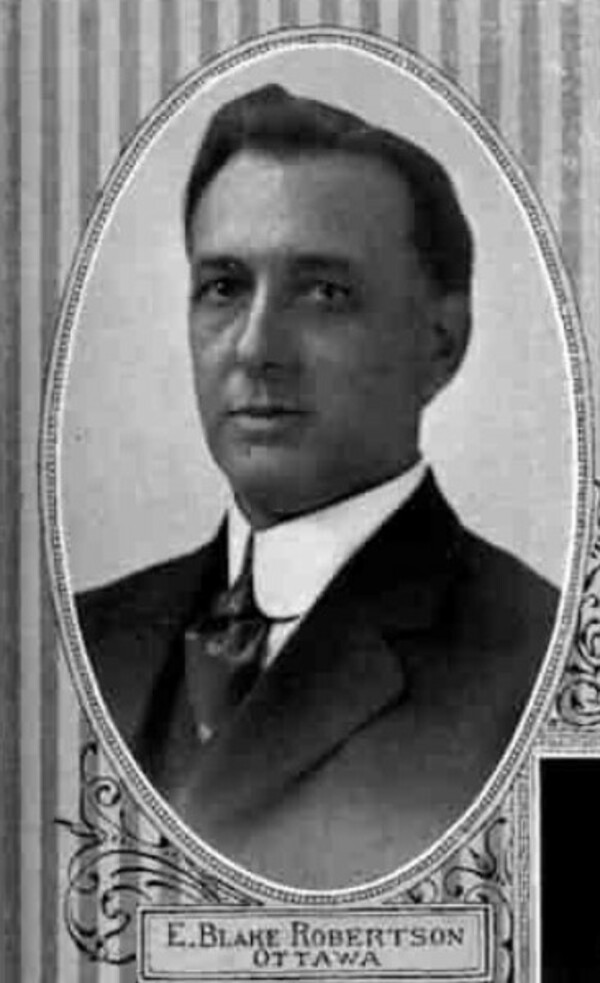
Source: Link
ROBERTSON, EDWARD BLAKE, educator, civil servant, and administrator; b. 27 Feb. 1877 in Lanark County, Ont., youngest son of William Robertson and Marian Watt; m. 25 Dec. 1901 Christina Isola Wrixon in Winnipeg, and they had one son; d. 24 Oct. 1940 in Ottawa.
E. Blake Robertson was a mid-level Canadian immigration official during the Komagata Maru incident of 1914, when the Canadian government under Robert Laird Borden was forced by the actions of imperial subjects from India to deal with the conflict between the British empire’s promise of freedom of movement within its dominions and a Canadian immigration policy that favoured white people.
Robertson was born in eastern Ontario to parents of Scottish descent. His father, who worked in Lanark County as a postmaster, decided in 1879 to move his family to Manitoba. Robertson received his early education in Pilot Mound and then studied at the Winnipeg Normal School. He was a public-school teacher for six years. In April 1901 he moved into the provincial civil service as the chief clerk for Manitoba and was given the task of administering the decennial census that year.
Clifford Sifton*, who had been the federal minister of the interior since 1896, brought Robertson to Ottawa in August 1903 to work privately for him. Robertson’s famous superior had, like him, relocated to Manitoba from Ontario at a young age. At the end of 1904 Sifton appointed Robertson assistant superintendent of immigration under William Duncan Scott*. In this capacity Robertson travelled extensively across Canada, the United States, and Great Britain, and became known as a leading authority in his field. After Sifton resigned in 1905, Prime Minister Sir Wilfrid Laurier* replaced him with Frank Oliver. In 1911 responsibility for Chinese immigration passed from the Department of Trade and Commerce to Oliver’s department. On 21 September the Liberals were defeated by Borden’s Conservatives, and soon after Robertson became assistant chief controller of Chinese immigration.
Robertson’s Manitoba connections proved useful as immigration became a policy priority under the minister of the interior during the first decade of the 20th century. Skilled administrators were required to manage the mass movement of settlers into the Canadian west. Immigration boomed as the Laurier government sought those who could open up the land, increase the nation’s productivity, and protect the prairies from American expansion as that country’s own frontier disappeared. Between 1901 and 1913 the number of immigrants to Canada rose sharply, from a total of 41,681 in 1900 to 400,870 in 1913, the highest annual number in the 20th century. As workers continued to come from abroad, the movement to protect “white Canada” became gradually more vocal. It was particularly strong on the Pacific coast, where communities of Chinese, Japanese, and South Asian immigrants were blamed for much of the unemployment and poverty that existed in British Columbia’s rapidly urbanizing society.
In response to these sentiments, the Laurier government had increased the head tax on Chinese newcomers in 1903, and it limited immigration from Japan in 1908 through a gentleman’s agreement with that country. It was harder to explicitly discriminate against immigrants from India: as British subjects they were, in principle, entitled to settle anywhere within the empire. Nonetheless, to block their entry, the Laurier government passed two orders in council in 1908, mandating that to enter Canada such immigrants must possess $200 and make a “continuous journey” from their country of origin. After federal officials persuaded shipping companies to stop offering direct passages from India to Canada, Indians were accepted only in very rare circumstances [see Harnam Kaur*].
In the spring of 1914 a prominent Indian named Gurdit Singh decided to challenge Canadian limits on immigration. He chartered a Japanese-owned steamer, the Komagata Maru, and brought 376 Punjabis to Vancouver, where the ship anchored on 23 May. The passengers asserted their right to enter Canada as subjects of King George V, but the Conservative government of Robert Laird Borden did not allow them ashore. Tensions rose, and the living conditions aboard the Komagata Maru quickly deteriorated. Borden received several incendiary reports from Malcolm Robert James Reid, the Vancouver immigration agent. Reid’s political backer, Vancouver mp Henry Herbert Stevens*, was a relentless opponent of immigration from Asia. He feared the possibility of rioting if the ship remained in port, and wanted to send the Punjabis back to India, by force if necessary.
In contrast, Robertson advocated a peaceful resolution to the crisis that would be consistent with the rule of law. He collected and forwarded telegrams to Borden to keep him informed about the situation in Vancouver, and urged him to reject the “sharp practices” being suggested by Reid and Stevens. The prime minister agreed with Robertson’s proposal that a number of migrants should be chosen as “test cases” to go before the provincial Court of Appeal, which ruled on 6 July that the government had the right to bar the Punjabis from entering Canada. When federal officials tried to board the ship, some passengers hurled objects and caused injuries. The government then called out local militia units and dispatched the Royal Canadian Navy cruiser Rainbow to Vancouver. The Komagata Maru left for India on 23 July. Afterwards, Robertson arranged for Reid to be moved to a job where he had less authority.
Robertson left the civil service for the private sector in 1919, when he was named the Ottawa representative of the Canadian Manufacturers’ Association (CMA). The association had created this position in 1907 in order to have “a man constantly on the ground.” His responsibilities included apprising members of developments in parliament and monitoring the influence of labour organizations. Robertson spent the next 21 years at the CMA. In his spare time he enjoyed fishing and hunting, and was a motorboat enthusiast who belonged to the city’s Britannia Yacht Club. On 10 July 1940 he retired and began treatment for prostate cancer. He died at home a little over three months later.
During the last years of Canada’s patronage system of government, personal ties were not only considered acceptable but were believed to be the best qualification for entering the civil service. Robertson is an example. Clifford Sifton saw potential in the young teacher from Manitoba and integrated him into the workings of the immigration administration. Robertson’s real value as a civil servant emerged during the Komagata Maru crisis, when he presented reasonable and legal (although racially biased) alternatives to the ideas coming directly from Vancouver’s immigration offices.
AO, RG 80-2-0-96, no.13456; RG 80-2-0-548, no.11571; RG 80-08-0-1972, no.12296. Man., Dept. of Justice, Vital Statistics Agency (Winnipeg), no.1901-002735 (Edward Blake Robertson and Christina Isola Wrixon, 25 Dec. 1901). Can., Citizenship and Immigration, Citizenship and immigration statistics, 1996 (Ottawa, 1999); Dominion Bureau of Statistics, Canada year book (Ottawa), 1948/49, 1967. S. D. Clark, “The Canadian Manufacturers’ Association: a political pressure group,” Canadian Journal of Economics and Political Science (Toronto), 4 (1938): 505–23. Cyclopædia of Canadian biog. (Rose and Charlesworth), vol.3. H. J. M. Johnston, The voyage of the “Komagata Maru”: the Sikh challenge to Canada’s colour bar (Delhi, India, 1979; 2nd ed., Vancouver, 1989). South Asian Canadian Digital Arch., “Komagata Maru: continuing the journey.”
Image Gallery

Cite This Article
Julie Gilmour, “ROBERTSON, EDWARD BLAKE,” in Dictionary of Canadian Biography, vol. 16, University of Toronto/Université Laval, 2003–, accessed June 1, 2026, https://www.biographi.ca/en/bio/robertson_edward_blake_16E.html.
The citation above shows the format for footnotes and endnotes according to the Chicago manual of style (16th edition). Information to be used in other citation formats:
| Permalink: | https://www.biographi.ca/en/bio/robertson_edward_blake_16E.html |
| Author of Article: | Julie Gilmour |
| Title of Article: | ROBERTSON, EDWARD BLAKE |
| Publication Name: | Dictionary of Canadian Biography, vol. 16 |
| Publisher: | University of Toronto/Université Laval |
| Year of publication: | 2026 |
| Year of revision: | 2026 |
| Access Date: | June 1, 2026 |