

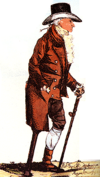
cast much of the blame on the “absurd Mixture of French & English Law,” which was the “Handle for Oppressive Partialities,” and on Governor Frederick
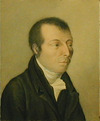
PANET, PIERRE-LOUIS, lawyer, notary, seigneur, office holder, politician, and judge; b. 1 Aug. 1761 in Montreal (Que.), son of
active role in the committee set up in the autumn of 1773 to demand an assembly, a year later he avoided joining his compatriots who sought repeal of the Quebec Act. On the question of the law in force in
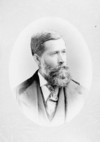
metaphysics, and an ma in 1853.
Crooks studied law concurrently with his university work; he received a
combined flattery and assurances that Newfoundland was loyal and law-abiding. However, he was also reluctant to surrender some of his other paid appointments after becoming chief justice, and in 1804 and
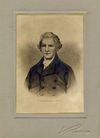
. 1779. In that year he published Remarks on the law of descent, a critique of Sir William Blackstone’s Commentaries on the laws of England. He did not practise in the circuit courts
creditor. This bitter experience with French civil law may have spurred Young to become a spokesman for the city’s English-speaking merchants who wished to change the colony’s laws and constitution [see
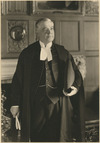
?]).
As well, Lemieux was the author of two books on the law: De la contrainte par corps: thèse pour le doctorat présentée et soutenue le 1er mai 1896 (Montréal, 1896) and
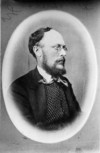
studies. He was called to the bar on 6 Oct. 1856, after having studied law with Napoléon Bureau of Trois-Rivières from 1851 to 1853 and with the Montreal firm of
evolution of Canada’s prostitution laws, 1867–1917,” Canadian Journal of Law and Soc. (Calgary), 1 (1986): 125–65. Regina v. Arscott, Ontario Reports, 9 (1885): 541–47
, and criminal law, since along with his business sense Jacrau had an acknowledged talent for legal matters; the attorney general Francis Maseres
Brunswick), though he did not receive a degree. Instead, he turned to law and studied under George Frederick Street*. On 8 May
, and a dcl in 1858. He studied law under William Blowers Bliss* and was called to the bar in 1831. His
positions of power and influence.
It was virtually inevitable that W. B. A. Ritchie would follow the law. His own father had been a barrister in
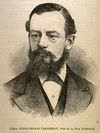
Petit Séminaire de Québec from 1851 to 1859, and then entered the Université Laval, where he graduated in law in 1862. An essay in rhetoric that he wrote on the library of Alexandria earned him several
Arthur Davidson].
Walker’s chief complaint was that the laws
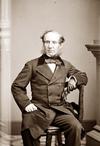
prominent in the public life of Nova Scotia, particularly in the fields of law and politics. Edward Mortimer Archibald was to follow in this tradition. He attended private elementary schools at Truro and was
faculty of law of the Université Laval, where he obtained his bachelor’s degree in 1887. He was accepted into the profession of notary on 6 October of that year and began practising law in Saint-Roch

his promotion to brigadier on 1 June 1904, he appeared at a conference under the title “commissioner of parole” for the Salvation Army.
With its
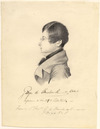
Papineau*, and for this reason his father prevented him from practising law in Montreal. Consequently he settled in Aylmer Township. He soon returned to Montreal, joined the Fils de la Liberté, and