

Source: Link
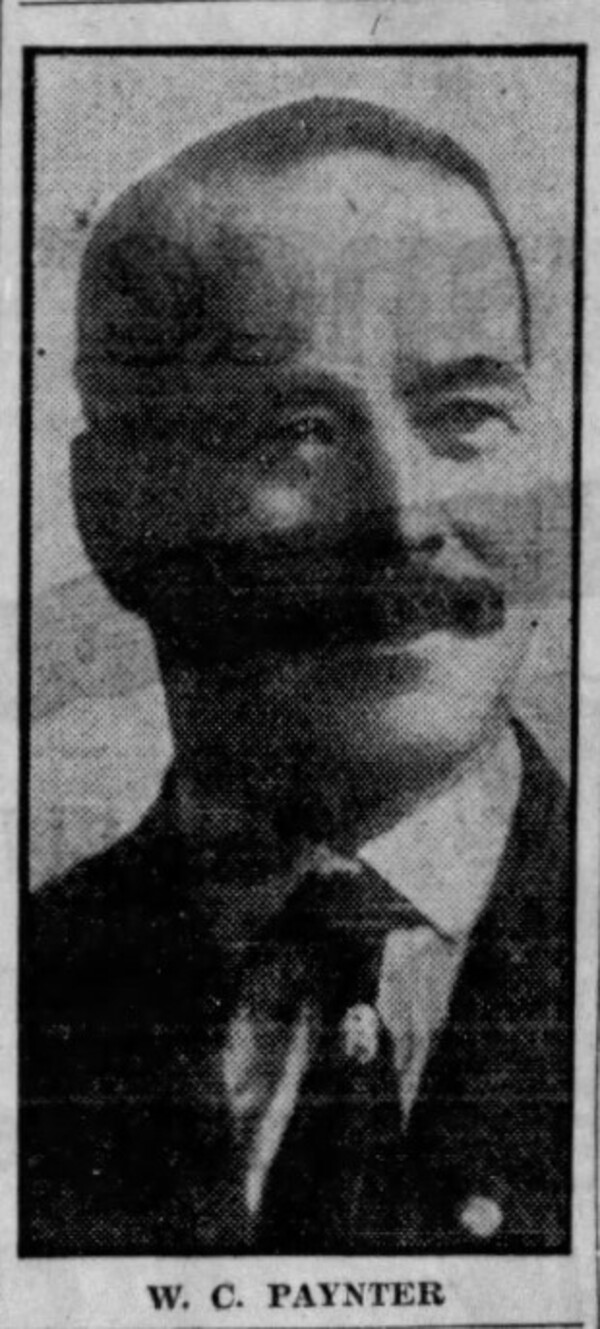
PAYNTER, WILLIAM CHARLES, teacher, farmer, colony co-founder, businessman, leader of a cooperative, and author; b. 6 July 1866 in Owen Sound, Upper Canada, son of William Daniel Paynter and Sarah Alice Doyle; m. first 6 Jan. 1892 Eliza (Lila) Mabel Shelvey (d. 1926) in Brandon, Man.; they had four boys, one of whom died at birth, and three girls, one of whom predeceased him; m. secondly 4 Jan. 1928 Mabel Estella Goodman (d. 1953) in Toronto; they had no children; d. 18 July 1934 in Winnipeg and was buried in Valley View Cemetery, Esterhazy, Sask.
The Paynter family moved in 1879 from Owen Sound to what would become Beulah, Man., where Will completed his education. He then taught at the Arrow River School, about ten miles away. In 1892 he married Lila Shelvey, and two years later he relocated to the North-West Territories after acquiring a homestead in the Qu’Appelle valley, south of Spy Hill. (The area would become part of Saskatchewan with the province’s establishment in 1905). During the early 1890s Will, his father, and his younger brother Joseph Edward (known as Ed) were organizers in the Patrons of Industry [see George Weston Wrigley*], a movement seeking greater legislative representation for farmers.
In 1895 Will and Ed wrote the constitution for the Harmony Industrial Association, the organizing body for a cooperative colony they intended to establish. In the document they declared that “the present competitive social system is one of injustice and fraud,” lamented “the evils springing from selfishness in the human heart,” and proposed to substitute cooperation for competition and greed. They planned to create public departments for essential purposes, including agriculture, education, and sanitation. In a concept that can be said to have anticipated medicare, the latter department would “furnish medical treatment and medicine to members and their families without personal charge.” On Will’s homestead the brothers and a small number of settlers founded the Hamona Colony, named after the biblical city of Hamonah (meaning “multitude”), the place where Gog and his armies were defeated and buried. The prophecy in the Book of Ezekiel (39:16) that “they shall cleanse the land” attests to the evangelical zeal that fuelled the Paynters’ vision.
The colony’s growth was stalled for more than two years by provisions of the Dominion Lands Act, which allotted homesteads to individuals rather than to collectives, and granted permanent title to settlers only after they cultivated the land and erected buildings. On 2 Nov. 1895 Will wrote to the minister of the interior, Thomas Mayne Daly*, about the colony’s dilemma: “We wish to build all our buildings in the Village. Perhaps you would get the Government to give us as a company the clear deed of the quarter section upon which we wish to build our village … otherwise we would be putting all Association’s buildings upon a single member’s homestead, and he would get the deed of the whole place.” More settlers arrived in 1897 and the colony slowly took shape. It sold butter to a store in Moosomin, traded with the Canadian Co-operative Society (a utopian colony in British Columbia), and seems to have been on the way to self-sufficiency. The issue of collective ownership, however, was not resolved until June 1898, when Sir Wilfrid Laurier*’s government passed an amendment to the act.
The little community of some 50 or 60 individuals continued only until 1900. One reason for its breakup was that, contrary to the hopes and expectations of the colonists, neither the Canadian Pacific Railway nor William Mackenzie* and Donald Mann’s upstart Canadian Northern Railway established a branch line through the site. In addition, there was dissension among members, some of whom wanted to share communal kitchens and (according to certain accounts) practise free love. The colony’s assets were distributed amicably, and members of the diverse group went their separate ways. Afterwards Will, Lila, and their children lived in nearby Tantallon. He served as a long-time trustee of the Hamona School, and during a dispute about whether a new building should be located in the valley or on the hill, he humorously suggested that it should be built on wheels to satisfy everyone.
Paynter’s main source of income after the colony disbanded was the profitable general store that he operated in Tantallon; in 1904 he took a leading role in the establishment of a cooperative creamery there, which also proved successful. In 1915 he became involved in another cooperative venture: Merchants’ Consolidated, a wholesale house for country and general merchants that made it possible for them to compete against big mail-order houses. The office was located in Winnipeg, and Paynter was named the first president.
Two years later Paynter became a director and the inaugural president of the Saskatchewan Co-operative Creameries, an alliance of 16 operations around the province. Unlike Merchants’ Consolidated, which did well financially, the cooperative ran into trouble in the early 1920s. A struggle for its future ensued, fuelled by an ideological tension that would remain a constant in the province’s politics: Paynter, a believer in public enterprise, urged Premier Charles Avery Dunning* to allow the association to raise money by issuing bonds guaranteed by the government, but Dunning, who was sympathetic to private firms that were competing with Paynter’s alliance, refused to provide assistance. In 1927, after years of turmoil, the Saskatchewan Co-operative Creameries amalgamated with a large private company.
Paynter was the author of The trumpet call of Canadian money and progress, a popular book in which he sharply criticized Canada’s economic system. To stimulate employment and growth, he argued for an increase in the money supply, which should be determined not by the nation’s stock of precious metals, but by its productive capacity and capital (including land, buildings, and other assets). He insisted that this increase would stem from a conservative estimate of the country’s true wealth, and would not result in the printing of “funny money.” The book’s fourth edition appeared in 1932, by which time Paynter was a member of the Canadian Currency and Banking Reform League’s central executive for Saskatchewan.
That year, amid the despair caused by the Great Depression [see Edward Jack Bates], the provincial government appointed Paynter to its banking inquiry commission. Moved by a sense that the international economic system was in crisis, the commission urged Canada to join other countries in establishing a central bank. For Paynter this stance represented an evolution of his concept of a farmers’ bank that would lend to those who needed money and not merely to those who already had it. In 1934, upon the recommendation of a federal royal commission led by Lord Macmillan, the government of Richard Bedford Bennett* passed legislation creating the Bank of Canada, which opened the next year, fulfilling the need for a central bank. Paynter did not live to see it.
William Charles Paynter died in July 1934, aged 68. He was survived by his second wife, Mabel, whom he had married two years after Lila’s death in 1926, and by five of his seven children. His youngest daughter, Hazel Pearl, later earned a commerce degree and worked for the bank whose creation her father had recommended. In 1955 the Co-operative Commonwealth Federation government of Thomas Clement Douglas* honoured Will and Ed Paynter’s contributions to Saskatchewan’s cooperative movement by naming an island in Keller Lake after them. Seven years later the CCF government implemented medicare, the landmark social program that was anticipated by the constitution the Paynters wrote in 1895 for the Harmony Industrial Association. The land on which they established the Hamona Colony was designated a provincial historic site in 1986.
The author is grateful to Will Paynter’s granddaughter Jean Thue for contributing information about the Paynter family and to his grandson Ken Fisher for providing a copy of an unpublished 1988 account, “The Paynters,” edited by Evelyn Geach, which contains a family tree prepared by Pearl Fisher. This work is cited in the author’s Practical utopians: the lives and writings of Saskatchewan cooperative pioneers Ed and Will Paynter (Regina, 2004), which reproduces the constitution of the Harmony Industrial Assoc.
Paynter’s publication, The trumpet call of Canadian money and progress: an ideal handbook of monetary reform (4th ed., Tantallon, Sask., 1932), was consulted in the preparation of this biography.
PAS, F 684 (Charles A. Dunning fonds), Coll. S-M6, file Y-15-6 (Saskatchewan Cooperative Creameries Ltd.), pp. 24955–56 (Will Paynter to Dunning, 28 Nov. 1922); R-348 (Department of the Provincial Secretary, Companies branch, II, Defunct companies), file 3675 (Merchants Consolidated Ltd.); R-513.1 (Paynter family), file 2 (Harmony Colony, c. 1939–57), Ed Paynter to Harry J. Perrin, 13 July 1939. Grain Growers’ Guide (Winnipeg), 12 May 1915. Alex MacDonald, Cloud-capped towers: the utopian theme in Saskatchewan history and culture (Regina, 2007). Sask., Banking inquiry commission, Report ([Regina, 1933]; copy at PAS, R-211.1, file 1).
Image Gallery

Cite This Article
Alex MacDonald, “PAYNTER, WILLIAM CHARLES,” in Dictionary of Canadian Biography, vol. 16, University of Toronto/Université Laval, 2003–, accessed May 25, 2026, https://www.biographi.ca/en/bio/paynter_william_charles_16E.html.
The citation above shows the format for footnotes and endnotes according to the Chicago manual of style (16th edition). Information to be used in other citation formats:
| Permalink: | https://www.biographi.ca/en/bio/paynter_william_charles_16E.html |
| Author of Article: | Alex MacDonald |
| Title of Article: | PAYNTER, WILLIAM CHARLES |
| Publication Name: | Dictionary of Canadian Biography, vol. 16 |
| Publisher: | University of Toronto/Université Laval |
| Year of publication: | 2026 |
| Year of revision: | 2026 |
| Access Date: | May 25, 2026 |