

Source: Link
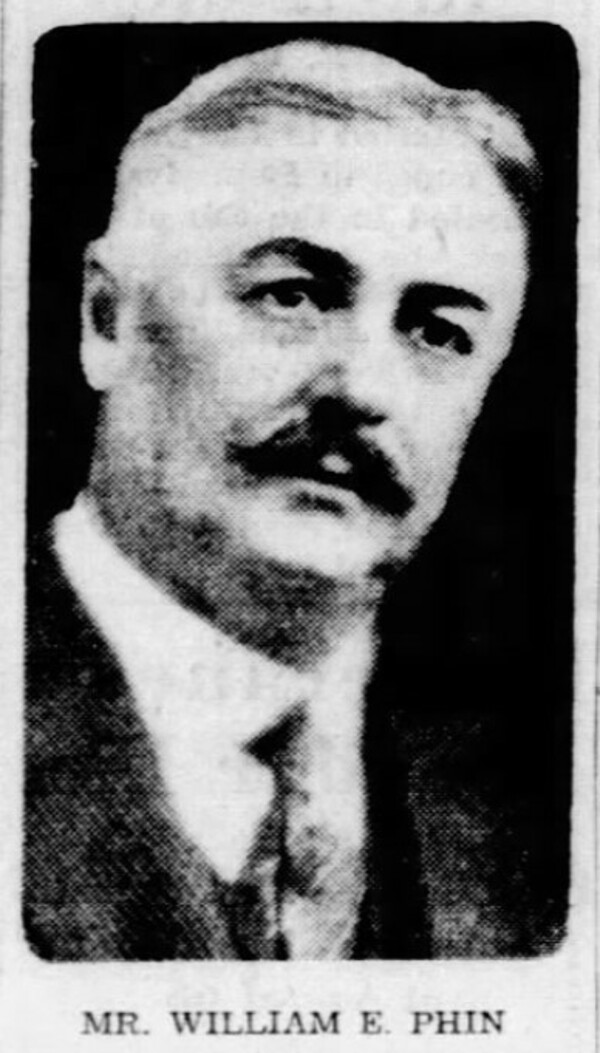
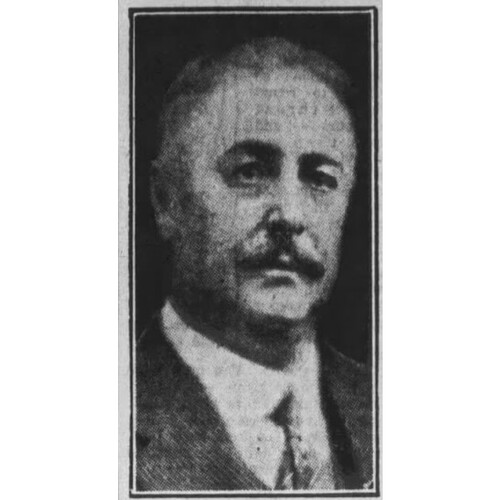
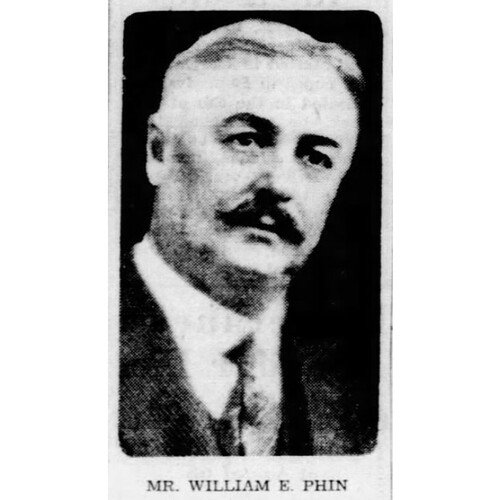
PHIN, WILLIAM EGERTON, travelling salesman, contractor, and businessman; b. 26 June 1863 in or near Hespeler (Cambridge), Upper Canada, son of James Philip Phin and Eliza (Elizabeth) Jane White; m. 20 Feb. 1896 his cousin Bertha Scarfe (d. 7 April 1934) in Brantford, Ont., and they had three daughters, one of whom predeceased him, and one son; d. 16 Feb. 1939 in Hamilton, Ont., and was buried in Hamilton Cemetery.
Family background and early years
William Egerton Phin, who preferred the name Bill, was born into the third generation of a farming family that was prominent in Waterloo Township. His paternal grandfather, James, a native of Roxburghshire, Scotland, had managed a large estate in County Monaghan, Ireland, before immigrating to Canada in 1833. According to the Illustrated atlas of the County of Waterloo, James’s son James Philip acquired “a very fine farm” north of Hespeler and was considered to be “among the thoroughly representative agriculturists of the township.” Both James and James Philip were magistrates; the younger Phin was also a school inspector, a county warden, and president of Waterloo Township’s Reform Association.
James Philip’s eldest child, Bill, received a sound education, attending elementary school in Hespeler, high school in Berlin (Kitchener), and the Ontario Agricultural College in Guelph. Had he returned to the farm after finishing his education, there would have been few prospects for establishing his independence. His father was in his early forties and unlikely to retire for many years. Instead, in about 1881 he took a job as a travelling salesman, working for his uncle – and future father-in-law – William John Scarfe, a partner in a varnish-manufacturing business in Brantford. After several years W. E., as he was known professionally, became the managing partner in the firm.
Contracting and dredging business
In 1889 Phin left Scarfe’s company and entered the contracting business as a partner in the Brantford-based firm of Nihan, Elliott, and Phin. It is likely that Thomas Nihan, a 50-year-old contractor and farmer, provided capital, contacts, and experience, while Phin and William George Elliott, both in their twenties, took charge of the operations and management. Their firm was one of a number that obtained contracts between 1888 and 1890 to excavate the approaches for the Grand Trunk Railway’s tunnel under the St Clair River, which would connect Sarnia, Ont., with Port Huron, Mich. Afterwards, Phin and Elliott continued working as canal and railroad contractors based in Brantford. They also kept alert to other opportunities; in 1890, for example, they bought the stock of an insolvent Brantford hardware merchant. In 1896 Phin and Elliott relocated to Rossland, B.C., to establish the Alf Gold Mining Company, which they incorporated to promote and develop claims in the West Kootenay region. Phin was secretary-treasurer, Elliott was vice-president, and Lloyd Harris, son of manufacturer John Harris*, was president. By 1898 Phin was no longer an officer of the company. Back in Brantford and on his own, he tendered for city excavation contracts and speculated in gold-dredging leases in the Yukon.
Phin and his family were long-time Liberal supporters, and so the election of the federal government of Wilfrid Laurier* in 1896 brought new opportunities. The following year “reliable parties,” probably including William Paterson, the long-time southwestern Ontario mp whom Laurier had chosen to head the Department of Customs, recommended Phin for the first of several contracts he received to dredge sections of Toronto Harbour. Because the contracts were small – the first two were for slightly less than $10,000 – they were not tendered, but paid at a fixed hourly rate, in accordance with Department of Public Works practice. In 1900 Phin and his new partner, Toronto lumberman and railway contractor George Plunkett Magann, successfully tendered to dredge the harbour and build an extension to a pier at its entrance. After the contract was completed, Conservatives in the House of Commons, most vocally Toronto West mp Edward Frederick Clarke, protested that Phin was inexperienced and had been overpaid. In rebuttal, Minister of Finance William Stevens Fielding*, Minister of Public Works Joseph-Israël Tarte*, Postmaster General William Mulock*, and Paterson vigorously defended Phin’s competence and the value of the work done. In 1908 the Tories would criticize the government for giving Phin an untendered contract of $5,100 for what they claimed was unnecessary dredging of the harbour in Bronte (Oakville), and for omitting the expenditure from the parliamentary estimates. The merit of the charge was debatable; its real importance (and probably its intent) was procedural, since it opened debate in the house’s committee of supply on much larger and more costly dredging operations, and raised questions about the Liberal connections with companies that had received dredging contracts worth millions. Such controversy was part of the patronage system, and as a beneficiary Phin was subject to scrutiny.
After the completion of its work in Toronto Harbour in July 1902, Phin and Company (as Phin and Magann styled their firm) concentrated on a large, multi-year contract that it had won the previous year to dredge and widen sections of the “Long Level” of the third Welland Canal, between Humberstone Township (Port Colborne) and Allanburg. Having moved his young family to Toronto while he was working there, Phin now relocated them again, this time to Welland. The project, which paid Phin and Magann $553,805, carried their firm into the spring of 1907. Afterwards, they dissolved their partnership.
Phin would continue dredging and excavating until 1920, taking on contracts across Ontario. Most of his work was done at small harbours on Lake Ontario, from Napanee to Hamilton, but he also completed larger projects, including widening the canal north of Welland, deepening the Thames River at various locations, and dredging around Port Arthur (Thunder Bay). His work at Port Arthur, conducted between 1909 and 1920, accounted for 70 per cent of the gross revenue of $986,000 that he earned from government contracts over the 13-year period that he was on his own.
Canadian Dredging Company
Phin was busy, but his operation – three dredges and their tugs and scows – was relatively small, and he did not possess the capacity to compete for the major contracts tendered for the fourth Welland Canal, also called the Welland ship canal. He had, however, acquired considerable knowledge of local conditions from his years of dredging in the area. About 1913 he amalgamated his business with the larger Canadian Dredging Company of Midland, which had been founded in 1906 (as Canadian Dredge and Construction) by Simcoe County entrepreneur James Playfair and other associates. Not long before the deal with Phin was made, the firm had absorbed the Owen Sound Dredging Company. Phin was not an officer of Canadian Dredging, but he was acknowledged as one of its principals.
Later in 1913 Canadian Dredging submitted the successful bid of $1,948,788 to dredge, excavate, and build bridges for section 5 (the Deep Cut) of the Welland ship canal, between Allanburg and Port Robinson. Construction progressed on schedule until January 1917, when the Conservative government of Sir Robert Laird Borden suspended work as a war measure and prohibited contractors from removing their plant and equipment without permission. After the contractors protested the violation of their contracts, the government settled with them in the spring of 1918 and cancelled all contracts. At war’s end, Borden tried to revive the project, but the contractors refused to continue on the same terms because of uncertain costs, especially wages. In response the government agreed to pay the costs plus eight per cent, and justified the terms as a postwar reconstruction measure that would be in effect only until the end of 1919. Construction halted in late 1919 after strikes had stopped work and funding ran out. Concerns about unemployment and labour unrest resulted in contracts being extended into 1920.
The government had never intended to complete the canal under cost-plus contracts. In 1921 tenders were again called, and Canadian Dredging was successful in regaining the contract for section 5. By the time the job was finished in 1926, the firm was already working on section 7 (the six miles between Welland and Humberstone Township), for which it had made the lowest bid in 1924. The project lasted until 1929 and brought in over $9,500,000, according to the company. Thereafter it continued to take work on the canal, and elsewhere on the Great Lakes and the St Lawrence River.
The company completed another project that the war had stalled, this one in New Brunswick: to improve Saint John Harbour and build and operate a shipyard and dry dock there. In 1918 Phin and the other principals of Canadian Dredging had formed a subsidiary, the Saint John Drydock and Shipbuilding Company, which took over the contract. The new firm then subcontracted the dredging work to its parent company.
Canadian Dredge and Dock Company
In 1928 James Playfair bought out Canadian Dredging’s interest in Saint John Drydock and Shipbuilding and in turn sold his holdings in Canadian Dredging, which prompted that company’s re-organization. Its management team and major investors formed the Canadian Dredge and Dock Company, with Phin as chairman of the board, to acquire shares in and take over the business of Canadian Dredging. The new firm, the largest in its field in Canada, remained profitable well into the Great Depression, paying dividends on its common shares in excess of those required on its preferred shares. The common shares became more attractive, not only because of their dividends, but also because of the speculative fluctuations in their value, which raised suspicions about possible insider knowledge and trading. Owing to government spending reductions, Canadian Dredge and Dock’s operations became less profitable in the late 1930s, although its financial situation remained secure. By then Phin had withdrawn from active participation in the company. His son, Donald Egerton, became vice-president and a director in 1938.
Additional interests and personal life
While advancing his dredging business, Phin had involved himself in several other enterprises. In 1906 he was a promoter of the Niagara Frontier Bridge Company, which was chartered to build and operate a bridge across the Niagara River near Queenston, Ont. Nothing came of the project. Also, he was a director of the Mutual Steamship Company of Port Colborne from its creation in 1907 to 1912. More fruitful than these ventures was his involvement as a founding director in the Welland Electrical Company. Chartered in 1906 to deliver power from the Hamilton Electric Light and Cataract Power Company’s generating station at DeCew Falls, near St Catharines, the firm provided Welland with the cheapest electricity of any industrial centre in Ontario. In addition, Phin acquired shares in Hamilton Electric Light and Cataract Power’s successor, the Dominion Power and Transmission Company, which was formed in 1907 to hold investments in a complex network of electrical and transportation companies in the Hamilton and Niagara area.
Around 1911 Phin moved his family from Welland to one of the most exclusive areas of Hamilton, displaying his up-and-coming status by having an eight-bedroom mansion built at 12 Ravenscliffe Avenue. One of his neighbours was business associate John Morison Gibson*, then lieutenant governor of Ontario. By 1916 Phin was a well-established member of the city’s business elite, serving as a director of Dominion Power and president of one of its subsidiaries, the Hamilton Street Railway. He supported the war effort as a member of the Hamilton Recruiting League and served on its finance and insurance committee. Over the years he was on the boards of numerous major local businesses, including the Bank of Hamilton (and the Canadian Bank of Commerce after it absorbed the Hamilton one in 1924), the Hamilton Bridge Works Company, the National Steel Car Company, and the Tuckett Tobacco Company. For a time he was president of the Guelph Trust Company, the estate and property management arm of the Guelph and Ontario Investment and Savings Society, of which he was vice-president. Like many of his business associates, Phin was a mason, and he belonged to private clubs in Hamilton, Toronto, and Guelph, as well as several sporting associations.
Presidency of Dominion Power
In 1925, on the retirement of James Robert Moodie, W. E. Phin was elected president of Dominion Power. The company had just suffered its worst financial year since the First World War, and several of its subsidiaries were having difficulties. Least promising were the transportation firms, whose electric radial railways were struggling to compete with buses and private automobiles. The imminent expiry of the Hamilton Street Railway’s franchise in 1928 made the company reluctant to improve its plant and garages or incorporate bus service. Strongest were the electrical companies, especially the Hamilton Electric Light and Power Company, which had major industrial customers. However, the expansion of the areas serviced by the Hydro-Electric Power Commission of Ontario and by municipally owned electrical utilities raised uncertainty about the long-term prospects of Dominion Power, whose officers complained that their company was unfairly taxed in comparison with these publicly owned corporations.
As president, Phin was able to address some of Dominion Power’s problems. Of significant assistance was the Power Corporation of Canada, a holding company formed in 1925 by the Montreal brokerage firm of Nesbitt, Thomson and Company to invest in electrical companies and participate in their management. That year Power Corporation’s vice-president James B. Woodyatt, an electrical engineer, was elected to the board of Dominion Power. He advised the firm on organizational and technical changes. Dominion Power’s electrical and transportation divisions were more effectively separated, and new investments were made in each, leading to improved profits. Most notably, the company expanded to provide interurban motorbus service, and by 1929 it would become one of the largest bus operators in the country. Phin also sought to build broader public support for Dominion Power and to curtail criticism from labour interests and advocates of public ownership of electrical utilities. In 1926 he announced the sale of $500,000 in preferred shares to employees, customers, and other local residents. Dominion Power did not rely on brokers or salespeople to sell the shares; they were marketed by the firm’s employees, many of whom purchased shares themselves. As the company advertised in the Hamilton Spectator on 9 November, each new investor would not be a mere shareholder, but rather “a profit-sharing partner.”
Sale of Dominion Power
These changes were important for Dominion Power’s operations; they were also intended to make the firm a more attractive and valuable investment in anticipation of a possible takeover by the Hydro-Electric Power Commission. The two corporations had talked intermittently since 1917, and rumours and denials of a sale occasionally appeared in the press. Arthur James Nesbitt, a Montreal stockbroker who was the president of Power Corporation, represented Dominion Power in these discussions, and in 1927 he became the second Power Corporation representative on its board. By that time Power Corporation, having increased its investment in Dominion Power, owned approximately one-third of the preferred shares. It was also rumoured to be buying common shares, and both stock categories appreciated in value.
On 26 March 1930 Premier George Howard Ferguson* announced the Hydro-Electric Power Commission’s purchase of Dominion Power for $21,000,000. Over the next two years the deal provided a target for government critics, who suspected that insider trading had occurred and claimed that the price paid was too high. In 1932 Premier George Stewart Henry* created a royal commission to investigate the acquisition of Dominion Power (as well as other matters relating to the Hydro-Electric Power Commission). Phin testified that the purchase had been “one of the cleanest transactions ever put through,” and William Renwick Riddell* and George Herbert Sedgewick, who concluded the royal commission’s work and wrote its report, judged that the deal “was reasonable as to price and was not prompted by any motive other than the public good.”
After the sale of Dominion Power, Phin became less actively engaged in business, but he did preside over the closing of the company’s financial records, a process that took several years. Robert Lochiel Fraser II, an accountant on staff during this period, reminisced that Phin sometimes sent him across town by streetcar to retrieve his glasses, which he had forgotten at home. When Fraser arrived at 12 Ravenscliffe, Phin’s wife, Bertha, always invited him in “for a glass of milk and a piece of pie.” When he protested that he ought to get back to work, she invariably replied, “It’s okay, Bob — Bill told me to do it. You come right in.” They would chat at the kitchen table while Fraser enjoyed his milk and pie. He remembered Phin fondly as “a good and decent man, a fine man, a real gentleman, and a good boss.”
Final years
In April 1934 Phin grieved the loss of two loved ones: Bertha died while returning home by ship from Bermuda, and the next day their daughter, Dorothy Evelyn, succumbed to a chronic illness. Phin’s health took a turn for the worse in April 1938, and his condition left him confined to his residence for the five months prior to his death in February 1939.
William Egerton Phin was raised in the country and moved to the city. With a background neither humble and poor nor privileged and wealthy, he possessed a sound education, a respected family reputation, and a talent for inspiring confidence. His success rested on his ability to merge his modest contracting business into much larger enterprises, and to offer corporate management to firms established by older associates.
DCB (Toronto), Corr. with Robert Lochiel Fraser III, 10 Jan. 2018. Border Cities Star (Windsor, Ont.), 28 March 1930, 15 June 1932, 19 July 1934. Financial Post (Toronto), 3 April, 1 May, 5 June 1925; 16 Dec. 1927; 3 Feb., 16 March, 15 June, 16 Nov. 1928; 25 Jan., 8 Feb., 15 Aug. 1929; 16 Jan., 27 March, 3 April 1930; 23 April 1931; 14 April 1934; 27 June, 5 Sept. 1936; 17 April 1937; 26 March 1938. Gazette (Montreal), 4 Feb. 1928; 22 April, 2 Sept. 1929; 27 March 1930; 22 April, 12 June 1931; 21 April, 3 Oct. 1932; 10 Oct. 1935; 23 April, 16 July 1938. Globe, 27 Sept. 1929; 27 March, 23 June 1930; 6 Jan., 25 March, 10, 16, 17 June 1932; 9 April 1934. Globe and Mail, 17 Feb. 1939. Hamilton Herald (Hamilton, Ont.), 29 June 1927; 24 March, 5 Sept. 1930. Hamilton Spectator, 16 April, 9 July 1925; 30 Oct., 9 Nov. 1926; 22, 23 April 1929; 1 March 1930. Ottawa Citizen, 26 April 1927, 6 June 1929, 28 March 1930. Saskatoon Phoenix, 24 Jan., 27 Feb. 1913. Wall Street Journal (New York), 8 July 1925, 29 April 1930. Can., House of Commons, Debates, 14 Feb. 1898, 481–82; 7 March 1898, 1337–38; 20 May 1898, 5917–18; 21 July 1899, 8145–46; 18 April 1900, 3770; 14 July 1900, 10230–41; Sessional papers, 1902–26 (reports of the auditor general, 1901–20; reports of the Dept. of Public Works, 1907–17; reports of the Dept. of Railways and Canals, 1901–24). Canadian Contract Record (Toronto), 14 Sept. 1898: 2, 4 Oct. 1899: 4. Canadian Manufacturer and Industrial World (Toronto), 19 Oct. 1906: 26, 7 Dec. 1906: 27–28. Canadian Railway and Marine World (Toronto), January 1911: 31; July 1911: 695; January 1913: 46; March 1913: 147; May 1914: 241; June 1914: 286; February 1917: 76; June 1917: 249; June 1918: 264; July 1918: 309; August 1918: 357–58; January 1919: 47; April 1919: 220; May 1919: 287; June 1919: 337; May 1920: 265–69; August 1920: 461; October 1920: 572; April 1921: 230; June 1921: 339; July 1921: 398. DHB, vol.3. Carolyn Gray, “Business structures and records: the Dominion Power and Transmission Company, 1896–1930,” Archivaria (Ottawa), no.19 (winter 1984–85): 152–61. Illustrated atlas of the County of Waterloo … (Owen Sound, Ont., 1972). J. N. Jackson, The Welland canals and their communities: engineering, industrial, and urban transformation (Toronto and Buffalo, N.Y., 1997). J. M. Mills, Cataract traction: the railways of Hamilton (Toronto, 1971). Ont., Royal commission appointed to inquire into certain matters concerning the Hydro-Electric Power Commission of Ontario …, Report (Toronto, 1932). Power Corporation of Canada, Seventy-five years of growth (Winnipeg, 2000). R. M. Styran and R. R. Taylor, This colossal project: building the Welland Ship Canal, 1913–1932 (Montreal and Kingston, Ont., 2016).
Image Gallery

Cite This Article
David G. Burley, “PHIN, WILLIAM EGERTON,” in Dictionary of Canadian Biography, vol. 16, University of Toronto/Université Laval, 2003–, accessed April 29, 2026, https://www.biographi.ca/en/bio/phin_william_egerton_16E.html.
The citation above shows the format for footnotes and endnotes according to the Chicago manual of style (16th edition). Information to be used in other citation formats:
| Permalink: | https://www.biographi.ca/en/bio/phin_william_egerton_16E.html |
| Author of Article: | David G. Burley |
| Title of Article: | PHIN, WILLIAM EGERTON |
| Publication Name: | Dictionary of Canadian Biography, vol. 16 |
| Publisher: | University of Toronto/Université Laval |
| Year of publication: | 2025 |
| Year of revision: | 2025 |
| Access Date: | April 29, 2026 |