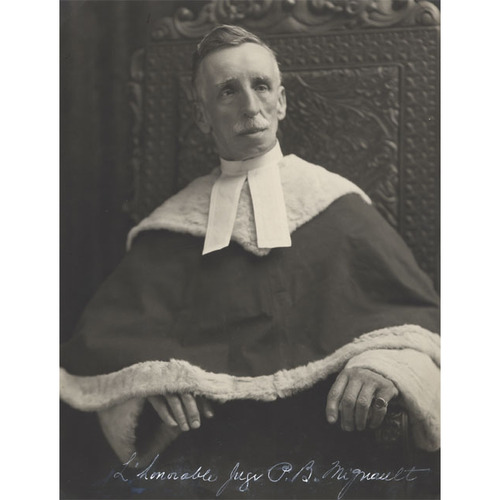

Pierre-Basile Mignault (1854–1945), a lawyer (1878–1945) and Supreme Court of Canada judge (1918–29), was the author of Le droit civil canadien (9 v., Montréal, 1895–1916), the first treatise devoted to Canadian civil law. For almost a century the work was indispensable for legal practitioners, and it established Mignault’s reputation. His defence of the integrity of civil law, and furthermore his concept of it as a judicial system based on specific procedures – ideas he strongly asserted at the Supreme Court – have left a deep impression on the legal community. They explain his lasting memory and enduring influence on legal thought.
Original title:  Pierre Basile Mignault, [Vers 1918-1929], Archives nationales à Québec, Collection Centre d'archives de Québec, (03Q,P1000,S4,D83,PM90), Photographe non identifié.

Source: Link

MIGNAULT, PIERRE-BASILE, lawyer, author, professor, and judge; b. 30 Sept. 1854 in Worcester, Mass., son of Pierre-Basile Mignault, a physician, and Catherine O’Callaghan; m. 18 Oct. 1888 Lizzie (Lizzie-Henriette-Marie) Branchaud in Beauharnois, Que., and they had a daughter and two sons; d. 15 Oct. 1945 in Montreal and was buried there three days later in Notre-Dame-des-Neiges cemetery.

Formative years

Pierre-Basile Mignault’s father was born in the parish of Saint-Joseph-de-Chambly (at Chambly), Que., and his mother in Boston. Young Pierre-Basile grew up in Worcester in a household where English was spoken. He would become fluently bilingual; his English was flawless, and he spoke French with a slight English accent. He attended elementary school in his birthplace and at some point settled with his family in Montreal. He began his classical education there in 1867, at the Collège Sainte-Marie. In 1875 he enrolled in the faculty of law at McGill College (McGill University from 1885), where in 1878 he earned a bcl degree and was awarded the Elizabeth Torrance Gold Medal [see John Torrance*]. Mignault articled with the law firm of Joseph-Alfred Mousseau*, Joseph-Adolphe Chapleau*, and Horace Archambeault*, was called to the bar of Quebec in 1878, and practised law in Montreal. From April to August 1880 he travelled in Europe, visiting France, Italy, Switzerland, Germany, Belgium, England, and Ireland. He recounted stories of his travels in a series of letters to his mother, written in English.

Practising and teaching law

Starting at the turn of the 20th century, Mignault regularly pleaded before the Supreme Court of Canada. He was named a qc by the Canadian government in 1893 and by the Quebec government in 1899. His reputation was such that he served as syndic of the Montreal bar (1905) and bâtonnier (1906–7). McGill University’s faculty of law appointed him to teach civil law (1912–18) and professional ethics (1919–35). From 1914 to 1918 he sat on the International Joint Commission [see Sir George Christie Gibbons*].

Mignault never stood for election as he was not interested in politics. He did, however, belong to the Club Libéral-Conservateur de Montréal, of which he became vice-president in December 1898; he gave up the post when the term ended in January 1900.

Mignault’s contemporaries described him as affable and modest, although he was not easily swayed. Replying in 1914 to a letter from a publisher with whom he was quarrelling, he made it very clear that he did not appreciate its content: “[I] am not accustomed to letting anyone, whoever they are, take that tone with me.” Mignault was capable of great concentration, had a flawless memory, and expressed his views clearly. The rigour evident in his writing was also characteristic of his manner. People described him as an orderly, methodical man who was attached to his daily routines.

Prolific author

Before beginning to write the legal works that would establish his reputation, Mignault was a regular contributor, both as an author and a critic, to the Montreal Revue canadienne between 1879 and 1888. In this respect he was like several of his colleagues from the bar who were drawn to authorship. His involvement with this periodical and some of his comments link him to the ultramontane movement, as is illustrated in his assessment of Histoire des Canadiens-français, 1608–1880 by Benjamin Sulte*.

Mignault published his first articles on law in the early 1880s. At the same time, he began drafting a text entitled “Cours de droit civil,” which survives in the 21st century in manuscript form. It is an unfinished commentary on the Civil Code of Lower Canada, covering only part of the subject – the beginning of the section concerning the law of persons. The work is based on treatises by jurists from France, notably Jean-Charles-Florent Démolombe and Frédéric Mourlon. It attaches little importance to sources from the province of Quebec, with the exception of the Commentaire sur le Code civil du Bas-Canada by Thomas-Jean-Jacques Loranger*.

In 1889 Mignault’s first legal volume, the Manuel de droit parlementaire …, was published in Montreal. In it he discusses Canadian parliamentary institutions and constitutional law. In the same city in 1893, he published Le droit paroissial …, which was written at the suggestion of the Montreal bookseller Joseph-Moïse Valois. In a province dominated by Roman Catholicism, this monograph, devoted to the study of the temporal affairs of the parish, enhanced the author’s reputation. Nearly 20 years after the Guibord affair [see Joseph Guibord*], Mignault rejected the notion of civil courts having the power to control the spiritual life of a parish, thus asserting the predominant authority of the bishop in this respect. However, he did acknowledge – and this is the point of his book – that a parish is subject to the law of the state in matters not covered by canon law but by civil or administrative law. In 1943 La revue du notariat devoted a special issue to the work to mark the 50th anniversary of its publication.

Alongside these treatises, Mignault provided the legal community with the Code de procédure civile du Bas-Canada annoté … (Montréal, 1891), a reference work containing judicial rulings, an essential subject for practitioners. From 1893 to 1904 he was a member of the editorial board responsible for the reports of the Court of Queen’s Bench and the Superior Court, published in Montreal by the Quebec bar and entitled Rapports judiciaires de Québec. The board’s task was to select the judgements destined for publication.

Le droit civil canadien

Although the codification of civil law dated back to 1866 [see René-Édouard Caron*], no large-scale doctrinal work had yet been devoted to the subject. Mignault, who lamented the situation, decided to undertake the writing of a treatise on civil law, with the support of two bold publishers, Richard Augustus Patrick Whiteford and Camille Théoret. The resulting publication, entitled Le droit civil canadien, comprises nine volumes printed in Montreal between 1895 and 1916.

By mutual agreement with his publishers, Mignault decided not to write an entirely original work but to adapt Mourlon’s treatise, Répétitions écrites sur le Code civil, for Quebec law. Although the work was not a top-ranked publication from France, it had been widely distributed, with a dozen editions appearing between 1846 and 1884. One of its merits, of which Mignault was well aware, was that it had been used to train students in France and Quebec. The subtitle of the first seven volumes acknowledged the author’s debt to his model: Basé sur les “Répétitions écrites sur le Code civil” de Frédéric Mourlon, avec revue de la jurisprudence de nos tribunaux. Mignault explained that he chose to adapt a French work because of the positive reception that would follow: “[I] would have preferred the entire work to be original, but, initially, we thought its success would be greater if we presented the public with an edition of Mourlon’s work.” He added that it was impossible for an author to surpass the quality of a publication from France, an admission that revealed the dominance of French doctrine over legal thought in Quebec.

Basing his text on a work from France had its advantages on the one hand. It followed a plan and a template familiar to readers. On the other hand, Mignault had to adjust the model to take into account the specific character of the Civil Code of Lower Canada and the resulting jurisprudence. The task demanded meticulous segmentation of the basic text in order to distinguish it from the additions. This work, to which he rigourously applied himself, was quite familiar since, like every lawyer in Quebec at the time, he was accustomed to reading publications originating in France and adapting them for the unique aspects of Quebec law. There were also particular subjects in Mourlon’s text upon which Mignault could not rely, and that necessitated complete redrafting of certain passages. In the two final volumes, he would depart entirely from the original work. Consequently, the subtitle was changed to Avec revue de la jurisprudence de nos tribunaux.

The creation of this work revealed Mignault’s intellectual evolution, and certainly that of the legal community. He broke free of his dependence on the foreign texts evident in the treatise’s initial orientation. There is no doubt that this action made the legal community aware of Quebec’s greater autonomy in publishing. The treatise established Mignault’s reputation, yet he now had less time to devote to writing subsequent volumes. From the beginning of the 20th century onward, he enlisted lawyers to assist him. Even so, he had trouble keeping up the pace.

The courts, including the Supreme Court of Canada and the Judicial Committee of the Privy Council in London, were very soon quoting Le droit civil canadien. Through this book Mignault earned a reputation that extended beyond the country’s borders. During the centenary celebrations of the publication of the Code Civil des Français in 1904, he represented Quebec’s legal community, contributing the article “Le Code Civil au Canada” in Le Code Civil, 1804−1904: livre du centenaire. The idea of writing a second edition of the treatise was raised at the end of the 1920s. Mignault thought about what form it might take but did not pursue the project. The original edition would be reprinted in the 1950s. The renewal of Quebec’s legal doctrine in the 1960s, and especially after Quebec’s Civil Code came into force in 1994, reduced the appeal of the treatise, although some lawyers and judges might still refer to it today.

Throughout his career, Mignault also published articles in Quebec, Canadian, and foreign law journals. They were relatively short and usually based on specific issues, and he sometimes presented them in lectures that, owing to his reputation, he was invited to deliver.

Supreme Court judge

Following the August 1918 death of Sir Horace Archambeault, the chief justice of the Quebec Court of King’s Bench, Mignault was mentioned as a possible candidate for the post of puisne judge. On 28 August La Presse described him as one of the “eminent members” of the Montreal bar, yet he was not selected. That October, after Sir Charles Fitzpatrick resigned upon his appointment as lieutenant governor, Mignault instead became a judge of the Supreme Court of Canada. He generally agreed with the majority opinion of the judges with whom he served, dissenting in just over five per cent of the judgements rendered. The reasons for his decisions revealed his desire to focus analysis on the specific issue put before the court and underscored his rigorous approach to applying the law.

Defending the particular nature of civil law’s characteristic principles and methods remained one of Mignault’s preoccupations at the Supreme Court. He deplored the habit of some judges who, in deciding a civil law case, relied on jurisprudence based on the tradition of common law, and who argued that the rules governing the two legal systems were related. He similarly objected to civil law lawyers who, when arguing their cases in court, based their arguments on common law authorities. His answer was to defend the autonomy of both legal systems, notably in the Desrosiers v. R. judgement, explaining that “civil law constitutes a complete system in itself and must be interpreted according to its own rules.” Even after leaving the Supreme Court, he continued to voice this opinion in articles and his correspondence. Over the following decades a generally held belief evolved regarding the specific nature of the civil law tradition, one that remained linked to his name. Although this view received general support, it was also considered a denial of a legal culture that had long been open to sources from various origins.

The importance Mignault attached to respecting the particular nature of civil law is also seen in his concern for an interpretation of the Code that accorded with the tradition of this branch of law. He was interested in a literal interpretation of the provisions of civil law. If he concluded that an article of the code was ambiguous, he tried to discover the legislator’s initial intentions. In his examinations he sometimes compared the French and English versions of a provision and favoured the one that agreed most closely with the law as it was before codification. His interpretation led him to consider the legislative document as a whole, to be analyzed in keeping with its internal dynamic. Although he adhered closely to a given text, Mignault believed that he could extract its general principles; he justified this as a means of finding solutions that were not clearly expressed in the law.

In his judgements Mignault showed restraint with regard to political power, choosing to avoid contradicting choices made by legislators. On constitutional issues concerning the division of powers between parliament and the provincial legislatures, he adopted a centralist position without, however, marginalizing provincial autonomy. In certain instances he was intensely loyal to the judgements of the Judicial Committee of the Privy Council, even if he might not agree with its positions, especially in constitutional matters. Such deference also applied to civil law, even though the rule of stare decisis, the doctrine of common law that insists lower courts abide by the decisions handed down by higher courts, was less widely applicable. In his article “Le Code Civil de la province de Québec et son interprétation,” published in the University of Toronto Law Journal, Mignault justified the authority of the decisions made by the Privy Council and the Supreme Court on “grounds that take their inspiration from the common good of society.” In effect, he believed that deviating from the jurisprudence of the courts of final resort incited parties to launch appeals that incurred costs and, ultimately, resulted in the confirmation of established jurisprudence.

The Act to amend the Supreme Court Act, ratified in 1927, set 75 as the age at which judges had to retire. Consequently, Mignault, having reached that age on 30 Sept. 1929, left the bench after serving on it for a little over a decade. He returned to Montreal, where he worked as legal counsel in the offices of Hackett, Mulvena, Hackett and Mitchell until his death.

Formalism and traditionalism

As both an author and a judge, Mignault asserted the supremacy of the law in the judicial system. His formalist approach to the letter of the law testified to his intent. His argument in favour of safeguarding institutions based on civil law stemmed in part from the same assertion. He defended the concept of a legal system founded on acts passed by a legislature, which carried more authority than jurisprudence did. He desired a predictable system of law and thus preferred an established jurisprudence that would neither vary nor be based on the opinion of the judge who was hearing the case. According to his reasoning, expressed in “Le Code Civil de la province de Québec et son interprétation,” jurisprudence was “the best commentary on the Code.” The rigorous nature of his approach did not, however, obscure his consideration for fairness.

Mignault’s respect for and restrained interpretation of written law explain his mistrust of the bold solutions put forward by some writers from France during the early decades of the 20th century. Mignault knew of and referred to this literature but refrained from approving of its tendencies. While conceding that the rule of law was malleable, in general he did not accept its authority to adapt to every situation. Accordingly, it was up to the lawmaker, not the judge, to intervene by bending a rule of law that had become out of step with social change. As for legal writers, their role was to present the law and explain how the courts’ decisions aligned with it. Mignault showed little interest in doctrinal constructions and general theories.

Beyond considerations that arose from legal texts, a conservative vision emerged from Mignault’s thinking in which his proposals as an author and decisions as a judge did not disrupt social relations. A conversation published in La Presse in 1913 (before he moved to the Supreme Court) revealed that he preferred to maintain the current status of marital-property law, whereas Frederick Parker Walton, dean of McGill University’s faculty of law, had suggested reforms related to women’s rights. When, as a judge, Mignault had to determine whether women were ”persons” as defined in Article 24 of the British North America Act and could therefore become senators, he answered in the negative, thus backing the majority decision drafted by Chief Justice Francis Alexander Anglin*.

Honours and recognition

During his career Mignault received many distinctions. He was awarded an honorary doctorate by the Université Laval at Quebec (1904), McGill University (1920), the Université de Montréal (1929), and the Université de Paris (1935). As well, he was elected to the Royal Society of Canada in 1908, and France made him a chevalier de la Légion d’Honneur. The Montreal bar honoured him at a banquet in 1936, and in 1940 students in the Université de Montréal’s law faculty formed a study group known as Conférence Mignault.

After Mignault’s death, praise was abundant and unanimous. Sustained by numerous initiatives, his name lived on. In 1948 the Canadian Bar Association [see Sir James Albert Manning Aikins*] presented a bronze bust of him to the Montreal bar, which placed it in its law courts library. A moot court competition, introduced in 1978 and aimed at students in faculties of civil law, was named after him. Since 2005 the main courtroom of Montreal’s Ernest-Cormier building [see Ernest Cormier*], where the Court of Appeal of Quebec in Montreal is located, is dedicated to him. The city named a street (1954) and a park (1963) in his honour.

Assessment

Pierre-Basile Mignault is the Quebec jurist who remains the most memorable. His legacy has withstood the passage of time, whereas other celebrities of the bar and the judiciary have been completely forgotten a few decades after their death. His treatise, Le droit civil canadien, was an essential text for legal practitioners for almost a century and has ensured his enduring recognition. His defence of the integrity of civil law and, in particular, his concept of civil law as a system founded on certain procedures – ideas that he strongly asserted during his time on the Supreme Court bench – made a deep impression on the legal community. They explain both his enduring public memory and his lasting influence on legal thought.

Sylvio Normand

The birth and baptismal records of Pierre-Basile Mignault could not be located.

Mignault is the author of Letters sent home: forsan et haec olim meminisse juvabit [And perhaps it will please [us] one day to remember these things] (n.p., 1883, unpublished work held by Library and Arch. Can., R12076-0-2-E); “L’autorité judiciaire,” La Rev. légale (Montréal), nouv. sér., 6 (1900): 145–79; “De la responsalité dbs [sic] accidents de travail,” La Rev. légale, nouv. sér., 6: 518–32; “Le Code civil au Canada,” dans Soc. d’Études Législatives, Le Code civil, 1804–1904: livre du centenaire (2v., Paris, 1904), 2: 723–31; “The authority of decided cases,” Canadian Bar Rev. (Toronto), 3 (1925): 1–24; “Le Code civil de la province de Québec et son interpretation,” Univ. of Toronto Law Journal, 1 (1935–36): 104–36; “Conservons notre droit civil,” La Rev. du droit (Québec), 15 (1936–37): 28–34; “Traité théorique et pratique de la fiducie ou trust du droit civil dans la province de Québec” [book review], Univ. of Toronto Law Journal, 2 (1937–38): 423–24; “L’abus des droits,” Univ. of Toronto Law Journal, 3 (1939–40): 360–86; and “Quelques notes,” La Rev. du notariat (Québec), 46 (1943–44): 171–73.

Bibliothèque et Arch. Nationales du Québec, Centre d’arch. de Montréal, CE607-S4, 18 oct. 1888; P675, S3 (Pierre-Basile Mignault to Séverin Létourneau, 17 avril 1942). Private arch., Claude Wilson (Montréal), Corr. (especially that of Pierre-Basile Mignault) and legal documents. Le Devoir (Montréal), 4 oct., 21, 22 nov. 1913; 6 nov. 1935; 16, 18, 25 oct. 1945; 1er sept. 1948. La Presse (Montréal), 10 mars 1893; 18 févr. 1895; 28 août, 24 oct. 1918; 21 févr. 1936; 25 juin 1981. J.-L. Baudouin, “Le Code civil québécois: crise de croissance ou crise de vieillesse,” Canadian Bar Rev. (Toronto), 44 (1966): 391–416. Biographies canadiennes-françaises, Raphaël Ouimet, édit. (Montréal), 1927: 317. Maximilien Caron, “Me P.-B. Mignault et son œuvre,” L’Action universitaire (Montréal), 7 (1940–41), no.7: 7–10. J.-G. Castel, “Le Juge Mignault défenseur de l’intégrité du droit civil québécois,” Canadian Bar Rev., 53 (1975): 544–57. Concours de plaidoirie Pierre-Basile-Mignault, “Historique.” P.-A. Crépeau, “Réflexions sur la codification du droit privé,” Osgoode Hall Law Journal (Toronto), 38 (2000): 267–95. Curley v. Latreille (1919–20), Reports of the Supreme Court of Canada (Ottawa), 60: 131–80. Desrosiers v. R. (1919–20), Reports of the Supreme Court of Canada, 60: 105–30. David Howes, “Dialogical jurisprudence,” in Canadian perspectives on law & society: issues in legal history, ed. W. W. Pue and Barry Wright (Ottawa, 1988), 71–90; “From polyjurality to monojurality: the transformation of Quebec law, 1875–1929,” McGill Law Journal (Montreal), 32 (1986–87): 523–58. J.-J. Lefebvre, “Généalogie partielle de la famille Mignault,” Le Bull. des recherches historiques (Lévis, Québec), 52 (1946): 147–54. L.-C. de Léry, “Un centenaire: Pierre-Basile Mignault,” Relations (Montréal), 14 (1954): 41–43. Armand Marin, L’Honorable Pierre-Basile Mignault (Montréal, 1946). T.-J.-J. Loranger, Commentaire sur le Code civil du Bas-Canada, A.-E. Brassard, édit. (2v., Montréal, 1873–79). Mile End Milling Company v. Peterborough Cereal Company, [1924], Canada Law Reports: Supreme Court of Canada (Ottawa): 120–34. Michel Morin, “Des juristes sédentaires?: l’influence du droit anglais et du droit français sur l’interprétation du Code civil du Bas-Canada,” La Rev. du Barreau du Québec ([Montréal]), 60 (2000): 247–386. Frédéric Mourlon, Répétitions écrites sur le Code civil, contenant l’exposé des principes généraux, leurs motifs et la solution des questions théoriques (3v., Paris, 1846–52). J.-M. Nadeau, “Pierre-Basile Mignault,” La Rev. du Barreau de la prov. de Québec (Montréal), 7 (1947): 61–66. “A noble roster”: one hundred and fifty years of law at McGill, ed. I. C. Pilarczyk (Montreal, 1999). Sylvio Normand, “Le droit civil canadien de Pierre-Basile Mignault ou la confection d’un palimpseste,” dans Le faux en droit privé, sous la dir. de Nicholas Kasirer (Montréal, 2000), 133–54. Antonio Perrault, “Pierre Basile Mignault (1854–1945),” Royal Soc. of Can., Trans. (Ottawa), 3rd ser., 40 (1946), app.B: 103–9. Quebec Official Gazette, 1899: 1282. Reference re meaning of word “Persons” in s.24 of the B.N.A. Act, [1928], Canada Law Reports: Supreme Court of Canada: 276–304. Regent Taxi & Transport Company v. Congrégation des Petits Frères de Marie, [1929] Canada Law Reports: Supreme Court of Canada: 650–714. E. H. Reiter, “‘Portrait du juriste en jeune homme’: un cours de droit civil inédit de Pierre-Basile Mignault,” dans La culture juridique québécoise: mélanges offerts à Sylvio Normand, sous la dir. de Michelle Cumyn et Alexandra Popovici ([Québec], 2024), 449–63. J. G. Snell and Frederick Vaughan, The Supreme Court of Canada: history of the institution ([Toronto], 1985). Benjamin Sulte, Histoire des Canadiens-français, 1608–1880: origine, histoire, religion, guerres, découvertes, colonisation, coutumes, vie domestique, sociale et politique, développement, avenir (8v., Montréal, 1882–84). Robert Taschereau, “Pierre-Basile Mignault,” La Rev. du barreau de la prov. de Québec, 7 (1947): 61–66. G.-G. Tremblay, “La pensée constitutionnelle du juge Pierre-Basile Mignault,” Les Cahiers de droit (Québec), 34 (1993): 257–88. La vie littéraire au Québec, sous la dir. de Maurice Lemire et al. (6v. parus, Sainte-Foy [Québec], 1991–    ), 4.

Cite This Article

Sylvio Normand, “MIGNAULT, PIERRE-BASILE,” in Dictionary of Canadian Biography, vol. 17, University of Toronto/Université Laval, 2003–, accessed July 17, 2026, https://www.biographi.ca/en/bio/mignault_pierre_basile_17E.html.

The citation above shows the format for footnotes and endnotes according to the Chicago manual of style (16th edition). Information to be used in other citation formats:


Permalink:   https://www.biographi.ca/en/bio/mignault_pierre_basile_17E.html
Author of Article:   Sylvio Normand
Title of Article:   MIGNAULT, PIERRE-BASILE
Publication Name:   Dictionary of Canadian Biography, vol. 17
Publisher:   University of Toronto/Université Laval
Year of publication:   2026
Year of revision:   2026
Access Date:   July 17, 2026