

Source: Link
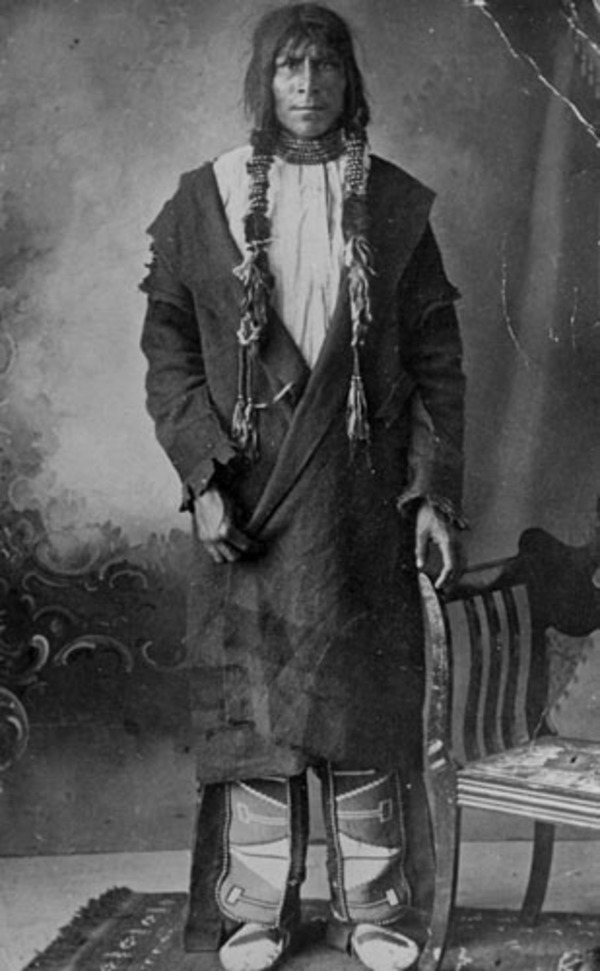
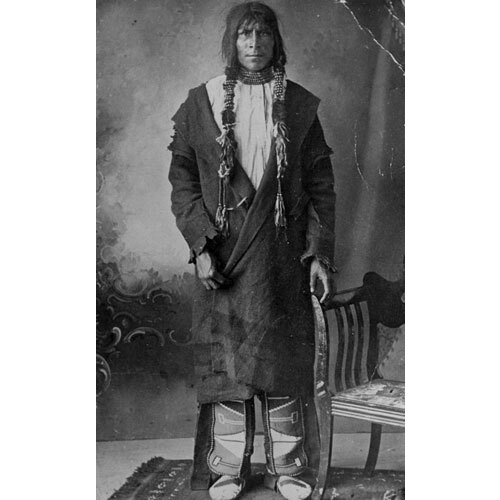
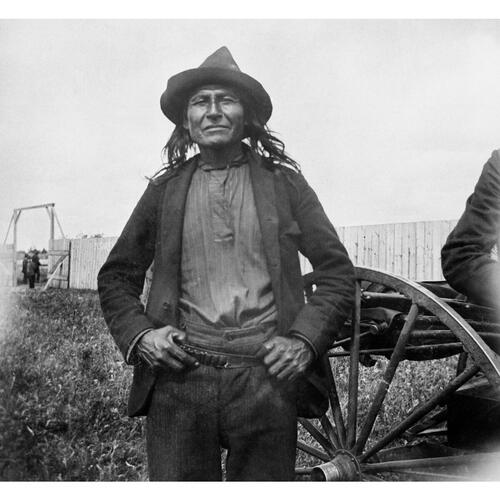
KITCHI-MANITO-WAYA (Kakee-manitou-wata, Kamantowiwew, Almighty Voice, also known as Jean Baptiste), Willow Cree hunter and fugitive; b. c. 1874, probably near Duck Lake (Sask.), first son of Natchookoneck (Nanācohkonākos, Spotted Calf, Appears in Various Ways), daughter of Willow Cree headman Kā-namhcīt (Left Hand) and adopted daughter of Kā-namhcīt’s brother chief Kāpeyakwāskonam* (One Arrow), and Sinnookeesick (Seenokesick, John Sounding Sky, The Sounding Sky), a Saulteaux from the Nut Lake (Yellow Quill) band; m. first 1890 a daughter of Nâpêsis (Little Man); they had no children; m. secondly 1892 a daughter of Rock Child, and they had two sons, one of whom died in infancy; d. 30 May 1897 in the Minichinas Hills, southeast of Batoche (Sask.).
Fiction and fact
“INDIAN HOLDS 1,000 AT BAY,” the newspaper headline screamed. With this hook, journalist Chief Buffalo Child Long Lance [Sylvester Clark Long*] opened his 1924 story on Almighty Voice. The article ran all over North America, including in the Winnipeg Tribune (5 Jan. 1924), relating how a young Cree, arrested for killing a government steer, had escaped from jail by nimbly taking a key from a snoozing guard and quietly unlocking his chains. Almighty Voice ran because he believed the North-West Mounted Police (NWMP) would hang him for his crime. “But they will never put a rope around my neck,” he defiantly told his mother. “I will die fighting them.” A Mountie later confessed that the hanging threat was only a joke: the usual penalty was one month’s imprisonment. Unaware of the hoax, Almighty Voice vowed never to be taken, and the affair resulted in what the journalist claimed was “the greatest single-handed stand in the history of the North American West.”
This recounting is the popular version of the Almighty Voice story, one that has been told and retold in newspapers, magazines, books, pulp fiction, poetry, plays, music, and a feature film. Almighty Voice has been romanticized, maligned, misunderstood, celebrated, and invented – a process of interpretation that began while he was still alive and has continued since his death. A search for the real subject of these many stories can be as frustrating as was the manhunt for him in 1895–97.
The plight of the Willow Cree
What is known is that Almighty Voice was born into the One Arrow band – one of the three Willow Cree bands living in the region of the North-West Territories that would become central Saskatchewan and Alberta. The Willow Cree followed a seasonal round from Duck Lake to Goose Lake (near North Battleford, Sask.) in the west, to Round Prairie (near Dundurn) in the south, and to Little Manitou Lake (near Watrous) to the east. During the summer these “fine hunters,” as Métis trader Norbert Welsh described them in his memoirs, killed bison, either by shooting from horseback or by the traditional method of pounding (driving animals into a corral-like enclosure and then killing them). Come winter, they took shelter in river valleys and subsisted on smaller game and on food that could be gathered, such as berries.
In August 1876 Chief One Arrow, Almighty Voice’s grandfather by adoption, entered Treaty No.6, which was negotiated by the lieutenant governor of the North-West Territories, Alexander Morris*, and the band took a reserve, known as the One Arrow Indian Reserve, on the east side of the South Saskatchewan River, near Batoche. At first the band was disinclined to take up farming, preferring to hunt game and gather other foods in the Minichinas Hills to the east. The disappearance of the bison in 1878–79 made it ever more difficult to sustain earlier ways of life [see Kamīyistowesit* (Beardy)].
Young Almighty Voice would have learned to be at home in these brush-clad hills as he honed his survival skills under the guidance of his father and grandfather. To the Department of Indian Affairs, the band’s stubborn adherence to traditional ways, particularly its members’ general refusal to speak English or convert to Christianity, equated to backwardness. Officials frequently complained about the band’s failure to bring land under cultivation, without acknowledging that the agricultural assistance promised by the treaty was not fully provided until 1884; thereafter One Arrow’s people made better progress. The federal government also maintained that Indigenous peoples would remain unprogressive and demoralized while they adhered to traditional practices and spiritual ceremonies, which would be partially banned in 1895 [see Amédée-Emmanuel Forget*].
At the start of the North-West rebellion in March 1885, Métis general Gabriel Dumont* and armed horsemen forcibly took the One Arrow band to Batoche to bolster the fighters led by Métis Louis Riel*. Almighty Voice would have been among the captives. After the rebellion the Canadian government declared One Arrow’s people disloyal and the chief was convicted of treason-felony. He was imprisoned and died in 1886, shortly after his release. No chief took his place. Hayter Reed*, assistant Indian commissioner for the North-West Territories, amalgamated the three Willow Cree bands and ordered One Arrow’s people onto the reserves allocated to the bands headed by Kamīyistowesit and Okemasis (Sayswaypus) near Duck Lake. When the One Arrow band refused to leave their home reserve, Indian Affairs tried unsuccessfully to starve them into submission.
Coming of age
Almighty Voice, known to the Canadian government as One Arrow band member no.57, came of age during these difficult years. The tall, handsome youth, who had a distinctive scar running from his left ear to the corner of his mouth, was a renowned hunter. Since he was the eldest of seven siblings, four of whom died young, his skill with a gun became increasingly important when government rations were reduced in the early 1890s. He also found work in nearby communities, and it was probably the Roman Catholic priests at Duck Lake who named him Jean Baptiste. In November 1888 Almighty Voice appears in the financial records of Indian Affairs’ Duck Lake agency as a freighter; he might have been hauling hay, which the One Arrow reserve supplied to local settlers.
In 1890 Almighty Voice married a daughter of Nâpêsis (Little Man) and lived with the young girl (described as “under age” in the agency register) for two years. After they separated, he took a daughter of Rock Child as his wife; their first son, born in May 1893, died a little more than a year later of tuberculosis. Although some accounts suggest that Almighty Voice had a third wife, the daughter of The Rump, treaty annuity pay lists document only two marriages in the early 1890s. He was not a polygamist as some have stated, but according to a member of another band, he did have a reputation as “a very wild young man.”
Arrest and escape
The 1890s were difficult years for the One Arrow band, and they were made no easier by Indian Agent Robert Sutherland Mackenzie. Appointed by the federal government, he, like other agents, was charged with encouraging Indigenous assimilation. His responsibilities included providing rations, keeping the peace, and trying to ensure that children were baptized and sent to Roman Catholic residential schools. Attendance at the schools was a particular concern to him and also strongly resisted by the Cree. Mackenzie was under intense pressure to limit agency expenses and had frequent run-ins with the Cree over government parsimony. In an attempt to demonstrate his authority, he threatened to withhold rations and trading rights if they refused to allow their children to be educated according to white values. Such treatment may explain why Almighty Voice once threatened to kill the Indian agent. A wary Mackenzie recognized the danger, later saying that he had “not the slightest doubt that he would shoot me if he got the chance.”
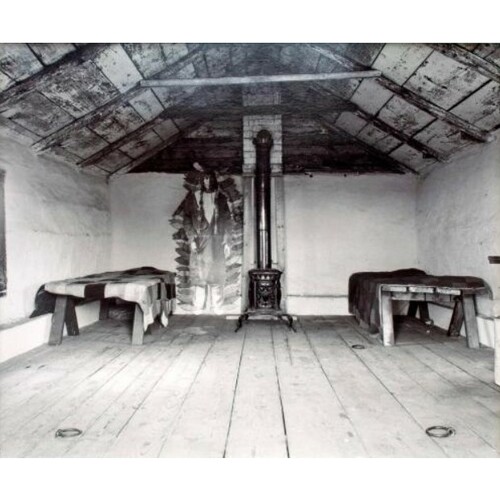
With the One Arrow people near starvation, in May 1895 Almighty Voice and his brother-in-law Flying Sound killed a settler’s stray cow (not a government steer, as Long Lance claimed) to feed their hungry families. Both men undoubtedly knew it was wrong; Almighty Voice later offered the settler a horse as compensation. Nothing came of the incident until 22 October when, during the payment of annual annuities at the One Arrow reserve, NWMP sergeant Colin Campbell Colebrook arrested the two men. (Good Young Woman, Almighty Voice’s sister, was also arrested for theft of small goods.) Colebrook escorted them to the Duck Lake barracks, where they were to appear the next morning before Mackenzie. Sergeant Harry Keenan took charge of the prisoners. He had beds made up for them – there was no jail cell – and organized a rotating night watch. Keenan did not shackle the prisoners; their crimes were minor and he expected them to receive light sentences. At 2:00 a.m. Constable Robert Casimir Dickson checked that the prisoners were asleep and went upstairs to rouse his replacement, Constable Andrew Nolan O’Kelly, leaving the key to the front door under a newspaper on a table. When O’Kelly came downstairs, Almighty Voice was gone. (His relatives were released the next day.)
It was later claimed by Long Lance, and then by other writers, that Constable Dickson had told Almighty Voice he faced hanging. But in neither the exhaustive police investigation of the escape nor the disciplinary hearings for Dickson and Keenan was the hanging threat mentioned. Nor is evidence found in Department of Indian Affairs records. Almighty Voice would have known that although restitution was required for his offence, killing a cow was never severely punished. But he was to be tried by the Indian agent he had threatened, and he feared confinement: his band believed that One Arrow had died as a result of his wrongful imprisonment.
Almighty Voice crossed the South Saskatchewan River near Saint-Laurent-de-Grandin (St-Laurent-Grandin) and made his way on foot to his family’s home. He knew that the mounted police would come looking for him, and on 24 October he fled, again on foot, seeking refuge in the rugged Carrot River country to the northeast. He was accompanied by a young woman, 13-year-old Small Face from the James Smith Indian Reserve.
Sergeant Colebrook, who had originally arrested Almighty Voice, took up the search. He was assisted by a relative of Gabriel Dumont, guide and tracker François (Frank) Dumont, who had taken treaty and joined the One Arrow band. François Dumont and Almighty Voice were apparently not on friendly terms, probably because Dumont was believed to be an Indian Affairs informant.
Death of a police officer
On the morning of 29 October, Almighty Voice, his companion, and a stolen horse were found east of Waterhen Lake, about 60 miles from the One Arrow reserve. Almighty Voice shouted to Dumont that he was prepared to shoot. Despite a warning from Dumont, Colebrook rode forward, calmly saying in his English accent, “Come on old boy,” while Dumont, speaking in Cree, called on Almighty Voice to surrender. The fugitive, with his shotgun primed, started walking backwards. He stopped two or three times, yelling in Cree, “Go away, go away.” Then he dropped to one knee and took aim. Colebrook again ignored the warning and kept advancing. Retreating to a bluff of trees, Almighty Voice killed the Mountie with a blast to his upper chest. Dumont rode for help. He gave some further assistance to the police, but in the spring of 1896 he fled to another reserve, fearing that Almighty Voice would seek revenge.
Leaving Small Face to find her way to safety, Almighty Voice rode north to the James Smith and Big Head (Cumberland) reserves, near Fort-à-la-Corne on the Saskatchewan River. In mid November he made his way southeast to the hunting territory of the Kinistin and Yellow Quill Saulteaux bands, seeking his paternal grandfather, Kā-namhcīt, and other relatives. It was a perfect hiding place. The rolling, bush-covered country, extending south from the Saskatchewan River, was almost empty of settlers. As a skilled hunter, Almighty Voice was welcomed by the area’s nomadic bands. He was able to travel in relative anonymity with small hunting groups. He likely returned home in late December or early in January 1896 to see his newborn son. (His wife had been pregnant when he was taken into custody.)
Although the NWMP continued the search, often in difficult conditions, they never sighted Almighty Voice in the 19 months after Colebrook’s murder. The bands on the reserves around Duck Lake were suspected of harbouring the fugitive. Whatever their feelings about Colebrook’s death, they resented government mistreatment, and they were not about to give up one of their own to the authorities. The failure to find the killer grated on NWMP Commissioner Lawrence William Herchmer*, who assured the public that the Mounties would, eventually, get their man. Regional newspapers, which provided regular, front-page coverage of the story, were patient at first but soon began calling for a reward. In Ottawa the superintendent of Indian Affairs, Thomas Mayne Daly*, brought the matter to the attention of Sir Prime Minister Mackenzie Bowell*, and a reward of $500 was sanctioned in April 1896.
Stand-off
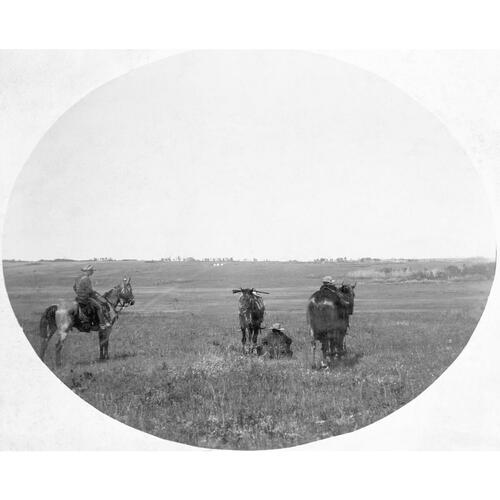
Early on 28 May 1897 a police patrol near Bellevue (St-Isidore-de-Bellevue) chanced upon three men running through the underbrush towards a sunken poplar bluff. They were Almighty Voice and two young men, cousin Anihšināpēns (Little Saulteaux) and brother-in-law Topean (Dublin). They were apparently headed to the One Arrow reserve, where Almighty Voice often visited his relatives during his months in hiding. Their sighting was entirely accidental. The long search for Almighty Voice would rank as one of the most famous in Canadian history, and in the elusiveness of its quarry would rival the later pursuits of Albert Johnson* and Simon Peter Gunanoot*.
The police tried to drive the three men out of the grove by entering the heavy brush from one side and forcing them into the open. It was a foolhardy manoeuvre, and two Mounties were seriously wounded. The fugitive and his companions, who had no food or water, then fortified their position by digging themselves a pit in the densest part of the bluff. A man was sent to Batoche to spread the word by telephone and telegram that Almighty Voice had been found. Several local volunteers from the Duck Lake community and the town of Prince Albert joined the growing police camp on a nearby hill. Members of the One Arrow community, including Almighty Voice’s mother, also came to watch from another hill.
Early that evening the police, with civilian volunteers, mounted a second assault on the bluff. It was disastrous. Two policemen and a civilian were killed. The police decided to call in reinforcements. Men came from Prince Albert, hauling a cannon; another was brought by Mounties from Regina, who travelled north by train on Saturday, 29 May, and arrived later that day. They were greeted by Almighty Voice, shouting in Cree: “Brothers, we’ve had a good fight to-day. I’ve worked hard and am hungry. You’ve plenty of grub; send me in some. To-morrow we’ll finish the fight.”
The doomed men were given no chance for escape or surrender, especially since it was feared that their defiance might cause an Indigenous uprising. Early on Sunday, 30 May, Assistant Commissioner John Henry McIllree, who wanted no more casualties, ordered a bombardment from the cannons that lasted some two hours. Then about 100 police and civilians, their guns blazing, charged through the remaining trees.
The three fugitives were dead. Topean had apparently been shot during the deadly skirmish with the police on the previous night. Almighty Voice and Little Saulteaux were found together in the pit, evidently both killed by the same artillery shell. The top of Almighty Voice’s skull had been blown off. It is not clear where his skull fragment was found, or by whom, but, treated as a “war trophy,” it would be displayed without the One Arrow band’s knowledge for several decades in the Mounties’ museum in Regina. The bodies were turned over to the band’s farm instructor for burial on the One Arrow reserve. Perhaps wanting to put an end to the episode as quickly as possible, the police did not arrange for a coroner’s inquest into the death of the two Mounties at the bluff.
Assessment
Neither the North-West Mounted Police nor the Department of Indian Affairs investigated what had happened. There was no inquiry into why Almighty Voice had killed the settler’s cow, fled from custody, and shot a police officer, and no questions were asked about how, assisted by family and friends, he had eluded capture for more than 19 months. It was assumed that his actions mirrored the worst qualities of his race, and it was considered fortunate that he had died before others joined him in a rebellion such as the 1885 uprising. The annual Indian Affairs report summed up its account of the fatal encounter in the bluff with the statement, “Thus the Indians learn that justice, although sometimes slow, is sure, and will be executed at whatever cost.” Commissioner Herchmer echoed this sentiment, pointing to “the trouble that even one bad Indian can give … [to] the peace and safety of the country.”
Given the desperate state of Indigenous bands in the North-West Territories, it is surprising that there were not more violent incidents of this kind. Clearly, the police and government officials were ignoring the miseries of Indigenous peoples, and perhaps it was inevitable that there would be resistance. “Almighty Voice was the champion of a race that is ‘up against it’ in civilization,” the Toronto Evening Telegram bluntly observed. “The wonder, is not that an occasional brave cuts loose, but that all braves do not prefer the sudden death to the slow extinction of their people.”
The life and death of Almighty Voice illustrate the priorities of the Canadian state in the late 19th century: opening up the west for white settlers, preserving the peace, and keeping Indigenous peoples confined to their reserves and under government control in the hope that they would become self-sufficient farmers who would gradually be assimilated into a society based on European values. Indian Affairs officials regarded Almighty Voice as a dangerous renegade who, once dead, should be forgotten as quickly as possible. The NWMP controller, Frederick White, complained in June 1897 that it was “unfortunate” that “so much fuss” was being made over the “Almighty Voice affair.” He resented the “amount of ridicule” over the use of cannon that he heard expressed by, among others, Sir Adolphe-Philippe Caron*, a former Conservative minister of militia and defence, who sarcastically suggested that “the Police will be taking out their 9-pounder guns to shoot flies when the warm weather comes.”
There was a wide gulf between non-Indigenous and Indigenous understanding of Almighty Voice’s story. Many government officials believed that they were working in the best interests of Indigenous peoples, and Indigenous peoples objected to the restrictive and often coercive policies of the Department of Indian Affairs. Inevitably, Almighty Voice was seen as either a “bad Indian” or a representative of resistance against overwhelming odds.
After his grandfather took treaty, Almighty Voice endured a stultifying existence. The One Arrow Indian Reserve was little better than a prison farm where band members had no independence and faced punishment unless they followed the directives of the Indian agent and farm instructor. Indian Commissioner Edgar Dewdney* called such tactics “sheer compulsion.” His successor, Hayter Reed, belittled the Cree as chronic whiners and tried to keep government money spent on their behalf to a minimum. Almighty Voice had seen his family and friends suffer, and his escape from what he considered unjustified persecution gave him the opportunity to defy the government’s iron control. In the end the overriding question about the Almighty Voice affair is not why it happened, but why such incidents did not happen more often.
For a book-length biography see the author’s In search of Almighty Voice: resistance and reconciliation (Markham, Ont., 2020). Early accounts by the North-West Mounted Police maligned Almighty Voice. Chief Buffalo Child Long Lance’s reporting, especially in his autobiography, Long Lance: the autobiography of a Blackfoot Indian chief (London, 1928), changed this interpretation, portraying Almighty Voice as a misguided young man who was duped into lashing out against agents of government authority and other white colonists. This version, especially the supposed threat that he would be hanged, has carried over to L. [B.] Peterson, Almighty Voice (Agincourt, Ont., 1974); D. D. Moses, Almighty Voice and his wife (Stratford, Ont., 1991); and a film directed by Claude Fournier, Alien thunder (1974). The author wishes to acknowledge the scholarly contribution of S. D. Hanson, who wrote the original version of this biography (1990); see Document History.
Library and Arch. Can. (Ottawa), MG26-A, vol.213 (Sir John A. Macdonald fonds, political papers, corr.), L. W. Herchmer to E. Dewdney, 10 Feb. 1886 (link, pp.90617–20); RG10, vol.3710, file 19550-3 (Northwest Territories – corr. regarding the Indian participation during the rebellion), Hayter Reed, 20 July 1885, “Memorandum for the Honorable the Indian commissioner relative to the future management of Indians” (link, items 137–45); RG10, vol.8616, file 1/1-15-2-1, pt.1 (Famous Indians – Almighty Voice), mfm. C-14236, J. H. Gordon to R. S. McKenzie, 6 Nov. 1895 (link, images 1791–93); RG10-A, vol.1603 (Duck Lake Agency – letterbooks, 1894–95), mfm. C-14861, R. S. McKenzie to A. E. Forget, 21 May 1895 (link, image 1654); RG10-A, vol.1607 (Duck Lake Agency – letterbooks, 1895–97), mfm. C-14862, R. S. McKenzie to J. H. Gordon, 12 Nov. 1895 (link, images 462–63); RG10-B-8-d, vols.9423–30 (Treaty annuity paylists – treaties 4, 6 and 7), One Arrow (1890–97), mfm. C-7147–C-7149 (link); RG10-B-8-k, vol.9995 (Financial statements of expenses – Duck Lake Agency, 1887–89); RG18, vol.10039 (NWMP Personnel records, Colin Campbell Colebrook file), J. B. Allen to G. B. Moffatt, 4 Nov. 1895, G. B. Moffatt to L. W. Herchmer, 26 Oct. 1895, and Frank Dumont and Small Face testimony, coroner’s inquest (link); RG18-A-1, vol.121, file 269-96 (Dickson, ex cons. R. C. – punishment of, for allowing Indian prisoner to escape), R. C. Dickson, 24 Oct. 1895, disciplinary hearing transcript; RG18-A-1, vol.137, file 376-97 (Allan, Insp. J. B. – shooting of, by Almighty Voice), Allan to S. Gagnon, 27 July 1897; RG18-B-1, vol.1038, file 68 ([First Nations & Indian Dept. – Prince Albert Dist.]), A. B. Perry to A. G. Irvine, 19 Feb. 1886 (link); RG18-B-1, vol.1347, file 226-1895 (Pursuit of Indian murderer, “Almighty Voice”), G. B. Moffatt to NWMP commissioner, 13 March 1896; RG18-B-1, vol.1398, file 186-1897 (Injury received by Napoleon Venne during pursuit of Almighty Voice), Pee-yeh-chew witness statement; F. Smith to L. W. Herchmer, 1 June 1897; O’Kelly to Gagnon, 2 June 1897; RG18-B-5, vol.2480 (Court documents – “Almighty Voice,” murder), pt.1, J. H. McIllree to L. W. Herchmer, 4 June 1897; RG18-G, vol.7197 (NWMP Personnel records, Harry Keenan file), 18 Nov. 1895, disciplinary hearing transcript. Univ. of Regina, Canadian Plains Research Center, Indian History Film Project, “[Transcript of an interview with Seno-Kisik (Sounding Sky) by D. G. Mandelbaum, 17 July 1934].” El Paso Times (El Paso, Tex.), 6 Jan. 1924. Family Herald and Weekly Star (Montreal), 5 Jan. 1924. Can., House of Commons, Sessional papers, 1893, vol.8, no.13 (exploratory survey in the Saskatchewan district, N.W.T.): 59; Sessional papers, 1896, vol.11, no.15 (report of the commissioner of the North-West Mounted Police Force, 1895): 4; Sessional papers, 1898, vol.11, no.14 (annual report of the Department of Indian affairs for the year ended 30th June 1897): xx, and vol.12, no.15 (report of the commissioner of the North-West Mounted Police Force, 1897): 2–3. W. A. Fraser, “Soldier police of the Canadian northwest,” McClure’s Magazine (New York), 13 (May–October 1899): 231. John Jennings, “The North West Mounted Police and Indian policy after the 1885 rebellion,” in 1885 and after: native society in transition, ed. F. L. Barron and J. B. Waldram (Regina, 1986), 235–36. Buffalo Child Long Lance [S. C. Long], “How Canada’s last frontier outlaw died,” MacLean’s, 1 Jan. 1924: 19–20, 42, 44. T. M. Longstreth, The silent force: scenes from the life of the mounted police of Canada (London, 1928), 220. Dale Russell, “The Fort a la Corne forest area: a survey of the historical documents” (Saskatoon, 2007). J. L. Tobias, “Canada’s subjugation of the Plains Cree, 1879–1885,” in Sweet promises: a reader on Indian-white relations in Canada, ed. J. R. Miller (Toronto, 1991), 222. Mary Weekes, as told to her by Norbert Welsh, The last buffalo hunter (Saskatoon, 1994), 19–20, 44–45.
Image Gallery

Cite This Article
W. A. Waiser, “KITCHI-MANITO-WAYA (Kakee-manitou-wata, Kamantowiwew, Almighty Voice, Jean Baptiste),” in Dictionary of Canadian Biography, vol. 12, University of Toronto/Université Laval, 2003–, accessed May 29, 2026, https://www.biographi.ca/en/bio/kitchi_manito_waya_12E.html.
The citation above shows the format for footnotes and endnotes according to the Chicago manual of style (16th edition). Information to be used in other citation formats:
| Permalink: | https://www.biographi.ca/en/bio/kitchi_manito_waya_12E.html |
| Author of Article: | W. A. Waiser |
| Title of Article: | KITCHI-MANITO-WAYA (Kakee-manitou-wata, Kamantowiwew, Almighty Voice, Jean Baptiste) |
| Publication Name: | Dictionary of Canadian Biography, vol. 12 |
| Publisher: | University of Toronto/Université Laval |
| Year of publication: | 1990 |
| Year of revision: | 2026 |
| Access Date: | May 29, 2026 |