

Source: Link
GRAVIER, JACQUES, priest, Jesuit, missionary, founder of the Illinois mission; b. 17 May 1651 and baptized five days later at Moulins, France, son of Antoine Gravier, procurator, and Janne Bogy; d. the night of 16–17 April 1708 in or near Mobile (Alabama).
Jacques Gravier entered the Society of Jesus in the fall of 1670 and made his novitiate at Paris. From 1672 until 1680 he taught and tutored in the Jesuit schools of Hesdin, Eu, and Arras. He interrupted these assignments for a year of philosophy studies at the Collège Louis-le-Grand in Paris (1678–79); he returned to the same institution for theological studies (1680–84). The letters he would later write, in which he commented perspicaciously on theological and canonical questions, demonstrate his knowledge and the quality of his reasoning. After his third year of theology studies he was ordained a priest, and after the fourth he set out promptly for Canada. He sojourned briefly at the college in Quebec, and then spent a year at Sillery studying the Algonquin language (1685–86).
Called westward to the Ottawa (Odawa) mission, he went to Saint-Ignace and there wrote out, in his own serious, space-sparing hand, the solemn profession of four vows on 2 Feb. 1687. For the remaining 21 years of his life, he would dedicate himself to the promises made that day.
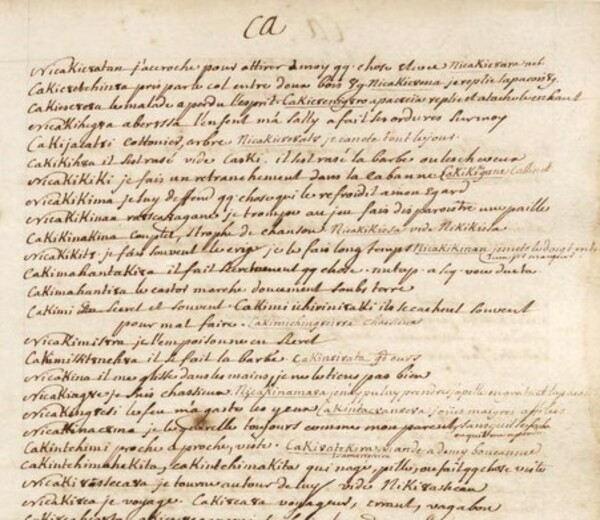
In 1689 he took up residence among the Illinois people – first at Starved Rock on the Illinois River. With the help of fur trader Jacques Largillier, dit le Castor, he prepared a grammar of the Miami-Illinois language, in which he excelled. By founding this mission, Gravier carried out the promise made almost two decades before by Jacques Marquette*. In 1696 he was named “Superior of the Missions among the Ottawa, the Illinois, the Miami, and others”; in this capacity he had to return to Michilimackinac. Bishop Saint-Vallier [La Croix] of Quebec named him his vicar general for these missions. With typical tenacity Gravier strove to retain the Tamaroa mission as part of the bishop of Quebec’s original 1690 commission to the Jesuits. He nevertheless had to yield to the adamant Saint-Vallier, who entrusted the village to the Quebec seminary priests.
Gravier canoed downriver to the primitive Louisiana settlements in November 1700; during a year of ministry to French and Indigenous people, he won the lasting friendship and esteem of the officer Jean-Baptiste Le Moyne* de Bienville. In turn Gravier, a good linguist, was impressed by Bienville’s knowledge of Indigenous languages. He left the Gulf Coast colony in February 1702 to return to the Illinois country. During 1702–4 he was again among “his Illinois,” and in 1705 was named superior of that mission, now separately administered.
In the autumn of 1705, in a context of growing tension with the French, a Peoria man attacked Gravier, letting fly five arrows. According to some sources, the altercation was the result of a disagreement concerning a Peoria burial. The deep wound in his arm was crudely treated, with the result that infection set in and the pain grew worse. Despairing of healing in such a remote location, he made the trip to Mobile in midwinter (1705–6). Still without relief, he sailed for France in late 1706. (Both in Mobile and in Paris he took the side of Bienville against Henri Roulleaux de La Vente, a priest of the Séminaire des Missions Étrangères, and Nicolas de La Salle, the commissary.) Whatever alleviation he obtained, it was clear that he would suffer from the wound for the rest of his life; with this knowledge he sailed back to Mobile, arriving in February 1708, and made preparations to return to his post among the Peoria people. The infection of the wound and the fatigue of his travels thwarted his plans. Death came to his fever-racked frame while he was in or quite near old Mobile.
AN, Col., B, 29, ff.260v, 261, 263v, 265; C13A, 1, ff.504–7, 570–81, 582; Marine, 3JJ, 389, f.19. ARSI, Gallia 110/II, ff.269–70v, 271–72v, 273v. ASJ, France (Chantilly), Fonds Brotier, 105. ASQ, Lettres, R, 82, 83; Lettres, M, 38, 39; Lettres, S, 102. BN, MS, Fr. 6453, ff.18ff. Library of Congress (Washington), Jesuit Relations mss. Découvertes et établissements des Français (Margry), IV, 5. [Jacques Gravier], Lettre du P. Jacques Gravier, le 23 février 1708, sur les affaires de la Louisiane (New York, 1865); Relation ou journal du voyage de r.p. Jacques Gravier de la Compagnie de Jésus, en 1700 depuis le pays des Illinois jusqu’à l’embouchure du Mississipi (New York, 1859). JR (Thwaites), LXV, 100–79; LXVI, 32–34, 120–43. Lettres édifiantes et curieuses escrites des missions étrangères (nouv. éd., 14v., Lyon, 1819), IV, 209.
Delanglez, French Jesuits in Louisiana. O’Neill, Church and state in Louisiana. Rochemonteix, Les Jésuites et la N.-F. au XVIIe siècle, III, 538, 547, 688–90.
Bibliography for the revised version:
Arch. Départementales, Allier (Yzeure, France), “État civil en ligne,” Jacques Gravier, Moulins, Saint-Pierre-des-Ménestraux, 22 mai 1651 (baptism). Gilles Havard, Empire et métissages: Indiens et Français dans le pays d’en haut, 1660–1715 (Sillery [Québec] et Paris, 2003). Jay Higginbotham, Old Mobile: Fort Louis de la Louisiane 1702—1711 (Mobile, Ala., 1977). Michael McCafferty, “Jacques Largillier: French trader, Jesuit brother, and Jesuit scribe par excellence,” Ill. State Hist. Soc., Journal (Champaign, Ill.), 104 (2011), no.3: 188–98.
Image Gallery

Cite This Article
Charles E. O’Neill, “GRAVIER, JACQUES,” in Dictionary of Canadian Biography, vol. 2, University of Toronto/Université Laval, 2003–, accessed March 10, 2026, https://www.biographi.ca/en/bio/gravier_jacques_2E.html.
The citation above shows the format for footnotes and endnotes according to the Chicago manual of style (16th edition). Information to be used in other citation formats:
| Permalink: | https://www.biographi.ca/en/bio/gravier_jacques_2E.html |
| Author of Article: | Charles E. O’Neill |
| Title of Article: | GRAVIER, JACQUES |
| Publication Name: | Dictionary of Canadian Biography, vol. 2 |
| Publisher: | University of Toronto/Université Laval |
| Year of publication: | 1969 |
| Year of revision: | 2026 |
| Access Date: | March 10, 2026 |