

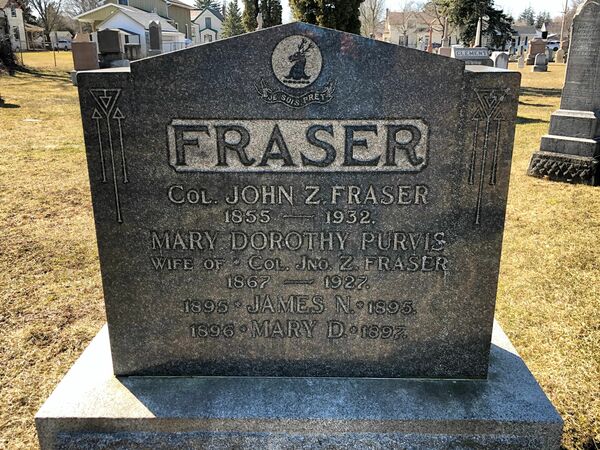
Source: Link
FRASER (Frazer), JOHN ZIMMERMAN, farmer, militia officer, and agrarian activist; b. probably 14 Oct. 1855 in St George, Upper Canada, son of John L. Fraser and Nancy Clark (Clarke); m. 1 Feb. 1893 Mary Dorothy Purves (Purvis) (1867–1927) in Beloit, Wisc., and they had five sons and three daughters, of whom one son and one daughter died in infancy; d. 22 Nov. 1932 in Brantford, Ont.
Little is known about J. Z. Fraser’s early years. He was the son of Scottish immigrants and likely received a rudimentary education. He subsequently followed his father into farming, setting up operations in Brant County’s Burford Township. Fraser would farm the same piece of land for some 60 years, and evidently he was successful at his calling. Given his geographic location, it is likely that he dedicated at least a portion of his property to fruit growing. Farming did not occupy all of Fraser’s attention: the Standard dictionary of Canadian biography, which describes him as a “large-hearted man” with a rugged build, notes that he read a great deal and was “restless and fond of adventure.” He spent time during his early adulthood in the Canadian and American west, and helped suppress Louis Riel*’s North-West rebellion in 1885. A proud soldier, he belonged for many years to the 2nd Dragoons, a militia unit based in St Catharines, Ont. On 4 May 1909 he was promoted lieutenant-colonel and given command of the regiment, which he led until 1922. Although he assisted in recruiting drives for the South African War and First World War, Colonel Fraser, as he was called, was not on active duty during either conflict.
Politics was another of Fraser’s interests. By the late 19th century he had become a Tory booster, and in the provincial election of 1902 he was the nominee of James Pliny Whitney*’s Conservatives in Brant South. Fraser’s campaign advertising in the Brantford Courier stated that he stood for “Clean government, the best Interests of Ontario, and a Progressive and Business Like Policy.” The riding, held by former premier Arthur Sturgis Hardy* from 1873 to 1899, was a Liberal stronghold. The incumbent mpp, Thomas Hiram Preston, won the election, but Fraser performed well, capturing 47 per cent of the popular vote in a two-way race.
Fraser is best known for his involvement in agrarian organizations. Most farmers’ associations in Canada failed or stagnated during the late 19th and early 20th centuries [see James Moffat Douglas*]. Fraser had first-hand knowledge of these disappointments, as he had been involved in the North American organization called the Patrons of Husbandry – better known in Canada as the Dominion Grange – which was established with great enthusiasm in 1874 but had dwindled markedly in size and influence by the mid 1890s. To remedy the situation, he and a few others were determined to create an organization that could influence public policy and revitalize the agrarian movement. In late 1913 Fraser met in Toronto with Ernest Charles Drury*, William Charles Good*, and James J. Morrison, all well-known farm leaders in the province. Together they devised the idea of creating a new agrarian organization by co-opting the provincially run Farmers’ Institutes and merging them with other farmers’ associations. The United Farmers of Ontario (UFO) was formally established in early 1914, as was a sister organization, the United Farmers’ Co-operative Company (UFCC). The UFO was to serve as an educational body and lobby group, and the UFCC was designed to manage the farmers’ many cooperative ventures. Fraser occupied executive roles in both bodies: he was a director of the UFO and would hold various positions in the UFCC. He also served as president of the Farmers’ Publishing Company (FPC) between 1918 and 1931. From April 1919 the FPC published the UFO’s newspaper, the Farmers’ Sun (founded in 1892 by George Weston Wrigley* as the Canada Farmers’ Sun), which had about 30,000 subscribers by the end of 1919 and some 40,000 readers in the early 1920s.
During the First World War there was considerable unrest in rural Ontario, and much of this discontent was directed towards Premier William Howard Hearst*’s Conservatives and Newton Wesley Rowell*’s Liberals, particularly the perceived corruption within and undemocratic nature of their political machines. During the campaign that preceded the provincial election on 20 Oct. 1919, UFO clubs across the province nominated candidates to run against local Conservatives and Liberals (now led by Herbert Hartley Dewart*). Surprisingly, the UFO won a plurality of 45 of the legislature’s 111 seats and then formed a coalition government with the 11 elected members of the Independent Labor Party of Ontario [see Joseph Taylor Marks]. Having campaigned without a leader, the UFO now sought one to serve as premier. Perth South mpp Peter Smith was briefly considered for the position, and business titan Sir Adam Beck* and James J. Morrison each refused to take the job. The premiership fell to Ernest Drury.
Fraser had been ambivalent about taking direct political action, believing that the UFO was not a conventional party but a movement that would be more effective if it acted as a lobbying organization. After it formed the government, he became involved in the UFO’s “Broadening Out” controversy. Drury, who appears to have coined the term, wished to reach out to non-agrarian groups (especially urban-based progressives) to create a mass people’s party, whereas prominent figures such as Fraser and Morrison wanted to restrict the UFO to advancing the interests of farmers. By 1921 Fraser was convinced that Drury was being duped by people from the old political order who sought to prolong the “Broadening Out” controversy because it would destroy the party. Using his position as head of the FPC, Fraser openly attacked the premier. In an interview published in the Farmers’ Sun and reprinted on 20 January by the Globe, he declared: “Mr. Drury is unwittingly being made the instrument of destruction. Apparently a body of designing and unscrupulous men, by their wily sycophancy and blandishments, have secured the Premier’s ear. He, being unused to the wiles and stratagems of designing politicians, is not astute enough to fathom their base designs.” The highly public split certainly did not help the UFO in the election of 25 June 1923, which it lost decisively to George Howard Ferguson*’s Conservatives.
In addition to his activities in the UFO, Fraser was the founding president of the Hydro Information Association, which was established in 1920 and which helped persuade the Drury government to reject Beck’s plan to create a network of publicly owned, electrically powered interurban radial railways in southwestern Ontario [see William Francis Tye; Robert Franklin Sutherland*]. Fraser also represented the province on the Canadian Council of Agriculture and was a member of the Canadian Wheat Board. Locally, he was a director of the South Waterloo and North Dumfries Fire Insurance Company. Fraser retired shortly before dying of a cerebral embolism in Brantford on 22 Nov. 1932. He was buried in the Burford Congregational Cemetery. The value of his estate (approximately $45,000, a substantial amount during the Great Depression) suggests that he was successful at his first calling and perhaps helps to explain his conviction that the UFO worked best when it focused on farmers’ livelihoods rather than broad populist and political objectives.
J. Z. Fraser was one of the many UFO supporters who shed their previous party affiliations in favour of agrarian activism. He occupied important positions within the movement, his work on its cooperative side aided rural families materially, and he helped to educate farmers throughout Ontario and beyond. His willingness to publicly air the movement’s divisions and take shots at other leaders, however, undoubtedly damaged the UFO, whose electoral defeat and subsequent collapse made it effectively impossible for farmers’ organizations in the province to take direct political action in the future.
Ancestry.com, “Wisconsin, U.S., marriage records, 1820–2015,” John Zimmerman Fraser and Mary Dorothy Pewes [Purves], Rock, 1 Feb. 1893. AO, RG 22-325, no.7712. FamilySearch, “Canada, Ontario, deaths, 1869–1937 and deaths overseas, 1939–1947,” John Zimmerman Fraser, Brantford, Brant, 22 Nov. 1932. LAC, R233-35-2-E, Ont., dist. Brant South (159), subdist. Burford (B), div. 4: 23; R233-37-6-E, Ont., dist. Oxford South (102), subdist. Burford (A), div. 4: 3; R233-114-9-E, Ont., dist. Brant (67), subdist. Burford (14): 8; R4673-0-4-E (James J. Morrison fonds). Brantford Expositor (Brantford, Ont.), 23 Nov. 1932. Courier (Brantford), 10, 22, 23 May 1902. Farmers’ Sun (Toronto), 24 Nov. 1932. Globe, 8 Sept. 1920; 20 Jan., 29 Dec. 1921; 14 Dec. 1922; 4 Sept. 1924; 24 Nov. 1932. Toronto Daily Star, 19 Dec. 1918; 15, 18 Dec. 1919; 21 Jan., 16 Dec. 1920; 4 Jan., 6 Sept., 14 Dec. 1922. Kerry Badgley, Ringing in the common love of good: the United Farmers of Ontario, 1914–1926 (Montreal and Kingston, Ont., 2000); “The social and political thought of the Farmers Institute of Ontario, 1884–1917: manifestations of agrarian discontent” (ma thesis, Carleton Univ., Ottawa, 1988). Centennial edition of a history of the electoral districts, legislatures and ministries of the province of Ontario, 1867–1967, comp. Roderick Lewis (Toronto, [1969]). The challenge of agriculture: the story of the United Farmers of Ontario, ed. M. H. Staples (Toronto, 1921). E. C. Drury, Farmer premier: memoirs of the Honourable E. C. Drury (Toronto, 1966). C. M. Johnston, E. C. Drury: agrarian idealist (Toronto, 1986). G. M. Kirby, Rounds complete: a history of the 57th Artillery Regiment (2nd/10th Dragoons) RCA (Niagara Falls, Ont., 1997). Standard dict. of Canadian biog. (Roberts and Tunnell), vol.2. L. A. Wood, A history of farmers’ movements in Canada (Toronto, 1924; repr., intro. F. J. K. Griezic, Toronto and Buffalo, N.Y., 1975).
Image Gallery

Cite This Article
Kerry Badgley, “FRASER (Frazer), JOHN ZIMMERMAN,” in Dictionary of Canadian Biography, vol. 16, University of Toronto/Université Laval, 2003–, accessed June 3, 2026, https://www.biographi.ca/en/bio/fraser_john_zimmerman_16E.html.
The citation above shows the format for footnotes and endnotes according to the Chicago manual of style (16th edition). Information to be used in other citation formats:
| Permalink: | https://www.biographi.ca/en/bio/fraser_john_zimmerman_16E.html |
| Author of Article: | Kerry Badgley |
| Title of Article: | FRASER (Frazer), JOHN ZIMMERMAN |
| Publication Name: | Dictionary of Canadian Biography, vol. 16 |
| Publisher: | University of Toronto/Université Laval |
| Year of publication: | 2026 |
| Year of revision: | 2026 |
| Access Date: | June 3, 2026 |