

Source: Link
GAGNIEUR, WILLIAM FRANCIS, Roman Catholic priest, Jesuit missionary, translator, and scholar; b. 10 May 1857 in Guelph, Upper Canada, son of Étienne-François-Antoine (Anthony) Gagnieur and Elizabeth Allan; d. 7 Feb. 1937 in Sault Ste Marie, Ont., and was buried in Sault Ste Marie, Mich.
William Francis Gagnieur, the “last of the Black Robes,” belonged to a devout Roman Catholic family. His father, who was born in Lyons, France, served as an officer in the French military, and his mother was a native of Edinburgh who converted from Presbyterianism. William grew up in the southwestern Ontario town of Guelph and received his early education from his parents. They were both accomplished musicians: Anthony taught music, and he and Elizabeth founded the choir of the local St Bartholomew’s Church, in which their children sang. William became the organist and choirmaster at the age of 15. By then his parents had moved to St Catharines, but William stayed in Guelph, where he lived in the Jesuit rectory and studied Latin and mathematics. His close association with the Jesuit community led to his admission to the Society of Jesus in Montreal on 6 Sept. 1873. His training, which involved both study and teaching, took him to Europe (London and Louvain, Belgium) for about six years. After returning to Canada, he was an instructor at the Collège Sainte-Marie in Montreal and then at St Dunstan’s College in Charlottetown. Two more years of teaching at the Collège Sainte-Marie (1881–83) were followed by three years of theological studies. Gagnieur was ordained in the Scolasticat de l’Immaculée-Conception in Montreal on 26 April 1886. He taught for the next year at the seminary in Trois-Rivières and had a final period of study in Montreal.
Gagnieur hoped that his ministry would be devoted to serving the spiritual needs of the Indigenous peoples of northern Ontario. On 3 July 1889 he started his first posting, at the Holy Cross mission [see Jean-Baptiste Proulx*] in Wikwemikong, a settlement on northeastern Manitoulin Island. In taking up this assignment, he was helping to maintain a tradition of Jesuit missionary work in North America, established in the early 1600s by men such as Father Jean de Brébeuf*. Like other Jesuits, Gagnieur believed that keeping Indigenous peoples separate from the white population and mastering their languages were the only ways to Christianize them. In a 1932 letter to a fellow Jesuit, he would write: “Their contact is too often with the least desirable specimens of the white race.… The result is not good when amalgamation occurs.” The large mission in Wikwemikong had become the centre in Ontario for the study of Ojibwa, and one of his duties was to produce the English translation of the unpublished Ojibwa–French dictionary compiled by Jesuit missionary Martin Férard earlier in the decade. Under the guidance of Jesuit priests Paul Nadeau and Dominique Du Ranquet (Chardon Duranquet), Gagnieur discovered the beauty of the Ojibwa language, in which he would write and deliver a homily within a year of his arrival.
Although he would have preferred to remain at Wikwemikong longer than four years, in 1893 Gagnieur was appointed superior of the Immaculate Conception mission founded in 1849 by Nicolas-Marie-Joseph Frémiot* and Jean-Pierre Choné on the Kaministiquia River, near Fort William (Thunder Bay) and the Fort William Reserve. Working alongside five other Jesuits, Gagnieur celebrated mass daily, performed baptisms and marriages, and officiated at burials. Occasionally, he travelled by canoe or dogsled south to Grand Portage and Grand Marais in Minnesota, and east to Ontario’s Lake Nipigon region, to administer the sacraments. After a fire destroyed the Fort William mission’s convent, orphanage, and church on 10 April 1895, Gagnieur supervised the plans to rebuild the structures.
In August 1895 Gagnieur was posted to Michigan’s Upper Peninsula, where he would mature as a missionary and scholar and reside for the remaining 42 years of his life. The base for his ministry was Sault Ste Marie, immediately south of the Canadian settlement of the same name. From there he travelled to 40 missions and performed 153 baptisms in his first year around lakes Michigan, Huron, and Superior. He also visited families in rural areas and villages along the major rail lines that criss-crossed the northern part of the state. In 1925 Gagnieur was instrumental in establishing mission churches such as Sacred Heart Church on Sugar Island, near the reserve adjacent to Sault Ste Marie. Responsibility for missionary activity in the Upper Peninsula had been transferred from the diocese of Marquette (to which Gagnieur belonged) to the Jesuit’s Chicago province in 1914, but his superiors had agreed that he should continue to serve the communities in the area he knew so well.
Gradually, Gagnieur’s focus shifted from ministering to scholarship. He authored an unpublished biography of the Jesuit missionary Frederic Baraga* and became well known in Michigan and Ontario as a writer, a lecturer, and a champion for the rights and culture of the region’s Indigenous peoples. Gagnieur found the Ojibwa language both expressive and complex. Through his research and articles he attempted to explain the precise meaning and etymology of place names in the Upper Peninsula. In 1918 he noted, “I have heard and I have read, more than once, meanings and interpretations of Indian names and places, which, I suppose satisfied the uncritical, but which in reality were nothing short of an insult to historical truth, and a slur on the beautiful Indian language.” His greatest contribution was to lend credence to the belief that an enduring imprint of the Indigenous peoples of the Upper Peninsula was found in the names of the region’s natural features and settlements.
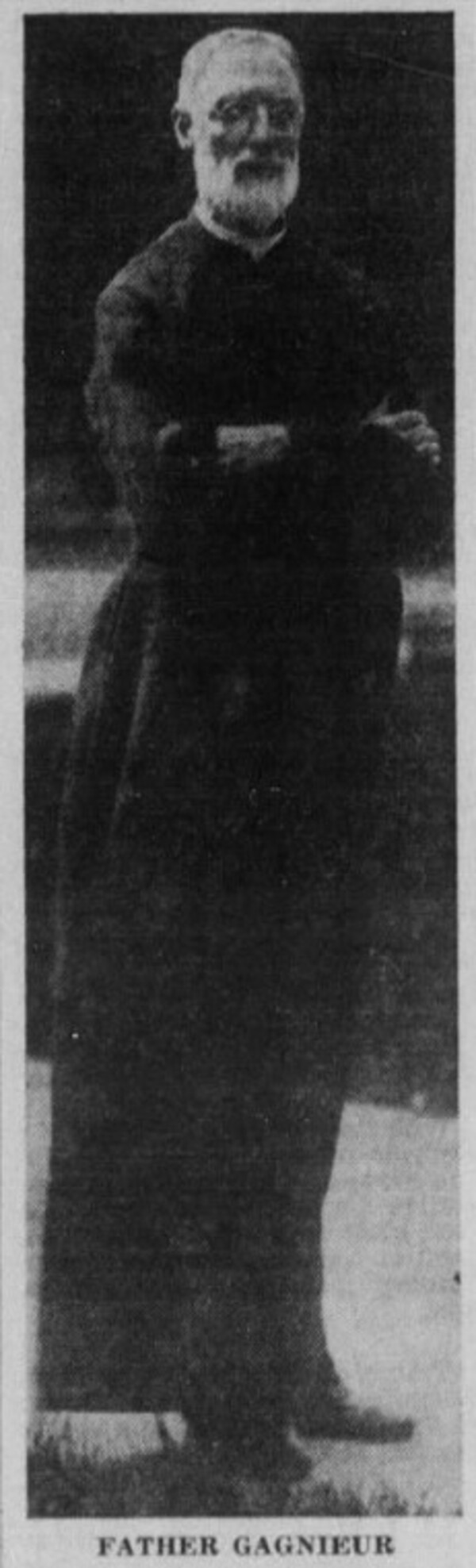
A frail and snowy-haired figure in his later years, William Francis Gagnieur was held in high esteem in Michigan and was an honorary member of the Michigan Pioneer and Historical Society. He was adopted by the Chippewa, who called him Pekinawgay, meaning “winner.” In July 1934, to mark the tercentenary of explorer Jean Nicollet* de Belleborne’s arrival in the area, Gagnieur led an outdoor mass attended by thousands. In its coverage of the service the Detroit Free Press hailed him as the “last of the Black Robes.” In April 1936 a three-day observance was held in Sault Ste Marie to mark the 50th anniversary of his ordination. Upon his death on 7 Feb. 1937 after a long illness, the local Evening News praised his “life of service, self-sacrifice and single-purpose devotion to God.” Two years earlier the Indigenous priest Philip Gordon had offered this tribute: “To you, Pekinawgay, I shall always turn when the going is toughest. I shall always remember what you did for my people.” Gagnieur’s legacy, in addition to nearly five decades of missionary work, includes his contribution to the understanding of the Ojibwa language.
William Francis Gagnieur is the author of “Indian place names in the Upper Peninsula, and their interpretation,” Michigan Hist. Magazine (Lansing, Mich.), 2 (1918): 526–55, and “Some place names in the Upper Peninsula of Michigan and elsewhere,” Michigan Hist. Magazine, 3 (1919): 412–19. He also wrote at least two unpublished works: a 1933 paper, “The Ojibway language, or, a glimpse at some peculiarities of the Algic dialects,” which is held in the Univ. of Mich. Library in Ann Arbor; and an undated manuscript, “Life and labors of Right Rev. Frederick Baraga,” which is located in the Jesuit Arch. & Research Center (St Louis, Mo.), Missouri Province personnel files, box 5.0043, W. J. Gagnieur folder.
FamilySearch, “Canada, Ontario, deaths, 1869–1937 and overseas deaths, 1939–1947,” Wm. F. Gagnieur, Sault Ste Marie, 7 Feb. 1937. Arch. of the Jesuits in Can. (Montreal), BO-0236 (William Francis Gagnieur fonds). Arch. of the Roman Catholic Diocese of Thunder Bay, Ont., 50.1 (Father William Maurice, s.j. fonds), North Lake Superior missions, vol.29, files 21–25 and vol.52, file 17, “Jesuit missions,” April 1932, 93. Detroit Free Press, 2 July 1934, 9 Feb. 1937. Evening News (Sault Ste Marie, Mich.), 8, 9, 10, 11, 12 Feb. 1937. State Journal (Lansing), 11 May 1936. Dictionary of Jesuit biography: ministry to English Canada, 1842–1987 (Toronto, 1991). R. H. Piovesana, Hope and charity: an illustrated history of the Roman Catholic diocese of Thunder Bay (Thunder Bay, 2002).
Image Gallery

Cite This Article
Roy H. Piovesana, “GAGNIEUR, WILLIAM FRANCIS,” in Dictionary of Canadian Biography, vol. 16, University of Toronto/Université Laval, 2003–, accessed April 28, 2026, https://www.biographi.ca/en/bio/gagnieur_william_francis_16E.html.
The citation above shows the format for footnotes and endnotes according to the Chicago manual of style (16th edition). Information to be used in other citation formats:
| Permalink: | https://www.biographi.ca/en/bio/gagnieur_william_francis_16E.html |
| Author of Article: | Roy H. Piovesana |
| Title of Article: | GAGNIEUR, WILLIAM FRANCIS |
| Publication Name: | Dictionary of Canadian Biography, vol. 16 |
| Publisher: | University of Toronto/Université Laval |
| Year of publication: | 2026 |
| Year of revision: | 2026 |
| Access Date: | April 28, 2026 |