

Source: Link
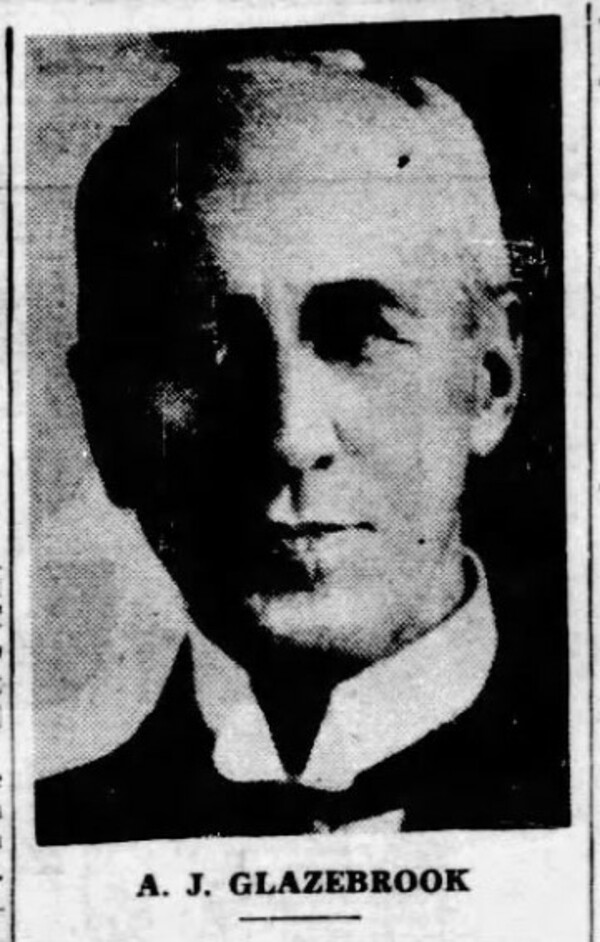
GLAZEBROOK, ARTHUR JAMES, banker, stock-exchange broker, educator, and imperialist; b. 2 Aug. 1861 in Kensington (London), England, youngest of the five children of Michael George Glazebrook and Margaret Elizabeth Tapson; m. 7 Nov. 1889 Lucy Jane Maclauchlan (d. 1961) in Saint John, and they had one son and two daughters; d. 28 Nov. 1940 in Toronto.
Though the roots of the Glazebrook family were in Lancashire, Arthur James Glazebrook was born in Kensington and his father was a wine merchant in Hampstead (London). Arthur was the youngest of three sons: the eldest, Michael George Jr, would become headmaster of Clifton College in Bristol and a canon of Ely Cathedral, and Hugh de Twenebrokes would gain fame as a portrait painter. In 1875 Arthur was enrolled in Haileybury College, located close to Hertford, but his studies were interrupted when, following a setback in his father’s finances, the family emigrated to Canada. Settling in Ontario, the Glazebrooks farmed first near Cooksville (Mississauga) and then near Thorold. By 1881 they had returned to England, where Arthur was soon employed at the London and County Bank. Of his family members, he alone yearned to make Canada his permanent home, and in 1883 he secured employment at the Bank of British North America. After a brief posting to New York City, he would spend the rest of his life in the dominion, where, according to his obituary in the journal Round Table, he remained distinctly English, never acquiring a trace of a Canadian accent.
Glazebrook spent 17 years working for the Bank of British North America, with successive stints in Saint John, Halifax, Montreal, Toronto, and London, Ont. During his time in Saint John, he met and married Lucy Maclauchlan, a native of Edmundston. In 1900, while in London, he was afflicted with a debilitating case of writer’s cramp, which necessitated his early retirement from the bank. That year he established an exchange-brokerage firm in Toronto, and in 1907 he took on Benjamin Hudson Cronyn as a partner. Glazebrook had a private wire to brokers in New York, and supplied Toronto banks with continuous information on exchange rates to which the banks did not otherwise have access. As well, he regularly posted exchange information in Toronto newspapers. Having secured the confidence of bank managers, he also carried out currency transactions. Glazebrook provided a unique and much-needed service to the Toronto financial market, and his diligence, reliability, and forthrightness justly earned him a reputation as a valuable partner in financial dealings and currency exchange.
An enthusiastic supporter of the British empire, Glazebrook assumed a leading role in promoting the ideals of imperial cooperation in the years before the First World War. He corresponded regularly with the British statesman Lord Milner, who was a close friend of Glazebrook’s eldest brother Michael. When Milner visited Canada in 1908, Glazebrook helped organize his itinerary and arranged letters of introduction to managers at the Canadian Bank of Commerce. Glazebrook felt that the tour had been “an absolute success,” as he put it in a letter to British publicist Richard Jebb, and he soon formed a club in Toronto to discuss Canadian and imperial affairs.
After the Round Table movement was founded in 1909, Glazebrook became one of its leading promoters in Canada. The Toronto club, which included historian Edward Joseph Kylie* and journalist John Stephen Willison*, attached itself to the movement following a 1911 visit to the dominion by the British writer Lionel George Curtis, and Glazebrook frequently contributed unsigned articles on Canadian and financial matters to the Round Table journal. Like many Canadian members, Glazebrook recognized the growth of nationalism in the dominion and believed it to be compatible with imperial cooperation. However, he opposed the establishment of an imperial parliament in London composed of representatives from all of the empire’s constituent parts. Curtis favoured this idea, as did supporters of the Imperial Federation League, such as George Taylor Denison*, but Glazebrook believed that any institution with a rigid, highly centralized structure would be unworkable and would stifle the views of the dominions.
During the First World War Glazebrook remained active in imperialist circles and sat on a committee of citizens, chaired by Sir Byron Edmund Walker*, that called in 1917 for an imperial conference on the organization of the empire. In an article published that year in The new era in Canada – an edited collection that featured contributions from, among others, John Wesley Dafoe*, Stephen Butler Leacock*, and Willison – Glazebrook wrote critically of the empire: “It is in reality an extraordinary combination of extreme centralization with an almost anarchic lack of co-ordination. The control of the foreign policy of the Empire … is in fact almost in the hands of two people, namely, the Prime Minister and the Secretary for Foreign Affairs in the British Cabinet.” To help remedy this undesirable concentration of power, Glazebrook did not offer any specific proposals, but he emphasized the importance of gradual change rather than the immediate creation of new structures of imperial governance. His hopes soon faded: three weeks after the armistice, he concluded in a letter to Lord Milner that the war had made “not more possible but less possible any scheme of organic union for the British Empire.”
After the war the Round Table movement declined in Canada and Glazebrook`s primary focus shifted to education, a subject in which he was keenly interested. He believed that better public understanding of foreign affairs was an essential precursor to the successful reorganization of the empire. In 1918 he was a founder, along with college principal William Lawson Grant, of the Workers’ Educational Association (WEA), a Toronto-area group that provided classes for working-class adults on topics such as economics, politics, and history. Glazebrook taught classes on finance and appealed to the Ontario government for funds for the WEA. He hoped that the association, building on links with WEAs in Great Britain and Australia, would offer classes with imperialist undertones. In 1919 he established the Bankers’ Educational Association, which provided lectures to bank employees. Finally, in 1925, Glazebrook would be appointed special lecturer in banking and finance in the University of Toronto’s department of political economy. His classes were popular among students, and he was happy to introduce his academic colleagues to the many contacts he had in the financial world.
By the 1920s the demand for Arthur James Glazebrook’s services as an exchange broker had begun to decline because Toronto banks had secured their own direct lines to New York. His partner, Benjamin Cronyn, died in 1932, and Glazebrook wound up the business two years later. He nevertheless remained a prominent figure in financial circles, and his views on contemporary affairs were frequently canvassed by his peers. In 1925 he declared that Canadian banks were strong and that there was no need for a central bank, and in 1933, testifying before the royal commission on banking and currency, he took an orthodox approach to combating the Great Depression, arguing that Canada should return to the gold standard. In 1935, however, he declared his support for the New Deal proposals of Prime Minister Richard Bedford Bennett*.
In 1934 Arthur James Glazebrook suffered a serious accident in London that left him largely paralysed, and in 1937 he was forced to give up his lectureship at the University of Toronto. He spent his final years at his Toronto home, where he died in 1940. Glazebrook was remembered by the Globe and Mail as “a man of singular personal charm and a brilliant conversationalist” who had “exercised a remarkable influence for good upon a wide circle of young men, who loved him and revered him as a model of intelligent public spirit.” The Times of London noted that he had left behind “an abiding memory of a singularly sweet and gifted character.” One of his two daughters, Marjorie French, married Ralph Wilfred Hodder-Williams of the English publishing company Hodder and Stoughton. Glazebrook’s son, George Parkin de Twenebrokes, became a University of Toronto professor who published widely on Canadian history.
Arthur James Glazebrook is the author of “Our future in the empire: central authority,” in The new era in Canada: essays dealing with the upbuilding of the Canadian commonwealth, ed. J. O. Miller (London and Toronto, 1917), 263–75; and “The economic development of Canada, 1867–1921: (I) Finance and banking,” in The Cambridge history of the British empire, ed. J. H. Rose et al. (8v. in 9, New York and Cambridge, Eng., 1929–59), 6: 625–41. The Arthur James Glazebrook fonds at LAC (R1613-0-5) includes correspondence with Lord Grey and Lord Milner and memoranda on international finance, and the Lord Milner papers at the Bodleian Library, Univ. of Oxford, Eng. (GB 161 MSS. Milner dep. 1–698, MS. Milner dep. adds. 1) contain letters between Milner and members of the Glazebrook family.
Globe, 16 Aug. 1901, 14 Nov. 1919, 5 March 1920, 29 Oct. 1923, 1 July 1925, 18 April 1932. Globe and Mail, 29 Nov. 1940, 29 Dec. 1961. Times (London), 30 Nov. 1940. Toronto Daily Star, 10 Feb. 1917; 5 March, 14 Dec. 1920; 4 Nov. 1922; 26 Jan. 1925; 8 Sept. 1933; 7 Jan. 1935. Armorial families: a directory of gentlemen of coat-armour, comp. A. C. Fox-Davies (5th ed., Edinburgh, 1905). “Arthur James Glazebrook,” Round Table (London), 31 (1940–41): 340–47. “Glazebrook, Michael George,” ODNB. H. A. I., “Obituary: Arthur James Glazebrook,” Canadian Journal of Economics and Political Science (Toronto), 7 (1941): 92–94. Haileybury register, 1862–1891, ed. L. S. Milford (2nd ed., Hertford, Eng., 1891). J. E. Kendle, The Round Table movement and imperial union (Toronto and Buffalo, N.Y., 1975). Ian Radforth and Joan Sangster, “‘A link between labour and learning’: the Workers Educational Association in Ontario, 1917–1951,” Labour (St John’s), 8/9 (1981–82): 41–78. J. L. Thompson, A wider patriotism: Alfred Milner and the British empire (London and New York, 2007).
Image Gallery

Cite This Article
Wesley Ferris, “GLAZEBROOK, ARTHUR JAMES,” in Dictionary of Canadian Biography, vol. 16, University of Toronto/Université Laval, 2003–, accessed May 9, 2026, https://www.biographi.ca/en/bio/glazebrook_arthur_james_16E.html.
The citation above shows the format for footnotes and endnotes according to the Chicago manual of style (16th edition). Information to be used in other citation formats:
| Permalink: | https://www.biographi.ca/en/bio/glazebrook_arthur_james_16E.html |
| Author of Article: | Wesley Ferris |
| Title of Article: | GLAZEBROOK, ARTHUR JAMES |
| Publication Name: | Dictionary of Canadian Biography, vol. 16 |
| Publisher: | University of Toronto/Université Laval |
| Year of publication: | 2026 |
| Year of revision: | 2026 |
| Access Date: | May 9, 2026 |