

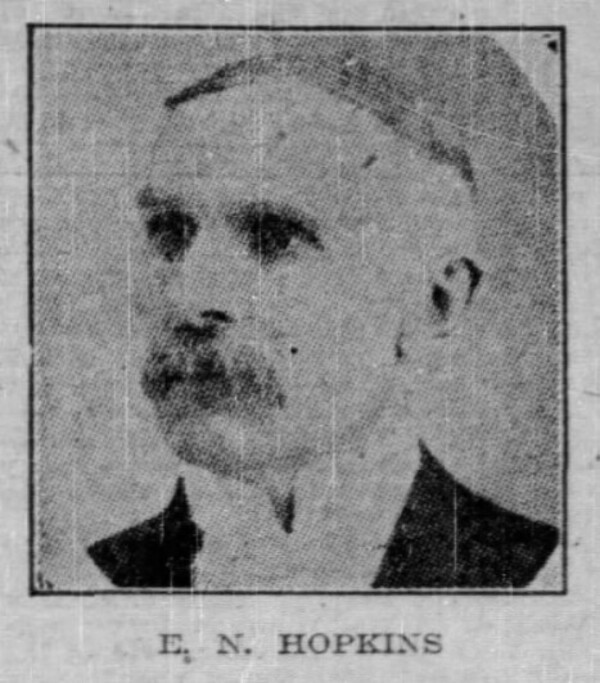
Source: Link
HOPKINS, EDWARD NICHOLAS, farmer, cheese manufacturer, and politician; b. 3 Oct. 1854 in Brownsville, Upper Canada, third child of Benjamin Hopkins and Margaret Loucks; m. 2 Jan. 1890 Minnie Latham in Moose Jaw (Sask.), and they had two sons, one of whom predeceased him, and one daughter; d. there 14 July 1935.
The story of Edward Nicholas Hopkins is intertwined with the early history and business growth of the city of Moose Jaw and with western Canadian agriculture. Hopkins was born in Upper Canada to an Irish father and United Empire Loyalist mother, and as he grew up he helped out on the family farm. Educated locally in Oxford County schools and the London Commercial College, he and his elder brother, James Edwin, learned the craft of cheese making. Edward then worked as a cheese maker at the factory at Bayham (1866–68) and later as manager of several other Ontario-based cheese factories.
In 1882 Hopkins moved west in company with his brother-in-law, Robert Key Thomson. No doubt drawn by the western boom created by the Canadian Pacific Railway, he nonetheless arrived in the North-West Territories before the tracks were laid, driving overland through flood-waters from Brandon, Man., to the Boharm district (Sask.). There he settled just outside the proposed townsite of Moose Jaw and began farming. In 1886 Thomson and Hopkins set up a cheese-making factory, one of the first in western Canada. A reporter from the Regina Leader visited that fall: “I drove out to see the Eureka Farm cheese factory. It is about six miles west of Moose Jaw, and there for the first time I saw cheese manufactured.” Milk came from 30 milch cows owned by the farm – an early example of on-farm commercial production and manufacturing in western Canada.
Hopkins’s commercial cheese interests led to his involvement with the Dairymen’s Association of the North-West Territories, formed in 1892. Alexander Gillan Thorburn* was the first president; Hopkins was selected as vice-president and would become president in 1896 when the association was reorganized after a plan was developed to secure government assistance for western creameries. There were two competing schemes. One, backed by Senator William Dell Perley, would have had the federal government establish creameries under the supervision of James Wilson Robertson*, the dominion commissioner of agriculture and dairying. Hopkins and his associates John Hawkes and William Watson supported an alternative, which called for the backing of the territorial government. A modified version of the dominion plan eventually won out, but it proved less successful than had been hoped. Ultimately, Hopkins and his contemporaries realized that cheese, a staple product in Ontario, was less cost-effective in western Canada owing to the distance it had to be shipped to reach markets and the cost of freight, and because cows did not give milk throughout an entire year. Manufacturing cheese was also less profitable than growing wheat, and the dairy industry soon turned to making butter to maximize its investment.
As his business prospered, Hopkins engaged in local and regional politics. He helped organize the Local Improvement District (a forerunner to the Saskatchewan Association of Rural Municipalities, which was chiefly in charge of road construction); as well, he chaired the Interprovincial Council of Farmers’ Associations and was president of both the Moose Jaw Agricultural Society and the board of the General Hospital. He was also the first secretary of the local Board of Trade and a founding member of the Moose Jaw Boys’ College. According to Hawkes, Hopkins developed “extensive property interests,” which contributed to the family’s wealth. In 1905 he and his wife, Minnie, built a beautiful Classical Revival house at 65 Athabasca Street West.
As a leading farmer in what would soon be the new province of Saskatchewan, Hopkins joined one of Canada’s largest mass agrarian movements: the Territorial Grain Growers’ Association. It was established in 1902 and became the Saskatchewan Grain Growers’ Association in 1906. Historian Brett Fairbairn describes the SGGA as “the most important interest, lobby, and policy group in the province” at the time. Hopkins was elected president early in the association’s history and worked with men such as Frederick William Green* and Edward Alexander Partridge to address farmers’ concerns, particularly the questions of grain elevators and shipment to eastern markets. A 1909 speech he delivered during his presidency, and described in the Grain Growers’ Guide, called for “self-reliant, serious study” of agriculture and policy, including the establishment of a “corps of experts” with a “broad-minded, big-hearted way of looking at things,” as the best way to draw Saskatchewan forward. Like Premier Thomas Walter Scott and others, Hopkins was certain that the province’s future was bright and it depended on agriculture. Always a businessman, he declared at the opening of a local flour mill that grain should be “converted into the finished article at our very doors” so that “no other country would receive the manufacturing gain that is rightfully ours.” His plain-spoken manner made him a popular speaker known, as the Manitoba Free Press reported in 1915, for his “good old fashioned agricultural” common sense. A year into the Great War he declared, characteristically, that “a man’s first duty is his wife and family, then his creditors, then to the country.”
Hopkins was elected honorary president of the Saskatchewan grain growers at the end of his term. In this capacity he was appointed to a royal commission investigating agricultural production in Canada (sometimes referred to as the Natural Resources Commission). Chaired by mp James Alexander Lougheed*, it was one of several such bodies established during the war, and by 1916 it had become the Economic and Development Commission, which laid out ideas on immigration, colonization, and soldier land settlement.
In April 1923 Hopkins ran in the Moose Jaw County constituency in the federal by-election, winning on the Progressive ticket; 63 other members of the party, then under the leadership of Robert Forke, joined him in Ottawa after the general election in June. John Hawkes wrote in 1924 that Hopkins believed “in taking into politics and government the same open-minded willingness to adopt new methods that will promote efficiency that he has shown in the operation of his farm.” He used his political influence to safeguard the interest of western farmers. Although urbanization was increasing, Hopkins maintained that on the prairies “the interest of the city is so connected with that of the farmer that they cannot be divided.”
Hopkins was particularly critical of post-war reconstruction efforts and their impact on farmers, especially the centralization of business and politics. “In my opinion,” he declared in the House of Commons, “we have not started re-construction yet.” Western Canadians faced “strenuous days,” and the only way to address past grievances was to lay a new foundation. He made his position clear: “Everything that is possible to centralize in Montreal, is centralized there; if it slips by Montreal it is stopped at Toronto; if it slips by Toronto it goes to Winnipeg.” Westerners did not “believe in centralization.” Hopkins supported alternatives, such as cooperative marketing efforts, to “raise the selling price of our products.” Reducing the tariff would also help produce cheaper goods, but decreases were “not enough. The problem of the farmer,” he stressed, was to find new ways “to get a remunerative price for his products.”
Hopkins served until 1925, when he was defeated by Liberal John Gordon Ross. He remained active in Moose Jaw by working for the Wild Animal Park Society, which he opened in 1929. He was a Methodist and, after 1925, a member of the United Church of Canada [see Samuel Dwight Chown; Clarence Dunlop Mackinnon]. Hopkins died on 14 July 1935 in Moose Jaw, joining in death his elder son, James Erle, who had drowned in 1907.
Edward Hopkins was representative of the first settlers in western Canada who were lured by the promise of a new beginning in a land of opportunity. He quickly learned through personal experience in several business ventures and local and provincial community service that agriculturalists had to work together if they were to meet the challenges of marketing their products for a fair return. This cooperative spirit eventually led Hopkins to try to bring about change through political engagement. He had great faith in Saskatchewan’s future and worked tirelessly to ensure that the province’s potential – as the wheat province – was realized.
The Edward Nicholas Hopkins residence was later refurbished as a restaurant. It is supposed that Minnie Hopkins haunts her former home and, as a result, the Hopkins Dining Parlour is often included as a famous Saskatchewan and Canadian haunted house in publications and media productions, among them Sheila Hervey’s book Canada ghost to ghost (Toronto, 1996) and the Canadian television series Creepy Canada, which was aired by OLN from 2002 to 2006.
AO, RG 80-2-0-189, no.037224. eHealth Saskatchewan, “Genealogy index,” James Erle [Earle] Hopkins, birth registration, 1891. LAC, “Land grants of western Canada, 1870–1930,” Edward N. Hopkins and Robert K. Thomson; R233-30-3-E, vols.271–462, Can. West (Ont.), dist. Oxford, subdist. Dereham: 108; R233-34-0-E, Ont., dist. Oxford South (13), subdist. Dereham (A), div. 2: 21; R233-35-2-E, Ont., dist. Oxford South (165), subdist. Dereham (A), div. 4: 47; R233-36-4-E, Northwest Territories, dist. Assiniboia West (199), subdist. Moose Jaw and Regina (C), div. 6: 8. Sask. Arch. Information Network Coll., “MJ-18 – Moose Jaw General Hospital fonds” [finding aid]. Grain Growers’ Guide (Winnipeg), 7 Aug. 1907, 7 Aug. 1909, 30 Nov. 1910, 20 Oct. 1915. Lethbridge Herald (Lethbridge, Alta), 15 July 1935. Manitoba Free Press, 10 Feb. 1915. Moose Jaw Herald Times (Moose Jaw, [Sask.]), 24 Jan. 1890. Ottawa Evening Journal, 11 April 1923. Times-Herald (Moose Jaw), 10 June 1933, 14 July 1935. Winnipeg Tribune, 21 Feb., 26 June 1907; 20 Feb. 1909; 10 March, 5, 11 April 1923. Can., Economic and development commission, Draft interim reports (Ottawa, 1916). G. C. Church, An unfailing faith: a history of the Saskatchewan dairy industry (Regina, 1985). Brett Fairbairn, “Canada’s ‘co-operative province’: individualism and mutualism in a settler society, 1905–2005,” in Perspectives of Saskatchewan, ed. J. M. Porter (Winnipeg, 2009), 149–73. John Hawkes, “Edward Nicholas Hopkins,” in his Story of Saskatchewan and its people (3v., Regina, 1924), 3: 1591–93. Lipad – Linked Parliamentary Data, “Transcripts of parliamentary debates,” Edward Nicholas Hopkins, 21 May 1923, 10 April 1924, 5 May 1925. Ont., Dept. of Agriculture, Annual report, 1891 (Toronto), 1892. Pioneers and prominent people of Saskatchewan (Winnipeg and Toronto, 1924). Who’s who in western Canada … (Vancouver), 1911.
Image Gallery


Cite This Article
Merle Massie, “HOPKINS, EDWARD NICHOLAS,” in Dictionary of Canadian Biography, vol. 16, University of Toronto/Université Laval, 2003–, accessed May 10, 2026, https://www.biographi.ca/en/bio/hopkins_edward_nicholas_16E.html.
The citation above shows the format for footnotes and endnotes according to the Chicago manual of style (16th edition). Information to be used in other citation formats:
| Permalink: | https://www.biographi.ca/en/bio/hopkins_edward_nicholas_16E.html |
| Author of Article: | Merle Massie |
| Title of Article: | HOPKINS, EDWARD NICHOLAS |
| Publication Name: | Dictionary of Canadian Biography, vol. 16 |
| Publisher: | University of Toronto/Université Laval |
| Year of publication: | 2026 |
| Year of revision: | 2026 |
| Access Date: | May 10, 2026 |