

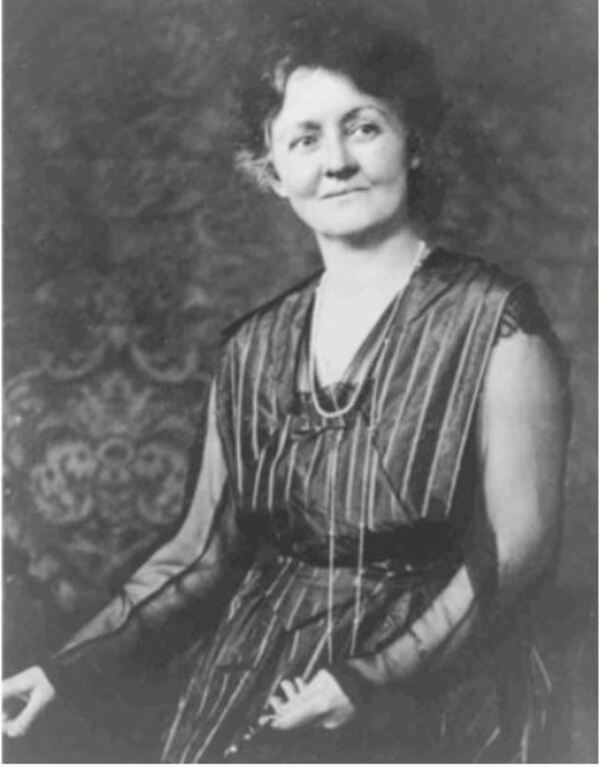
Source: Link
MacMURCHY, MARJORY JARDINE RAMSAY (Willison, Lady Willison), author, journalist, and social reformer; b. April 1870 in Toronto, daughter of Archibald MacMurchy and Marjory Jardine Ramsay; m. there 10 April 1926 Sir John Stephen Willison*; they had no children; d. there 15 Dec. 1938.
Marjory Jardine Ramsay MacMurchy was among the most respected Canadian female journalists of the early 20th century. She grew up in an intellectual household, the youngest of three girls and three boys. Her father, who in 1840 had come with his Presbyterian family to Upper Canada from Argyll, Scotland, was a prominent educator. During his 28 years as principal of the Toronto (later Jarvis Street) Collegiate Institute, it became known for high academic standards. He was also an author and editor. Her mother, who was involved in the Woman’s Foreign Missionary Society [see Marjory Laing*], died when Marjory was in her late teens. Marjory had attended her father’s collegiate, and between 1892 and 1894 she took classes at the University of Toronto.
MacMurchy began writing in 1888 for her own amusement. She may have been inspired by Sara Jeannette Duncan*, who had started contributing a column to the Globe in 1885. MacMurchy’s first published story, “The spirits of the hearth fires,” appeared in the 1891 Christmas edition of the Dominion Illustrated (Montreal). More short stories, essays, book reviews, and profiles of literary figures followed in the pages of, among others, Harper’s Bazaar (New York) and Toronto periodicals such as Canadian Bookman, Canadian Magazine, Grip, and Saturday Night; in the last two she used the pseudonym Penny. In 1903 she began full-time newspaper work in Toronto at the Evening News, which was run by John Stephen Willison, one of the most influential English-speaking journalists in the country. MacMurchy was soon appointed the literary editor of the Evening News and enjoyed growing renown. In 1911 she was sent to London to cover the coronation of King George V. The paper folded in 1917. From 1921 to 1922 she contributed a weekly column to the Mail and Empire called “Politics for women,” which drew a large readership.
In 1909 MacMurchy had been named the founding president, and her friend Jean Graham vice-president, of the Toronto branch of the five-year-old Canadian Women’s Press Club (CWPC) [see Catherine Ferguson*; Katherine Angelina Hughes*]. When MacMurchy’s group hosted the annual meeting of the CWPC a few months later, she was elected its president as well. She served until 1913 and would continue as honorary president until 1920. That year she was invited to represent the CWPC at the Imperial Press Conference, which held meetings across the country. In Montreal, Baron Atholstan [Graham] welcomed more than 100 participants to Canada from all parts of the British empire. The other female delegate was Mary Frances Billington of the London Daily Telegraph, who attended on behalf of the British Society of Women Journalists.
Since 1903, when she entered journalism full time, MacMurchy’s byline had appeared with increasing frequency on articles that covered a wide range of topics. She was also regularly mentioned in newspaper accounts of social and cultural events, including the activities of the Heliconian Club, a women’s arts and letters organization on whose executive she sat. She is credited with ushering Lucy Maud Macdonald [Montgomery*] into Toronto literary circles after the author and her husband moved to Ontario in 1911. MacMurchy had first met L. M. Montgomery (as she was known professionally) through the Atlantic region’s CWPC. She hosted teas and arranged talks, introducing the creator of Anne of Green Gables (Boston, 1908) to the city’s elite. Among them were MacMurchy’s lawyer brother Angus and the three unmarried siblings with whom she lived in the upper-class Rosedale neighbourhood: John Campbell, also a lawyer (brother Dugald James had died in 1891), Bessie, who was prominent in the work of foreign missions, and Helen*, a distinguished physician. According to scholar Mary Henley Rubio, Helen was likely the model for the “woman-doctor” in Montgomery’s novel Magic for Marigold (Toronto, 1929).
In 1914 Marjory MacMurchy began examining economic and social issues in syndicated articles on topics such as the education of girls, the cost of living, and the future of domestic workers. This involvement led to roles outside journalism: she was appointed assistant secretary for the Ontario commission on unemployment, 1914–16, which Premier William Howard Hearst* had asked Willison to chair, and she headed the women’s department of the Canadian Reconstruction Association, which was set up by business leaders in 1918 and also overseen by Willison. Under her direction the department released a series of booklets on how women could contribute to peacetime activities and new developments in the country, and how their economic welfare could be improved. In Women and reconstruction she wrote: “It is a natural conviction that enfranchised Canadian women will apply themselves intelligently and with energy to the basic economic problems of national existence.… The co-operation of Canadian women in industrial life and reconstruction is indispensable.”
Her wry sense of humour is evident in the title of her 1916 publication The woman – bless her: not as amiable a book as it sounds, in which she examined the rise of national women’s organizations. She praised them but also criticized the fact that decision making was often centralized in Ontario, leadership tended to be autocratic, and most members were middle-aged homemakers who accounted for only a fraction of the adult women in Canada. Three years later, in the Canadian Reconstruction Association booklet Women of to-day and to-morrow, she acknowledged that the conditions imposed by the First World War had “greatly strengthened” women’s organizations but insisted that their ideals needed to be scrutinized to reveal their purposes. Also in 1919, The Canadian girl at work: a book of vocational guidance was published by the Ontario Department of Education for use in school libraries. MacMurchy’s intention was to “assist girls in finding satisfactory employment” and to detail “what constitutes a right attitude toward work and toward life through work.” She called for more training, not only for pursuing trades outside the home but also for running a household and raising children, and she envisioned a future in which working men and women could be co-partners in “laying the foundations of a new earth.”
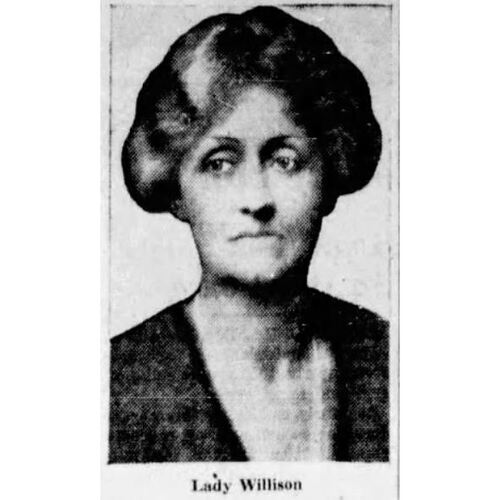
In 1925 MacMurchy and Willison launched Willisons Monthly (Toronto), whose masthead announced it as “a national magazine devoted to the discussion of public affairs affecting Canada and the Empire.” Willison’s wife died that same year. In 1926, at age 56, MacMurchy became his second wife, but their marriage was brief: Willison succumbed to cancer 13 months later. Over the next decade Lady Willison, as she was now known (her husband had been knighted in 1913), wrote three books: a guide to children’s reading; a tribute to the city of Victoria; and, the year before her death, an anthology of stories for young girls, The longest way round. Montgomery confided in her journal that she found it “a terribly commonplace production” compared with MacMurchy’s “cleverly written” 1923 collection The child’s house. When asked to review it, she felt obliged to accept because MacMurchy had always critiqued her work “so kindly – but I hate to, because I shall have to say insincere things.”
At age 68, after an illness of a few weeks, Lady Willison suffered a cerebral haemorrhage at home. She was buried in Toronto’s Mount Pleasant Cemetery following a private funeral.
Like many women who carved out a career in journalism in the early 20th century, Marjory MacMurchy adopted the role of educator for her female readers. Paradoxically, those who addressed domestic matters in print often had little personal experience in the realm. MacMurchy, for instance, was unmarried until later in life, had no children, and likely did not consider herself a homemaker. Yet she provided guidance on all these subjects, and she was able to break through some of the boundaries that confined her colleagues. Addressing publishers at a Canadian Press Association meeting in 1910, she made it clear that “the conduct of a social page, a beauty department or a section on home adornment did not exhaust the possibilities of a newspaper woman.” She worked for social reform, especially on behalf of women, and explored a range of possibilities as a writer. A member of the Canadian Authors Association, she was also an early affiliate of PEN, the worldwide society of poets, essayists, and novelists, which was founded in 1921.
No birth registration for Marjory Jardine Ramsay MacMurchy has been located. At the time of the 1871 census, taken that April, she was one year old. In the 1911 census the birth month was recorded.
Marjory Jardine Ramsay MacMurchy left no diaries or personal papers, but some of her correspondence survives among the papers of the Canadian Author Assoc. at LAC.
MacMurchy’s series on the coronation of King George V, titled “The king’s crowning,” was published in the 1911 annual report of Ontario’s Women’s Institutes. She is the author of The woman – bless her: not as amiable a book as it sounds (Toronto, 1916) and The Canadian girl at work: a book of vocational guidance (Toronto, 1919). Her booklets for the women’s department of the Canadian Reconstruction Assoc., all published in Toronto, are Women and reconstruction (1918), What shall I do now?: how to work for Canada in peace (1919), Better houses for Canadians (1919), A unity programme for Canadian women (1919), and Women of to-day and to-morrow ([1919]; the latter was first published in Canadian Magazine, 53 (May–October 1919): 155–60. In addition, she authored two children’s novels – The child’s house … (London, 1923) and The longest way round (Toronto, 1937) – and she published Golden treasury of famous books … (Toronto, 1929). She also wrote Victoria, B.C., city of enchantment in Canada’s evergreen playground (Victoria, 1933). MacMurchy contributed many articles to Toronto’s Evening News between 1903 and 1917. Her short stories, reviews, profiles, and features were published in several periodicals starting as early as 1891; besides those listed in the biography, they include Canada: a Monthly Journal of Religion, Patriotism, Science & Literature (Benton, N.B.), Canadian Courier (Toronto), Canadian Home Journal (Toronto), Globe (Christmas editions), Life and Work (Edinburgh), Montreal Witness, Queen’s Quarterly (Kingston, Ont.), Rev. of Hist. Publications Relating to Canada (Toronto), Short Stories (New York), Times (London), University Magazine (Montreal), and Willisons Monthly (Toronto). Her review of Sir John Stephen Willison’s book Reminiscences, political and personal (Toronto, 1919) appeared in Canadian Magazine, 54 (November 1919–April 1920): 271–72, and her article “Journalism and literature, books of the year by Canadian women” was included in the 1915 Canadian woman’s annual and social service directory, ed. E. P. Weaver et al. (Toronto).
LAC, MG28-I2 (Canadian Authors Assoc., corr.), vol.2, Willison, Lady Marjory; R233-34-0, Ont., dist. Toronto East (47), subdist. St Davids Ward (C): 23; R233-177-0, Ont., dist. Toronto North (126), subdist. Ward 3 (84): 6. Globe, 29 April 1912; 12, 13 April 1926. Toronto Sunday World, 21 March 1915. A. D. Brodie, “Canadian short-story writers,” Canadian Magazine, 4 (November 1894–April 1895): 334–44. Canadian men and women of the time (Morgan; 1912). Robert Donald, The Imperial Press Conference in Canada (London and Toronto, [1920?]), 108. M. L. Lang, Women who made the news: female journalists in Canada, 1880–1945 (Montreal and Kingston, 1999). Literary history of Canada: Canadian literature in English, ed. C. F. Klinck et al. (2nd ed., 4v., Toronto, 1976–1990), 2. L. M. Montgomery, The selected journals of L. M. Montgomery, ed. M. H. Rubio and E. H. Waterston (5v., Toronto, 1985–2004), 5 (1935–1942, 2004), 208–9. Kay Rex, No daughter of mine: the women and history of the Canadian Women’s Press Club, 1904–1971 (Toronto, 1995). P. J. Robinson, “Dr. Archibald MacMurchy: a sketch,” in J. E. Middleton et al., The municipality of Toronto: a history (3v., Toronto and New York, 1923), 1: 549–52. M. H. Rubio, Lucy Maud Montgomery: the gift of wings ([Toronto], 2008).
Image Gallery


Cite This Article
Linda Kay, “MacMURCHY, MARJORY JARDINE RAMSAY (Willison, Lady Willison),” in Dictionary of Canadian Biography, vol. 16, University of Toronto/Université Laval, 2003–, accessed June 1, 2026, https://www.biographi.ca/en/bio/macmurchy_marjory_jardine_ramsay_16E.html.
The citation above shows the format for footnotes and endnotes according to the Chicago manual of style (16th edition). Information to be used in other citation formats:
| Permalink: | https://www.biographi.ca/en/bio/macmurchy_marjory_jardine_ramsay_16E.html |
| Author of Article: | Linda Kay |
| Title of Article: | MacMURCHY, MARJORY JARDINE RAMSAY (Willison, Lady Willison) |
| Publication Name: | Dictionary of Canadian Biography, vol. 16 |
| Publisher: | University of Toronto/Université Laval |
| Year of publication: | 2025 |
| Year of revision: | 2025 |
| Access Date: | June 1, 2026 |