

![Original title: Portrait of John Penman, [after 1931], D.A. Smith Photograph Collection, 1999.9113.01, Paris Museum and Historical Society via OurOntario.ca.](/bioimages/w600.25211.jpg "Portrait of John Penman, [after 1931], D.A. Smith Photograph Collection, 1999.9113.01, Paris Museum and Historical Society via OurOntario.ca.")
Source: Link
PENMAN, JOHN, textile and clothing manufacturer and philanthropist; b. 17 or 19 May 1845 or 1846 in New York City, son of Daniel Penman and Clementine (Clementina) Menzies; m. 9 Sept. 1890 Martha McVicar (1862–1934) in Brantford Township, Ont.; they had no children; d. 19 Oct. 1931 in Paris, Ont., and was buried in Brooklyn (New York City).
John Penman’s father, Daniel, was a graduate of the University of Glasgow. He emigrated from Scotland to New York City, where he taught mathematics and geography and married Clementine Menzies in 1843. In 1865 he moved his family to Woodstock, Upper Canada, and established a woollen factory and a small knitting mill. John, who had been educated at home, was responsible for running the latter. A lack of water power restricted expansion, so three years later Daniel purchased a sawmill in nearby Paris, next to the dam on the Nith River. John Penman and William E. Adams, a British immigrant with expertise in American-made power-knitting machines, set up a factory, but not long afterwards it was destroyed by fire. The partnership dissolved, and Adams joined James Henry Hackland in constructing another mill. In 1870 the Penmans built a large establishment to manufacture undergarments and hosiery, one of ten such businesses in Canada. In November that year Daniel wrote to a friend that despite setbacks “nothing can daunt my son, all misfortune has only tended to make him more determined.”
In January 1882, nine months after the death of his father, John incorporated the Penman Manufacturing Company Limited with a capitalization of $250,000. As president, Penman was the largest shareholder, with shares valued at $16,700. Other directors included David Morrice, a Montreal commission agent, and three Hamiltonians: Charles Edmund Newberry and the brothers Horace James and William Dubart Long. By 1883 Penman employed 400 of the 750 people working in Paris’s main knitting interests. Four years later he took over the mill run by Adams and Hackland, renaming it Penman’s No.2. He bought several additional sites along the Grand River, which prevented competitors from locating in Paris and allowed for future expansion. He set out to dominate the woollen industry in Canada, recapitalizing for $1 million in 1893. By amalgamating operations, usually through an exchange of shares with small-mill owners, he eliminated the possibility of their cutting prices, and thereby controlled sales. That year he purchased the Coaticook Knitting Company in Quebec, the Peninsula Knitting Mills in Thorold, Ont., and the Norfolk Knitting Mills in Port Dover. Five years later he would obtain the Watson Manufacturing Company and transfer its machinery from St Catharines to Paris. Acquisitions in nearby Dundas and in Saint-Hyacinthe, Que., followed in 1903. The former owners and managers often continued to run operations after acquisitions. The advantages of consolidation included increased bargaining power in purchasing raw materials and a more diversified product line for Morrice to offer to retailers. When demand slackened, Penman shut down the outlying mills for a period to maintain prices.
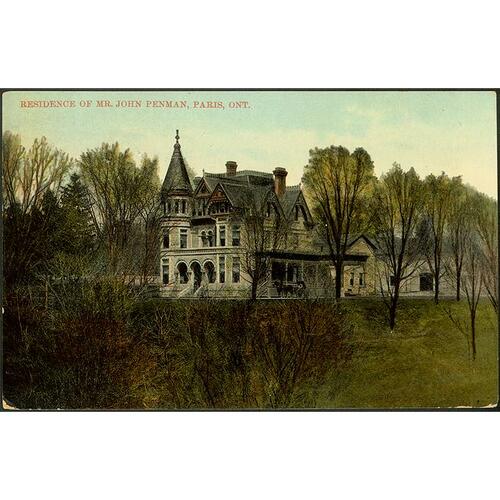
Penman had married Martha McVicar in 1890, and around that time he bought the stone mansion built by the founder of Paris, iron manufacturer Hiram Capron. The Penmans added Scottish Baronial embellishments, including a turret, and decorated the rooms in cheerful colours. Penmarvian, as they named it, was also home to Martha’s parents, one of her sisters, and her nephew Harold George Smith, whose mother had died shortly after childbirth. Smith had been raised in Brantford by his father and paternal grandparents; the Penmans, who had no children of their own, informally adopted him after he completed high school and paid for his further education. He apprenticed in his uncle’s mills.
Even during the difficult economic times of the 1890s, Penman Manufacturing, now the largest woollen knitter in the country, returned steady dividends. Production involved carding and spinning wool, often incorporating cotton, and then knitting undergarments, hosiery, sweaters, and blankets. The company was best known for its combinations – all-in-one winter underwear for men, women, and children. Boxcars were used to ship large quantities to lumber camps. Second in popularity was the brand made by the Truro Knitting Mills Company of Nova Scotia, headed by the Stanfield brothers, John and Frank.
Penman Manufacturing did not have a sales department. For a fee of four per cent, merchandising was handled by Morrice, who represented almost all Canadian textile manufacturers. His firm acted as an informal cartel, monitoring output and prices and selling to wholesalers, who in turn dealt with retailers. William Long headed the business that supplied raw wool, while another Penman director, Hamiltonian Peter Duncan Crerar of the Imperial Cotton Company, provided cotton. Throughout his career Penman made trips to the United States and Europe to keep abreast of trends and evolutions in equipment. He developed innovative machines for producing patterned sweaters and socks, and frequently took out patents in the United States and Canada.
Penman employed a small number of men as carders and supervisors, but most labourers were women because they were considered to be more dexterous at spinning, knitting, and sewing. They were recruited from area farms, but a chronic shortage of female workers in Paris constrained production. To address this problem, in 1902 Penman bought the American Plow Company and moved it to his town. By relocating the 50 male employees of the renamed Paris Plow Company, Penman could engage the women of their families in his mills. Sales of the farm implements were poor, however, and the parent company incurred increasing debt; both went bankrupt in 1906 and were taken over by the Sovereign Bank of Canada. The mills were sold to a syndicate formed by several directors of the Montreal-based Dominion Textile Company Limited, which had been founded the year before by David Yuile*. The enterprise was incorporated as Penmans Limited. Penman stayed on as president of Watson Manufacturing, its subsidiary, and maintained an office at Paris, but in November 1912 the Montreal directors asked him to resign.
The following year Penman and his nephew Harold Smith established Mercury Mills in Hamilton, the hub of Ontario’s primary cotton and knitwear industry. Mercury Mills, which produced underwear and hosiery, prospered thanks to Penman’s styling skills and Smith’s management abilities. Profits from a wartime surge in demand enabled them to erect in 1916 a state-of-the-art plant powered by electricity. The entrance was decorated with a 30-foot-high limestone carving of Mercury, the Roman god of commerce. With its two subsidiaries – Maitland Spinning Mills in Listowel and the Oxford Knitting Company in Woodstock – Mercury Mills employed more than 1,000 people, many recruited from England. In the 1920s Mercury Mills added silk and rayon underwear to its product line, as well as sweaters and sportswear.
Penman was described as “reserved” by his grand-nephew, Harold Penman Smith. He was always formally dressed, even at his summer home in Ontario’s Muskoka region. A devout Presbyterian, each morning he read scripture to the family and servants and led them in prayer. He served as an elder in the church for 26 years and contributed funds to its missions in China and India. Between 1897 and 1928 he sat on the local, national, and international committees of the Young Men’s Christian Association (YMCA), and he underwrote the construction of a YMCA facility in Hankou (Wuhan), China. Penman was also generous to the town of Paris, donating a YMCA building in 1905 and helping erect the Central School in 1908. To support female employees and to maintain his mills’ responsibility in the eyes of the community and future recruits, he financed the local Young Women’s Christian Association, and he sometimes subsidized university students and sent food hampers to the needy. He was also a member of the administrative board and the senate of Knox College, Toronto, but he never ran for public office, having retained his American citizenship.
After Penman’s death his body was transported to the United States for burial in the family plot. He bequeathed Penmarvian to the Presbyterian Church in Canada to be used as a residence for retired ministers, missionaries, and their wives and widows, and he left part of his art collection to the Art Gallery of Hamilton. Samples of his factory’s work held by Library and Archives Canada include fine skeins of different colours and designs so dense that even skilled knitters would find them difficult to duplicate.
AO, F 181 (Penman family fonds). LAC, R1351-0-6 (Dominion Textile Company fonds), ser.16, vol.19, file 3; ser.17, vol.19, file 5, and vol.20, files 1–2; ser.18, vol.21, files 4–5. Paris Museum & Hist. Soc. (Ont.), Holdings on Penman Manufacturing Company and Penmans Ltd. Paris Star, 28 May 1986. B. [J.] Austin, “Combinations,” Administrative Sciences Assoc. of Can., Proc. (Winnipeg), 23 (2002): 1–10. Fred Bemrose, “A history of Penmans,” in The read book (Paris, 1994), 20–23, 79. Joy Parr, The gender of breadwinners: women, men, and change in two industrial towns, 1880–1950 (Toronto and Buffalo, N.Y., 1990). D. A. Smith, At the forks of the Grand: volume II (Paris, 1982). D. A. Smith and J. P. Pickell, At the forks of the Grand: 20 historical essays on Paris, Ontario ([Paris, 1956]). Vanished Hamilton, ed. Margaret Houghton (4v., Burlington, Ont., 2005–12), 4: 103.
Image Gallery


Cite This Article
Barbara J. Austin, “PENMAN, JOHN,” in Dictionary of Canadian Biography, vol. 16, University of Toronto/Université Laval, 2003–, accessed June 2, 2026, https://www.biographi.ca/en/bio/penman_john_16E.html.
The citation above shows the format for footnotes and endnotes according to the Chicago manual of style (16th edition). Information to be used in other citation formats:
| Permalink: | https://www.biographi.ca/en/bio/penman_john_16E.html |
| Author of Article: | Barbara J. Austin |
| Title of Article: | PENMAN, JOHN |
| Publication Name: | Dictionary of Canadian Biography, vol. 16 |
| Publisher: | University of Toronto/Université Laval |
| Year of publication: | 2025 |
| Year of revision: | 2025 |
| Access Date: | June 2, 2026 |