

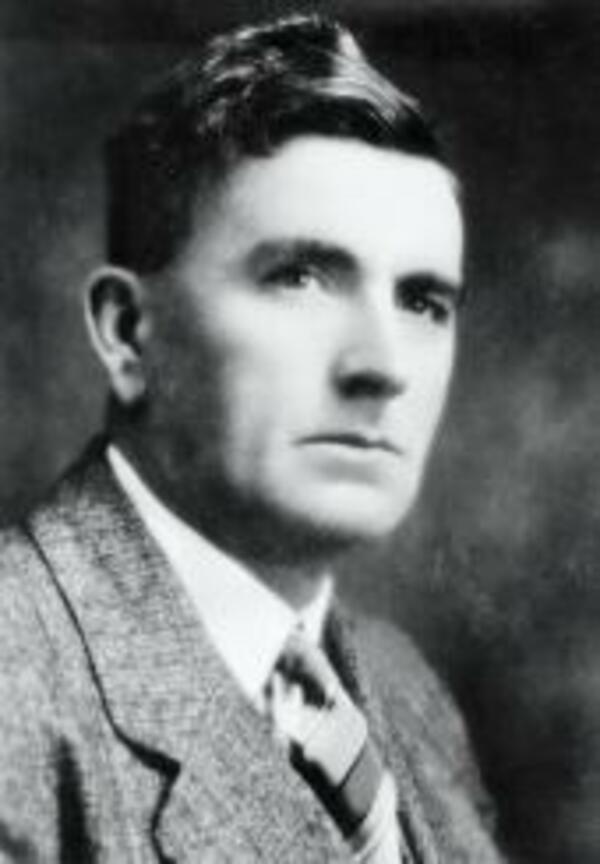
Source: Link
WEIR, ROBERT, educator, militia officer, soldier, farmer, stockbreeder, and politician; b. 5 Dec. 1882 in Wingham, Ont., son of Robert Weir and Jane Johnson; m. 1922 Margaret Dorothy Vance of Emerson, Man., and they had a daughter and a son; d. 7 March 1939 near Weldon, Sask.
Bob Weir grew up on his family’s farm in Huron County and was educated in a small rural primary school and a secondary school in Clinton. After receiving teacher training at the London Normal School, opened in 1900 under Francis Walter Merchant, Weir taught for a time in Huron County and served as principal of the public school in Marmora. He then attended the University of Toronto, where he studied mathematics, physics, and actuarial science and earned a ba in 1911. After a brief stint in the actuarial department of the Confederation Life Association in Toronto, he moved to Saskatchewan in 1912 to take up an academic position at the Regina Collegiate Institute. Weir seems to have been happy there; he was a popular teacher and an outstanding athletic coach. According to a school inspector’s report, Weir’s instruction in mathematics was “vigorous and effective,” his lessons were “developed logically,” and his classes were “thoroughly stimulated and controlled.” He also became lead instructor for the 70 students in the Canadian militia unit at Regina Collegiate, the No.155 Cadet Corps.
Like many men of his generation, Weir felt compelled to volunteer for military service after the First World War broke out in August 1914. Immediately following the 1914–15 school year, he joined the 95th Regiment (Saskatchewan Rifles) of the active militia, and in February 1916 he signed up to serve overseas in the Canadian Expeditionary Force. His militia experience made him an effective training officer, a role he performed in Canada and England. By October Weir had been promoted major, but he insisted on fighting and gave up his rank so that he could be sent to the Western Front, which he reached the following February. He suffered a bout of trench fever, but escaped injury for most of 1917 while fighting bravely in numerous battles. Weir’s luck ran out during the battle of Passchendaele: on 31 October he was severely wounded by shrapnel from an exploding artillery shell. Removed from the front, he spent the rest of the war organizing and managing correspondence courses that were part of the Khaki University of Canada, which allowed fellow soldiers to further their education after being demobilized.
In 1919 the Saskatchewan Liberal government of William Melville Martin* appointed Weir a provincial school inspector, but he found the job’s gruelling travel schedule difficult and stressful, owing partly to the effects of his wartime injuries. Advised by his doctors to consider an outdoor occupation, in 1922 Weir bought what would become Hereford Park Farm, a 1,000-acre property near Weldon, a village located between Melfort and Prince Albert. That year he married Dorothy Vance, with whom he set up house on his mixed farm. By applying scientific techniques to his livestock and grain operations, Weir turned Hereford Park Farm into a major attraction in the province, particularly because of his award-winning Berkshire hogs, Shropshire sheep, Hereford cattle, and Percheron horses. His financial success with the venture enabled him to purchase a ranch near Pincher Creek, Alta, where he also bred Herefords.
Weir’s fame as a farmer and breeder made him attractive to political parties, and he was recruited by the federal Conservatives to run in the Melfort constituency in the general election of 28 July 1930. Owing mostly to his personal popularity, Weir was able to defeat the Liberal mp, Malcolm McLean. Nationally, the Conservatives won a majority government. At the urging of some Saskatchewan Tories, the new prime minister, Richard Bedford Bennett*, appointed Weir minister of agriculture despite his lack of political experience.
Bob Weir entered government at a most unfortunate time, during the Great Depression. He would face a dual crisis of collapsing world markets for agricultural commodities and severe drought, especially in the semi-arid southern Canadian prairies, an area called Palliser’s Triangle after the explorer John Palliser*. Weir’s first policy response was to encourage dry-land wheat farmers to switch to mixed farming or, if necessary, move out of the hardest-hit regions of Palliser’s Triangle into wetter areas on the forest fringe. It would take Weir far too long to realize that neither of these costly options was viable for farmers who were barely surviving on relief payments.
Weir seemed paralysed by the sheer scale of the dust-bowl disaster in Palliser’s Triangle. Beyond facilitating relief payments to farmers in the prairie provinces, especially Saskatchewan, he was unsure of what to do. By the end of 1933 his critics were pointing to the success of numerous New Deal initiatives implemented south of the border by President Franklin Delano Roosevelt. Early in the next year Weir, evidently inspired by the interventionist measures taken by Roosevelt’s National Recovery Administration, oversaw the passage of the Natural Products Marketing Act, which allowed farmers to use quotas to control supply, and therefore selling prices, on the domestic market. Unfortunately, this policy did not apply to commodities, such as wheat, that were grown primarily for the export market.
More constructively, Weir ordered the directors of his department’s experimental farms and stations in the prairies (such as the one set up by Angus Mackay near Indian Head, Sask.) to compile information on the control of soil drifting and to prepare further studies on the problem. When Bennett announced his own New Deal in January 1935, Weir was finally prepared to enact radical measures to address the ecological catastrophe in Palliser’s Triangle. The Prairie Farm Rehabilitation Act, passed in April, established a new agency, the Prairie Farm Rehabilitation Administration (PFRA), which initiated a thorough and ultimately successful program of soil reclamation, water storage, and irrigation.
Politically, it was too late for Weir. Six years of the Great Depression had left Canadians in desperate straits [see Edward Jack Bates], and on 1 July a riot broke out in Regina after a two-week standoff between the Royal Canadian Mounted Police and unemployed participants in the On-to-Ottawa trek [see Nicholas John Schaack]. Weir and fellow cabinet minister Robert James Manion* had been sent there to try to deal with the men – to no avail. The violence in Regina further diminished the popularity of the Bennett government, and in the general election of 14 October the Conservatives were badly defeated and Weir lost his seat. The Liberals had rejected most of the New Deal during the campaign, but William Lyon Mackenzie King*’s government would build on Weir’s reforms, and King’s minister of agriculture, James Garfield Gardiner*, who had criticized the PFRA while serving as premier of Saskatchewan, would happily take credit for the agency’s successes.
After his defeat Bob Weir returned to farming. He would have few years to enjoy life after politics. In early March 1939, while he was hauling sacks of seed barley from Weldon to Hereford Park Farm, his sleigh became hung up in a snowdrift and then slid from the road and tipped over. Weir was crushed under the sleigh and sacks, and by the time a doctor arrived, he had died of internal injuries. Shortly after his funeral his widow and two children moved to Alberta. Weir’s most important legacy was the establishment of the Prairie Farm Rehabilitation Administration. This organization spearheaded a national response to the drought conditions in Palliser’s Triangle and helped rejuvenate agriculture in the devastated breadbasket of Canada.
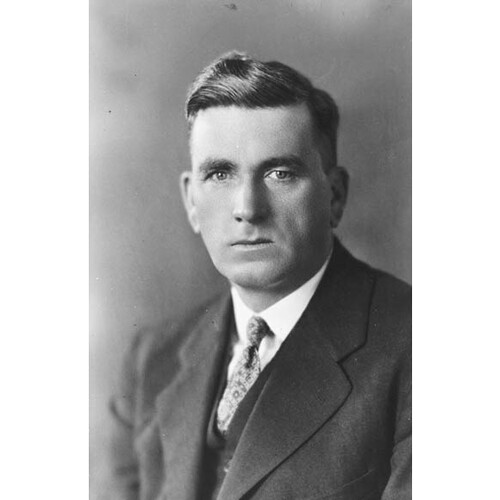
Photographs of Robert Weir are held by PAS (R-B2999, R-B11272) and by LAC (C-010149).
LAC, RG 150, Acc. 1992–93/166, box 10207-12. PAS, F 671 (William Melville Martin fonds). G. C. Allison, “‘Bob’ Weir – teacher, soldier, farmer: how Canada’s new minister of agriculture wins success,” Saskatchewan Farmer (Regina), 15 Aug. 1930: 15. Gazette (Montreal), 8 March 1939. Journal (Melfort, Sask.), 15 July, 26 Aug. 1930. Saskatoon Star-Phoenix, 7 March 1939. P. M. Abel, “Saskatchewan’s Cincinnatus,” Country Guide (Winnipeg), September 1930: 5, 63, 66. L. A. Glassford, Reaction and reform: the politics of the Conservative Party under R. B. Bennett, 1927–1938 (Toronto, 1992). G. P. Marchildon, “The Prairie Farm Rehabilitation Administration: climate crisis and federal–provincial relations during the Great Depression,” CHR, 90 (2009): 275–301. G. P. Marchildon and Carl Anderson, “Robert Weir: forgotten farmer-minister in R. B. Bennett’s depression-era cabinet,” Prairie Forum (Regina), 33 (2008): 65–98.
Image Gallery

Cite This Article
Gregory P. Marchildon, “WEIR, ROBERT,” in Dictionary of Canadian Biography, vol. 16, University of Toronto/Université Laval, 2003–, accessed June 2, 2026, https://www.biographi.ca/en/bio/weir_robert_16E.html.
The citation above shows the format for footnotes and endnotes according to the Chicago manual of style (16th edition). Information to be used in other citation formats:
| Permalink: | https://www.biographi.ca/en/bio/weir_robert_16E.html |
| Author of Article: | Gregory P. Marchildon |
| Title of Article: | WEIR, ROBERT |
| Publication Name: | Dictionary of Canadian Biography, vol. 16 |
| Publisher: | University of Toronto/Université Laval |
| Year of publication: | 2026 |
| Year of revision: | 2026 |
| Access Date: | June 2, 2026 |