

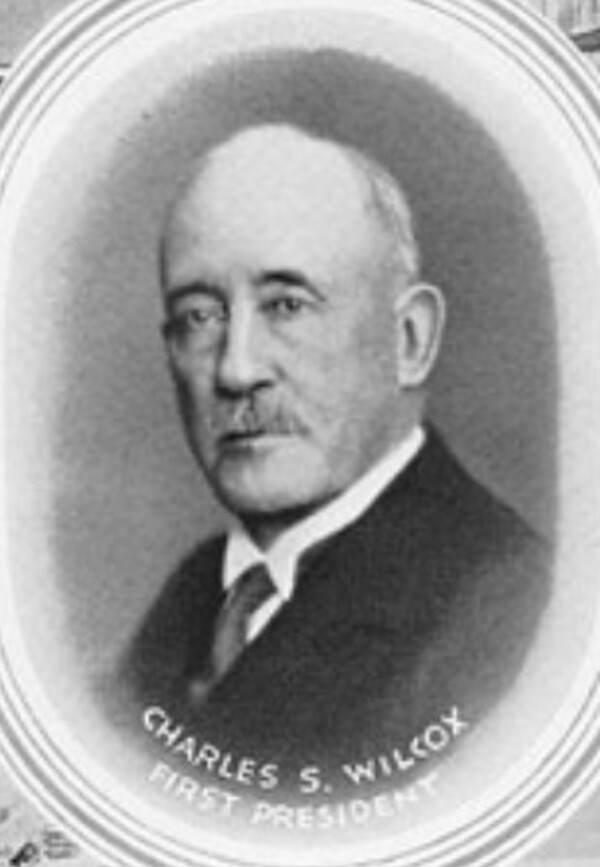
Source: Link
WILCOX, CHARLES SEWARD, industrialist and philanthropist; b. 16 March 1856 in Painesville, Ohio, youngest of the seven children of Aaron Wilcox, a merchant, and Eliza Jane Morley; m. 11 July 1907 Margaretta Muhlenberg Morley (1869–1958) in Camden Town (London), and they had a daughter; d. 6 June 1938 in Hamilton, Ont., and was buried in Painesville.
Charles Seward Wilcox was born into affluence: his father was a successful businessman who later became a bank owner, politician, and judge. Charles went to public school in Painesville before attending Dartmouth College in Hanover, N.H., and Yale College’s Sheffield Scientific School in New Haven, Conn. He graduated from Yale with a bachelor of philosophy degree in 1879, just at the time that his elder brother, Aaron Morley, and a group of Ohioans with experience in iron production decided to lease and reopen the Great Western Railway’s rolling mills in Hamilton, which had been closed since 1872. The Ohioans wanted to seize the opportunity created by Sir John A. Macdonald*’s recently enacted National Policy, which placed high tariffs on many imports to protect infant Canadian industries from foreign competition. By producing iron north of the border through their newly established Ontario Rolling Mills Company, the Ohioans could gain access to the Canadian market without having to pay the tariffs. Wilcox served a businessman’s apprenticeship in the firm and spent a decade advancing through positions of increasing responsibility: he was appointed a director and secretary in 1880, vice-president and treasurer in 1887, and general manager in 1890.
Ontario Rolling Mills started out as a producer of puddled iron from scrap metal and gradually expanded, acquiring a nearby nail works in 1879 and then absorbing the Hamilton Iron Forging Company in 1890, the same year that the directors first considered opening a steel plant. In 1892 Ontario Rolling Mills was one of the city’s largest employers, with 550 men on the payroll. Seven years later the directors decided to create a more substantial operation, one that included steel production, by merging with the Hamilton Blast Furnace Company, a pig-iron producer that had been established four years earlier by leading local businessmen such as William Southam and John Milne*. The consolidated enterprise was called the Hamilton Steel and Iron Company. Wilcox, who became general manager, would assume the presidency in 1903 upon the death of Andrew Trew Wood*.
Hamilton Steel and Iron opened a modest-sized steel plant in 1900. During the first decade of its existence the company was the smallest of the four leading steel manufacturers in Canada, the others being Henry Melville Whitney*’s Dominion Iron and Steel Company, John Fitzwilliam Stairs*’s Nova Scotia Steel and Coal Company, and Francis Hector Clergue’s Algoma Steel Company. In 1910 Wilcox, the leading voice for Hamilton Steel and Iron, reached an agreement to merge the company with four other firms: Cyrus Albert Birge*’s Canada Screw, of which Wilcox was a director; Lloyd Harris’s Canada Bolt and Nut, whose steel-finishing plants were spread across southern Ontario; Montreal Rolling Mills, controlled by financier William Maxwell Aitken*, and another Montreal firm, Dominion Wire Manufacturing. The resulting Steel Company of Canada (later known as Stelco) was a large corporation with integrated steel-production facilities. Wilcox became president and Robert Hobson* general manager. The two men developed a dynamic working relationship in which Wilcox’s sober, serious, taciturn, and conservative nature balanced Hobson’s flamboyance and adventurous managerial spirit. Under their direction facilities were overhauled, modernized, and expanded. Although the depression of 1913 to 1915 hit the firm hard (and, according to legend, led Wilcox to wander through the plant turning off lights to save money), the demands of munitions production for the First World War allowed Stelco to bounce back. By 1920 it was the country’s biggest and most successful steel company. Four years earlier Wilcox had ceded the presidency to Hobson and taken up the position of chairman of the board of directors, which he would occupy until his death.
To remain profitable in an industry that had to contend with shortages of raw materials, substantial overhead expenses, fluctuating consumer demand, and foreign competition, Canadian steel companies sought to utilize labour as efficiently and cheaply as possible. Under Wilcox’s leadership, Hamilton Steel and Iron and its successor, Stelco, ran the mills 12 hours per day, mechanized production as much as possible, and turned to migrant labourers, mostly from peasant villages in southern and eastern Europe, to do the less skilled work. A turning point in the company’s hiring practices was a bitter 1902 work stoppage, during which striking Canadians were replaced with these newcomers. They earned low wages and had a high rate of turnover, since most stayed only briefly while they sent money home to their families in Europe. The company sought to hold onto its more skilled employees by trying to guarantee steady employment and slowly introducing welfare measures, such as a profit-sharing plan in 1913 and a pension plan seven years later. The predominant managerial style was authoritarian, however, and the firm countenanced no unionization. Nonetheless, there were 16 strikes at Hamilton Steel and Iron and its successor Stelco between 1900 and 1920, of which the workers won 7 and lost 9.
Known as a quiet, retiring, and reticent man, Wilcox never assumed leadership roles in broadly based organizations such as the Canadian Manufacturers’ Association. Yet his business interests expanded in many directions and drew him into wide networks of interlocking directorships. At various times he was a director of two other Hamilton-based companies, Sawyer-Massey, an agricultural-implements manufacturer, and the Tuckett Tobacco Company, established by George Elias Tuckett*. Farther afield, Wilcox joined the boards of Canadian Cereal and Milling and Canada Crushed Stone, and he also served briefly on the executive committee of the North American Pulp and Paper Companies Trust. He was a director of numerous financial corporations, namely Crown Life Insurance, the Home Foreign Securities Corporation, Mercantile Trust, the Royal Bank of Canada, and the Traders’ Bank of Canada.
Wilcox was willing to make some of his fortune available for charitable work. In 1906 he became a director of the newly established Hamilton Health Association, which that year opened the Hamilton Mountain Sanatorium for Consumptives to fight tuberculosis in the city. He served on the board for many years and later paid for the installation of an in-house radio station for patients. Months before his death he donated $251,917.30 to build the sanitarium’s Wilcox Pavilion, which could accommodate 174 patients. He showed similar concern for curbing the alleged public rowdiness of working-class children. In 1909 he and his wife, Margaretta, joined the first executive committee of the Hamilton Playgrounds Association, and a year later he donated land for a park that became known as the Wilcox Playground. His impact on and contributions to the city were recognized in 1930 when Harvey Lane, next to the Stelco plant, was renamed Wilcox Street.
Like his fellow industrialists in Hamilton, the affluent Wilcox lived in an exclusive neighbourhood. In his leisure time he joined other male members of the elite at the Hamilton Club, the Royal Hamilton Yacht Club, the Hamilton Golf and Country Club, the Tamahaac Club, and, most enthusiastically, the Ontario (Thistle) Club, where he enjoyed curling. On Sundays he and his family attended the Anglican Church of the Ascension, where he was a churchwarden from 1913 to 1915. At his death in 1938 the New York Herald Tribune would describe him as “one of the Dominion’s wealthiest industrialists.” His estate was valued at $2,065,861.
Charles Seward Wilcox was exemplary of the new type of corporate capitalist that emerged in the dominion during the early 20th century. Better educated, richer, and more aloof than his predecessors in the Canadian business community, he straddled industry and finance and operated on a much larger scale and with much more power. As part of an emerging national capitalist class, he helped to reshape the country’s economy by developing new industries and corporate structures.
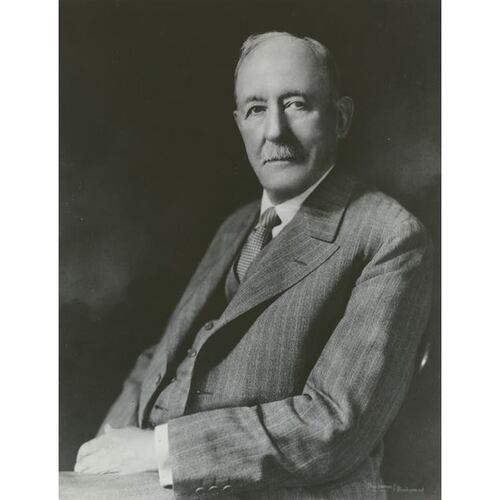
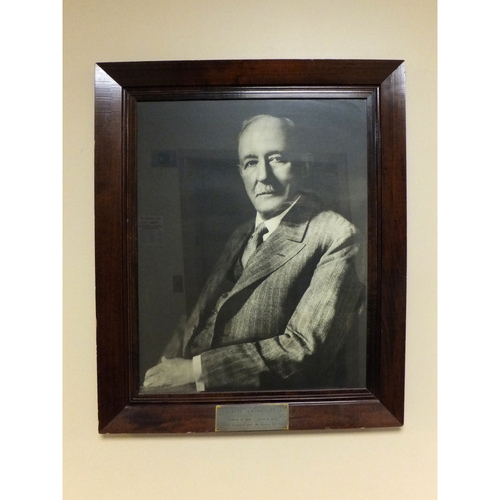
A portrait of Charles Seward Wilcox is in the collection of Hamilton’s Chedoke Hospital (formerly Hamilton Mountain Sanatorium for Consumptives) and can be viewed in this Flickr album.
Hamilton Public Library, Local Hist. & Arch. (Ont.), Ontario Rolling Mills Company Limited, minute books, 1879–99. Hamilton Spectator, 21 Oct. 1905, 23 April 1915, 15 July 1926, 5 Aug. 1932, 6 June 1938. New York Herald Tribune, 7 June 1938. New York Times, 7 June 1938. Annual financial rev. (Toronto and Montreal), 1902–19. Canadian men and women of the time (Morgan; 1912). Directory of directors in Canada, ed. W. R. Houston (Toronto, 1912). W. J. A. Donald, The Canadian iron and steel industry: a study in the economic history of a protected industry (Boston, 1915). Hamilton Health Assoc., Annual report (Hamilton), 1907–20 (available at McMaster Univ., Health Sciences Arch.). Hamilton street names, ed. Margaret Houghton (Toronto, 2002). Hamilton, the Birmingham of Canada (Hamilton, 1893). Craig Heron, Working in steel: the early years in Canada, 1883–1935 (Toronto, 1988). Industrial Canada (Toronto), 2 (1901–2), no.9. Iron Age (Philadelphia, etc.), 20 April 1899; 1, 21 Aug. 1902. William Kilbourn, The elements combined: a history of the Steel Company of Canada (Toronto and Vancouver, 1960). Souvenir number of the Hamilton Playgrounds Association: an historical review (Hamilton, 1931). R. H. Wilson, Chedoke: more than a sanatorium, ed. R. [J.] Williamson (Hamilton, 2006).
Image Gallery

Cite This Article
Craig Heron, “WILCOX, CHARLES SEWARD,” in Dictionary of Canadian Biography, vol. 16, University of Toronto/Université Laval, 2003–, accessed June 1, 2026, https://www.biographi.ca/en/bio/wilcox_charles_seward_16E.html.
The citation above shows the format for footnotes and endnotes according to the Chicago manual of style (16th edition). Information to be used in other citation formats:
| Permalink: | https://www.biographi.ca/en/bio/wilcox_charles_seward_16E.html |
| Author of Article: | Craig Heron |
| Title of Article: | WILCOX, CHARLES SEWARD |
| Publication Name: | Dictionary of Canadian Biography, vol. 16 |
| Publisher: | University of Toronto/Université Laval |
| Year of publication: | 2026 |
| Year of revision: | 2026 |
| Access Date: | June 1, 2026 |