

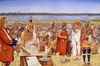
Buade* de Frontenac in 1682 that Kondiaronk first was noticed.
While the Ottawa speaker whined that they were like dead men and prayed that their
Buade* de Frontenac, comptroller of the navy and fortifications in New France (1701–18), secretary councillor and chief clerk of the Conseil Supérieur (1705–18
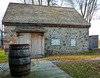
Buade* de Frontenac leased to the two men the post he had founded at Cataracoui, which was strategically located for trade with the Iroquois and some of the western First Nations. The following year
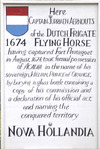
(Buade de Frontenac says “110 corsaires hollandais”), took the fort by storm in two hours. Chambly, wounded in the encounter, was taken prisoner. Aernoutsz destroyed Pentagouet and
Cataracoui (Frontenac), which he again attacked in August and September 1687.
In 1688 Chaudière Noire took part in the embassy that the Five Nations sent
Brisay de Denonville. In 1687 he went with Denonville’s troops to Cataracoui (Fort Frontenac), but the expedition against the Iroquois (Haudenosaunee) ended in a humiliating compromise for the
Buade de Frontenac’s expedition to Lake Ontario and in later years he frequently participated in others. In 1683 his name was considered for governor of Montreal, but he did not receive the
Frontenac County Registry Office (Kingston, Ont.), abstract of town lot 4. Daily News (Kingston), 19 Feb . 1861 – 7 Feb. 1868. Mitchell & Co.’s Canada classified
de Frontenac commended him to the king’s generosity, as “one of the first to have come to this colony . . . , burdened with a very large family, having several daughters and six sons
La Porte de Louvigny, the commandant of Fort Frontenac, had obtained through illegal transactions in the fur trade. He executed his mission efficiently
monastery and church of Notre-Dame-des-Anges. In the autumn of 1673 he went to the newly built Fort Cataracoui (Frontenac), where he acted as chaplain for nearly three years. He then returned to the monastery
Buade* de Frontenac’s campaign against the Onondagas in 1696, and a captain in the colonial regular troops on 12 May 1697. On 11 Nov. 1702
were born to them there. Levilliers went in 1695 with the Chevalier Thomas Crisafy* to Fort Frontenac (Cataracoui, now Kingston, Ont.). He
months the governor, Buade de Frontenac, had strengthened them considerably
[Rigaud*] sent Péan to command at Fort Frontenac (Kingston, Ont.), where he served until 1725. Two years later he was named commandant of Fort Chambly (south of Montreal) where his father-in-law
deal from gout. When he died it was, therefore, natural to think of his son as his successor. On the recommendation of Frontenac
General Phips* took Acadia in 1690, and lodged a complaint with the Earl of Bellomont, governor of Massachusetts. Late in 1695 La Tour was cited in dispatches by Frontenac
commandant of the post, a vital link between the Great Lakes and the Mississippi. He served a short term as commandant of Fort Frontenac (Kingston, Ont.) in 1746 and returned to Montreal where he died on 9
comte de Frontenac . . . a pourvu en l’année 1691 en attendant les commissions de sa majesté,” BRH, XIII (1907), 309. P.-G. Roy, Inv. ord. int., I, 92, 205
(Thwaites), LIX, 167–75. Michigan Pioneer Coll., XXXIII, 550, 559–61. NYCD (O’Callaghan and Fernow), IX, 865. Wis. State Hist. Soc. Coll., XVI, 285. Eccles, Frontenac, 328