

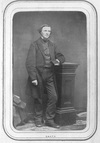
University of Toronto, and in 1855 he earned an md from Victoria College, then located in Cobourg.
At the
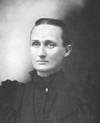
Woman’s Medical College at Philadelphia in 1870, no Canadian medical school at the time being open to women. During her first year of studies, the children stayed with David’s family in Montreal. Charlotte
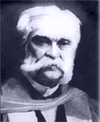
Willmott was born of English parents on a farm near Milton. He studied arts at Victoria College in Cobourg in 1854–55 but was forced to withdraw because of ill health. In 1858 he entered an indentureship in
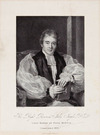
College, where he pursued “with distinguished success, a course of liberal instruction, as well in Classical learning, as in Philosophy, both Natural and Moral.” In 1798 he became his father’s private
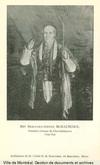
MacDonald* of Glenaladale to St John’s (Prince Edward) Island in 1772, 13-year-old Angus stayed behind to study for the priesthood in the secret Highland Catholic college at Buorblach (near Morar
at the Collège de Montréal. In the prize-giving of July 1852 his name appeared only once on the honours list: he placed first in religious instruction, as he was to do unfailingly each year. He
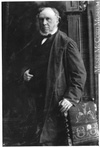
College and became professor of surgery, an appointment he retained until 1875 (when he received an honorary lld from the college), and professor of midwifery (a chair he
named principal pro tempore of a Presbyterian college established at Kingston, Upper Canada; he was active in efforts to secure funding [see William
mathematics and hydrography at the Jesuit college in Quebec until 1732. The courses included arithmetic, geometry, physics, as well as the use of the rule and dividers. Practical exercises had an important
.
Théogène Fafard’s family was well established in the Montreal area in the early 1870s. In 1872, after three years at the Collège de Montréal, Fafard began to study at the Montreal School of Medicine and
Macnaughton, of Paisley Free High Church, returned from Nova Scotia with details of the promising prospects for a theological training college there. With only four days’ notice, Forrester volunteered to visit
rhetoric classes at the Jesuit college in Pau from 1705 to 1710 and subsequently studied philosophy and theology in Poitiers. He left France for Canada in June 1716. He probably spent several months at
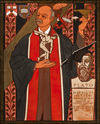
(London) and a leading 19th-century British intellectual. After attending Magdalen College School in Oxford, Maurice entered the university there. He graduated with a first in literae humaniores
Blackheath Proprietary School, London, England. He later attended King’s College, London, and in the early 1870s, Trinity College, Cambridge, from which he graduated ba. During
.
After his studies at the Jesuit college in Poitiers, Luc-François Nau was admitted into the noviciate of the Jesuits of the province of Aquitaine in Bordeaux on 12 Dec. 1720. He was a teacher of
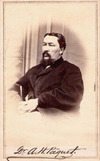
became a student at the Collège de L’Assomption. After finishing his classical studies, he enrolled in the Montreal School of Medicine and Surgery in 1849. He was admitted to the College of Physicians and
, live in Canada during the same period.
Jacques Quentin was a Master of Arts of the Collège of Douai and a priest when he entered the noviciate of the
Tracy [Prouville*]. The following year we find him teaching rhetoric and classics at the Jesuit college in Quebec. His teaching
left his job to enter the arts course at McGill College in 1871, though he would teach Sunday school during his time as a student. He earned a ba in 1876 with first-class
inception of the Free Church in Nova Scotia, he and several other clergymen had organized the Free Church College in Halifax. The college, giving classes in arts as well as divinity, opened with two