

Source: Link
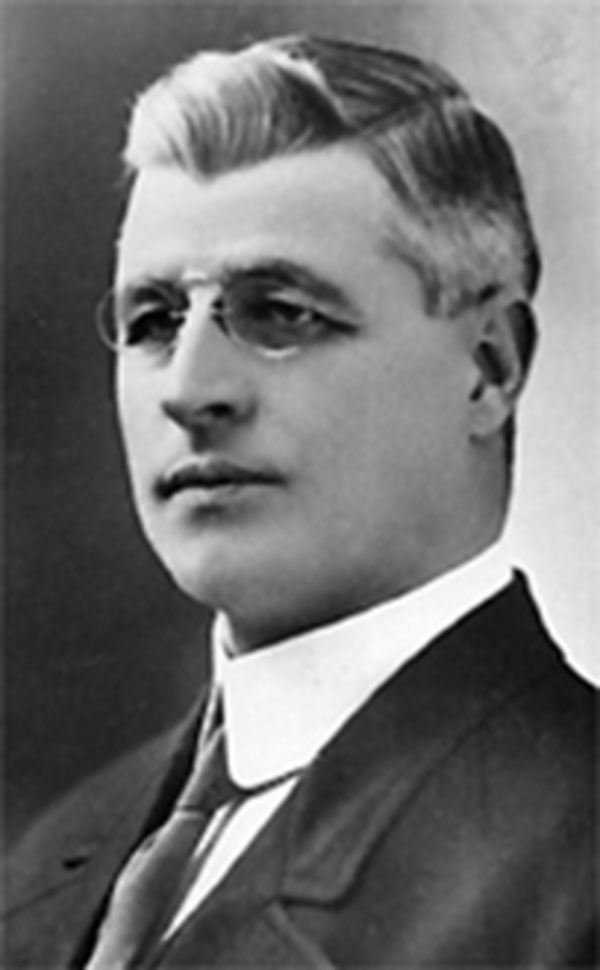
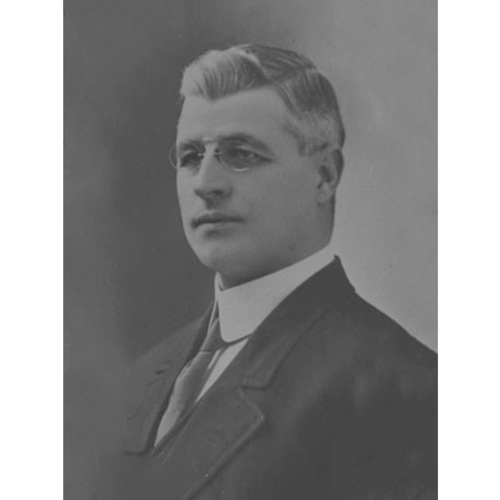
GUTHRIE, HUGH, lawyer, politician, and office holder; b. probably 13 Aug. 1866 in Guelph, Upper Canada, son of Donald Guthrie and Eliza Margaret McVicar; m. there 19 Dec. 1895 Maude (Maud) Henrietta Scarff (d. 1941), and they had three sons and one daughter; d. 3 Nov. 1939 in Ottawa.
Hugh Guthrie’s father, of Highland ancestry, was born in Scotland, and his mother was a native-born Upper Canadian. The Guthries were devout Presbyterians and staunch Liberals. In 1930 journalist Michael Grattan O’Leary* observed, “The Guthrie family were brought up on the Bible, the Shorter Catechism, and the editorials of the Toronto Globe.” Hugh had a strict upbringing. “My mother used to strap me at home,” he would recall. His father was a prominent lawyer who represented Wellington South as a Liberal in the House of Commons (1876–82) and the Ontario legislature (1886–94).
Lawyer and Liberal politician
After attending the Guelph High School, Hugh followed his father into law and then politics. He studied law at Osgoode Hall in Toronto, was called to the bar in 1888, and became a partner in the firm Guthrie and Guthrie, with his father. (Hugh would be made kc in 1902.) In 1900 Hugh was elected as a Liberal to the House of Commons, representing Wellington South. He was soon marked as one of Prime Minister Sir Wilfrid Laurier*’s promising young men: in 1901 he was given the honour of delivering the address in reply to the speech from the throne, and just six years later he became chairman of the house committee on railways, canals, and telegraph lines. During the general election of 1911, his was one of the most noticeable Liberal voices campaigning in favour of reciprocity with the United States. He was widely viewed as a potential successor to the retiring minister of justice, Sir Allen Bristol Aylesworth*, should the Liberals be re-elected. The party lost to Robert Laird Borden’s Conservatives, but Guthrie was among the few Liberal mps in Ontario who were not swept away by the Tory landslide. In opposition he played a prominent role on his party’s front benches, and many observers viewed him as a possible future leader.
The First World War
Things changed during the First World War. Guthrie believed it was Canada’s duty to support the British cause by all means necessary, and like many other anglophone Liberals, such as Newton Wesley Rowell*, he broke with Laurier in 1917 over his refusal to support the Borden government’s decision to begin conscripting men for overseas military service. Guthrie was the first Liberal mp to speak publicly in favour of the measure. Addressing the House of Commons on 19 June, he defended his position with logic and passion. Reminding his colleagues of the urgent need for reinforcements, he declared: “The call comes from every quarter; it comes from the men in the trenches and in the hospitals, from the returned soldiers and perhaps also from the dead. There is no doubt that the people of Canada are under the most solemn pledge that men or women could give to support the men who have gone into the trenches; we cannot avoid that responsibility whatever else we may avoid.” During the speech he gave an eloquent reading of “In Flanders fields,” the famous poem by army doctor and fellow Guelph native John McCrae*.
On 4 October, shortly before the formation of the Union government, Borden appointed Guthrie solicitor general (which was not yet a cabinet position). Guthrie then ran successfully as a Unionist Liberal in Wellington South in the divisive election of 17 December. On 5 July 1919 he was sworn into the cabinet as solicitor general, and on 24 January of the following year Borden made him minister of militia and defence. Guthrie would never return to the Liberals. According to writer Charles Arthur McLaren Vining, he quipped to reporters that “anybody was welcome to his discarded opinions.”
Conservative politician
Borden retired in 1920, and although Guthrie would have preferred Sir William Thomas White*, the minister of finance, as his successor, he loyally agreed to stay on as head of the Department of Militia and Defence when Arthur Meighen* became prime minister. Guthrie’s personal popularity allowed him to hold Wellington South in the election of 6 Dec. 1921 despite the fact that Meighen’s fragmenting coalition, styled the National Liberal and Conservative Party, was reduced to third-party status, coming behind William Lyon Mackenzie King*’s resurgent Liberals and Thomas Alexander Crerar*s newly formed, agrarian-based Progressives [see Thomas Wakem Caldwell]. In opposition the Meighen-led forces adopted the name that had become historic during Sir John A. Macdonald*’s tenure: the Liberal-Conservative Party. The Tories briefly returned to power in 1926 thanks to a scandal in the Department of Customs and Excise [see Jacques Bureau] that caused the Liberals to lose support in the house. King resigned after his request for an early dissolution of parliament was refused by Governor General Lord Byng. Meighen became prime minister and hastily assembled a cabinet of acting ministers that included Guthrie, who took on the portfolios of justice and national defence. The Meighen government was quickly defeated in the house. After a cabinet shuffle, Guthrie, now a full minister, stayed on at national defence during the general election campaign that followed. On 14 September King’s Liberals won decisively and Meighen, who lost his seat, soon resigned the party leadership. Guthrie’s remarkable hold on Wellington South survived unscathed.
Liberal-Conservative interim leader
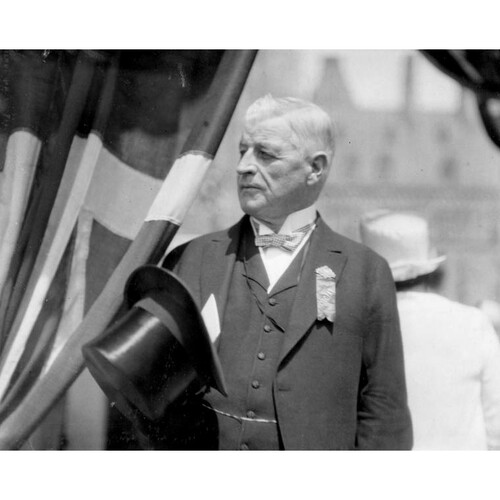
Surprisingly, Hugh Guthrie was chosen as the party’s interim chief at an October gathering of mps and defeated candidates. It was an unexpected outcome, not because he lacked experience – he was the dean of Tory mps, with 26 continuous years in the House of Commons – but because the first 17 of his years in parliament had been spent as a Liberal. Guthrie led the party with dignity and competence and chaired the committee that organized its first national leadership convention, scheduled for October 1927. Though there was no official campaigning, Guthrie figured prominently as a candidate. In addition to having unparalleled parliamentary experience, Guthrie presented an appealing image from the podium. The Conservative journalist Arthur Rutherford Ford* recalled: “He was an impressive figure, tall, dignified, stately, and always immaculately dressed. He looked the part of a statesman. He was a brilliant orator with a mellifluous voice.” Guthrie did not help his cause, however, when he banged the chairman’s gavel in Winnipeg and welcomed delegates to “this National Liberal convention.” When laughter broke out he quickly corrected himself, stating that it was the “National Liberal-Conservative convention,” but the damage was done. This gaffe, combined with his advocacy of a new focus on winning seats in western Canada rather than in Quebec, sealed his fate. Notwithstanding his strong support from the caucus, Guthrie came second to lawyer and Calgary West mp Richard Bedford Bennett*.
Minister of Justice
Though disappointed, Guthrie was not devastated. Grattan O’Leary noted of him that “he has never made politics the be-all and end-all of life.” A voracious reader of history, biography, and detective fiction, Guthrie was also a passionate collector of antiques. He faithfully served in Bennett’s shadow cabinet and campaigned across the prairie provinces in the election of 1930, which returned the Tories to power. His reward was the justice portfolio, as well as a trust and respect that the new prime minister granted to few cabinet colleagues. In 1931 Guthrie led the Canadian delegation to the League of Nations in Geneva, and together he and Bennett finalized the arrangements for the British parliament’s passage of the Statute of Westminster.
Bennett and Guthrie also implemented repressive measures against political agitators who, in the midst of the Great Depression, opposed the federal government. The most controversial tool employed by the “Bennett-Guthrie coercive state,” as scholar Kenneth William Kirkpatrick McNaught characterizes it, was the Criminal Code’s section 98, which empowered the government to persecute allegedly seditious organizations and effectively set aside the usual presumption of innocence. When asked about his department’s use of this section to imprison members of Timothy Buck*’s Communist Party and to deport alien immigrants, Guthrie replied, “Section 98 is not in any sense a hindrance to any right thinking person.” His views on this subject contrasted sharply with those of his former Liberal colleagues.
Guthrie’s increasingly illiberal views were also demonstrated by his long-standing feud with Progressive mp Agnes Campbell Macphail*, the first woman to be elected to the House of Commons, whose Grey Southeast riding was near Wellington South. Guthrie and Macphail had briefly clashed in 1922, during a parliamentary debate on women’s rights, and again during the election of 1926, when Guthrie labelled her a Bolshevik sympathizer. Their most dramatic conflict occurred in 1934 and 1935 over the issue of prison reform. Macphail urged a thorough public inquiry into the appalling conditions in penitentiaries, a call that the hardline minister of justice resisted. Attempting to undermine her, Guthrie resorted to a smear tactic, pointing out that one of the prisoners she was ardently defending had been convicted of “a bestial crime,” which at that time denoted homosexuality.
By 1935 four years of governing amidst unparalleled economic, social, and political upheavals had taken its toll on the prime minister and most members of his cabinet, Guthrie included. Though Bennett was suffering from heart problems, he chose to remain as chief, temporarily buoyed by the popularity of his New Deal radio broadcasts. Guthrie loyally soldiered on, introducing Criminal Code amendments that were in accord with the reform recommendations of the royal commission on price spreads, which had been chaired by his former cabinet colleague Henry Herbert Stevens*. Even as Guthrie presented the amendments, however, he confessed his doubt as to their constitutionality. When Stevens broke with the Conservatives and established the more radical Reconstruction Party, Guthrie stayed with Bennett.
In June Guthrie supported the prime minister’s decision to stop the On-to-Ottawa Trek, which comprised roughly 1,000 western relief-camp strikers who were riding the rails eastwards to bring their grievances to the federal government. Speaking in the house on 13 June, Guthrie gave two justifications for the government’s response: first, the trek was “under the direction of certain communist elements;” second, it constituted “a deliberate attempt to disturb the peace, order and good government of Canada by unlawful means.” The Royal Canadian Mounted Police forcibly halted the trekkers in Regina, where a riot on 1 July resulted in the death of city detective Charles Millar; hundreds were injured, including protester Nicholas John Schaack, who would become the second fatality.
On 11 August, following the conclusion of the parliamentary session, Guthrie resigned from the cabinet. His steadfast loyalty to Bennett was rewarded by an appointment as chief commissioner of the Board of Railway Commissioners. Guthrie did not run in the general election of 14 October, in which the Tories were badly defeated by the Liberals. For the first time in 35 years, Wellington South would be represented in the House of Commons by someone else.
Assessment
Hugh Guthrie died in harness, succumbing to illness on 3 Nov. 1939. When contemporaries considered his political legacy, the first significant item was simply his remarkable longevity in elected office. For three and a half decades he represented the citizens of Wellington South. For the first 17 of those years he was a Liberal, and for most of that time he was a true believer in the traditional Ontario Grit and Reform views of George Brown*, Alexander Mackenzie*, Edward Blake*, and Sir Oliver Mowat*: individual freedom, limited government, and unfettered trade. Guthrie’s beliefs became more Tory during the First World War, when Canadian and British troops fought and sacrificed in a common cause in the trenches of western Europe. His service as a minister in the Union government contributed to this transition in his views. By 1921 he was no longer a Liberal but a Liberal-Conservative. Even his stand on trade and tariffs was that of a Tory protectionist; during the 1930 campaign he argued that Canadian producers in both agriculture and manufacturing deserved access to their home market. This change of heart was, at least in part, the result of the urbanization and industrialization that occurred in Guelph over the course of his career.
Guthrie’s views on law and order were traditional and conservative. He believed in preserving, as the British North America Act famously put it, “Peace, Order and good Government.” As a lawyer and long-time Liberal he had equated liberty with respect for democratically created laws. When he became minister of justice in Bennett’s Conservative administration, he applied this principle vigorously amidst conditions of widespread unrest. Deporting alien immigrant agitators, incarcerating suspected Communists, and maintaining harsh prison conditions was, as he saw it, the duty of law enforcement in a free country: it was a nasty business, but it had to be done. As befitted his evolution from Grit to Tory, Guthrie came to see Canada as a country in which French Canadians had traditional rights, but only in Quebec, and immigrants were welcome only if they peacefully and quickly assimilated into the Anglo-Celtic majority population. These views, fairly typical of Canadians of his culture, ethnicity, and social class, would become less acceptable to succeeding generations. Guthrie was an accomplished and widely respected politician of his era; he was not a visionary prophet ahead of his time.
There is no significant archival collection of Hugh Guthrie’s private or public papers. A search through the finding aids for LAC’s R. B. Bennett fonds (R11336-0-7-E) and Arthur Meighen fonds (R14423-0-6-E) turns up some items of interest. There is some uncertainty about Guthrie’s year of birth. The 1901 and 1911 censuses give 1867, but most published and primary sources, including his marriage record, indicate that the correct year is 1866.
Ancestry.com, “Ontario, Canada, marriages, 1826–1940,” Hugh Guthrie and Maude Henrietta Scarff, Wellington, 19 Dec. 1895. LAC, R233-37-6-E, Ont., dist. Wellington South (126), subdist. Guelph (E), div. 15: 17; R233-177-0-E, Ont., dist. Wellington South (134), subdist. Guelph (45): 7. Pierre Berton, The Great Depression, 1929–1939 (Toronto, 1990). Can., House of Commons, Debates, 19 June 1917, 14 Feb. 1933, 13 June 1935. Terry Crowley, “Agnes Macphail, Canadian politics, and Guelph politicians,” Historic Guelph: the Royal City (Guelph, Ont.), 31 (1992–93): 32–47. A. R. Ford, As the world wags on (Toronto, 1950). L. A. Glassford, Reaction and reform: the politics of the Conservative Party under R. B. Bennett, 1927–1938 (Toronto, 1992). Kenneth McNaught, A prophet in politics: a biography of J. S. Woodsworth (Toronto, 1959). M. G. O’Leary, “Cabinet portraits, Hugh Guthrie,” Maclean’s, 1 Oct. 1930: 10, 48, 50. R. T. L. [Charles Vining], Bigwigs: Canadians wise and otherwise (Toronto, 1935).
Image Gallery

Cite This Article
Larry A. Glassford, “GUTHRIE, HUGH,” in Dictionary of Canadian Biography, vol. 16, University of Toronto/Université Laval, 2003–, accessed April 20, 2026, https://www.biographi.ca/en/bio/guthrie_hugh_16E.html.
The citation above shows the format for footnotes and endnotes according to the Chicago manual of style (16th edition). Information to be used in other citation formats:
| Permalink: | https://www.biographi.ca/en/bio/guthrie_hugh_16E.html |
| Author of Article: | Larry A. Glassford |
| Title of Article: | GUTHRIE, HUGH |
| Publication Name: | Dictionary of Canadian Biography, vol. 16 |
| Publisher: | University of Toronto/Université Laval |
| Year of publication: | 2026 |
| Year of revision: | 2026 |
| Access Date: | April 20, 2026 |