

Source: Link
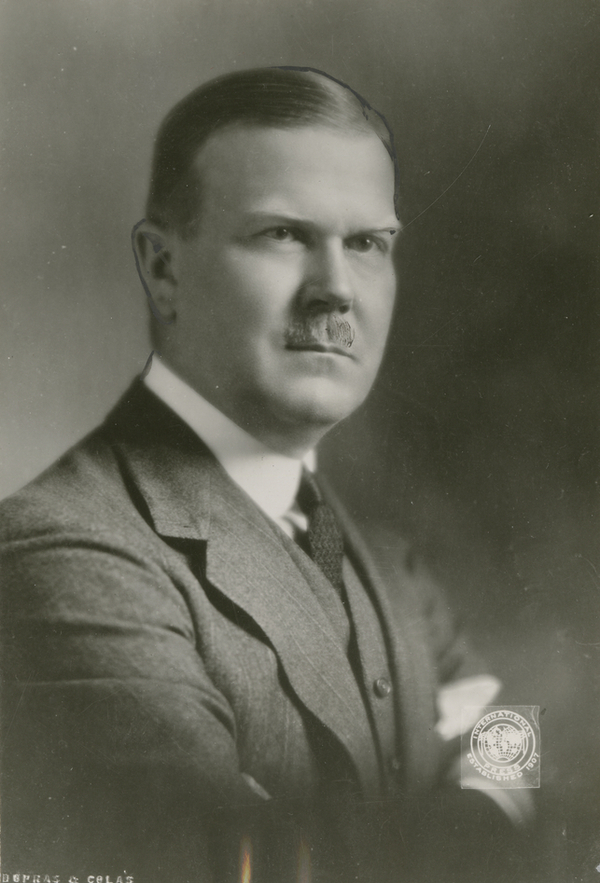
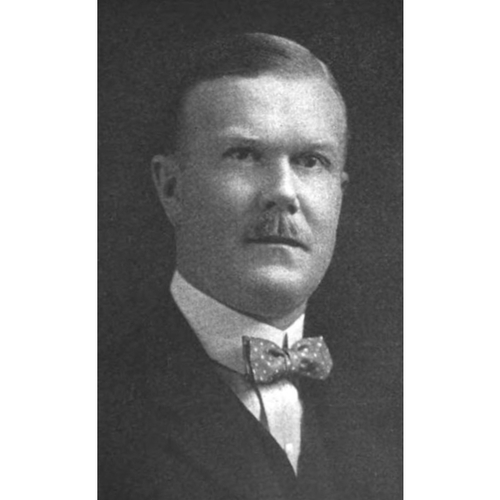
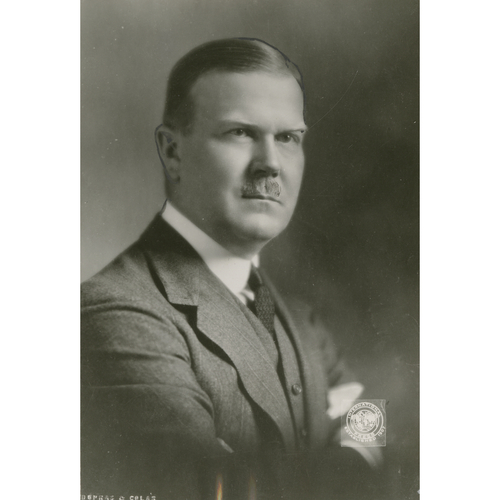
MOLSON, HERBERT, brewer, financier, army officer, company director, and philanthropist; b. 29 March 1875 in Montreal, son of John Thomas Molson, brewer, and Jane (Jennie) Baker Butler, and grandson of Thomas Molson*; m. 11 April 1899 Elizabeth (Bessie) Zoe Pentland in Quebec City, and they had two sons and two daughters; d. 21 March 1938 in Montreal and was buried two days later in Mount Royal Cemetery in Outremont (Montreal).
When Herbert Molson died, McGill University cancelled all classes so that its faculty and students could attend the funeral. Montreal’s two largest department stores, Eaton’s [see Timothy Eaton*] and Morgan’s [see Henry Morgan*], which flanked Christ Church Cathedral, where the funeral was to take place, closed their doors out of respect, as did nearby Birks [see Henry Birks*], the city’s leading jeweller. The tributes paid to Molson were fulsome. In a letter of condolence to Molson’s wife, Governor General Lord Tweedsmuir [Buchan] described him as “one of the great figures of Canadian life, for Canada had no finer citizen.” Colonel Andrew Hamilton Gault* wrote to her, “To us he ever stood sans peur et sans reproche for everything that was fine, and great, and true the very best that Canada produces.” Gault was not alone in referencing, by way of comparison, the description of the medieval French knight, the seigneur de Bayard; several other letters, which have been kept by the family, contain exactly the same expression.
In reviewing the life of Herbert Molson, this high esteem accorded him at his death is difficult to understand. It makes sense only in the larger historical context: the veneration is not so much a reflection of his achievements but of how well he embodied what had become important in Canadian society after the Great War.
Early life and education
Herbert Molson was born into wealth. His grandfather Thomas Molson was one of the most affluent pre-Confederation industrialists. John Thomas, Herbert’s father, inherited the Montreal brewery when Herbert was in his mid twenties. John Thomas led a life of leisure, angling at the six-member Bonaventure Salmon Club in the Gaspé and yachting around the world aboard his 120-ton steam-powered schooner Nooya with its crew of ten. The eldest of five children born to John Thomas’s second wife, Herbert was raised in a townhouse designed in the style of British architect John Nash, on Sherbrooke Street in Montreal, and he spent summers at Cacouna in the lower St Lawrence region.
Herbert attended the High School of Montreal and completed a bachelor’s degree in applied sciences at McGill University in 1894, after which he earned a diploma at the United States Brewers’ Academy in New York State. He appears to have done well during a brief apprenticeship at the family brewery in 1896, under the watchful eye of his uncle John Henry Robinson Molson, who left him $20,000 (over 36 times the average annual wage for skilled tradesmen in Montreal at the time) when he died the following year. John Thomas inherited control of the brewery from his brother and offered one-eighth of the shares to 22-year-old Herbert and the same amount to Herbert’s 36-year-old first cousin Frederick William. Fred, as he was known, was the younger son of William Markland, the ne’er-do-well brother of John H. R. and John Thomas.
Marriage and family
In the 1890s John Thomas and family started spending their summers at Metis Beach (Métis-sur-Mer), near Rimouski. There Herbert met and courted Bessie Pentland, the daughter of Quebec City lawyer Charles Pentland. Their marriage was the social event of the 1899 season according to the Daily Telegraph (Quebec City), which commented on the bride’s “magnificent diamond star[,] the gift of the bridegroom” and noted that “the wedding presents were remarkably numerous and costly.”
After a two-month honeymoon in Europe, the couple moved into a $13,500 home on Mountain Street in Montreal. In 1903, when members of the Molson family owned more than 60 city properties, assessed at close to $1 million, this was Herbert’s only real-estate investment. He was not a rentier. According to the 1901 census two unilingual, literate servants lived with the Molsons: Lizzie Brown, a 48-year-old English Canadian Anglican, and Annie Milloy, a 45-year-old Irish Canadian Catholic. They were paid $168 and $148 a year respectively. In July Bessie gave birth to the Molsons’ first child, Thomas Henry Pentland, and over the next six years to three more children.
The beer baron
Herbert began working full-time at the brewery after returning from his European honeymoon in 1899. With his father in poor health, Herbert devoted his attention to the brewery, where alongside Fred he oversaw the modernization of the facilities. Annual beer production tripled to more than a million gallons by 1907. This expansion built on the introduction in 1903 of Molson Export. Developed by the brewmaster, John Hyde, with the aid of Herbert, this ale had a higher alcohol content than the firm’s premier product, Crown and Anchor lager.
In 1909 Andrew Joseph Dawes of Dawes Brewery [see James Pawley Dawes*] proposed the creation of a provincial brewing monopoly. John Thomas Molson refused to join the other brewers, but Dawes went ahead and merged all but two of the province’s breweries into National Breweries Limited. This development changed the nature of the industry: instead of the market being served by competitive, family-controlled regional breweries, a single corporation now dominated.
The transformation of brewing was part of a general process of corporate concentration in which Canada was a world leader. By 1910 the market capitalization of the country’s corporate sector had already reached 220 per cent of gross domestic product, a rate that was the second highest among industrialized countries, just behind the United Kingdom (257 per cent) and well ahead of the United States (156 per cent), France (76 per cent), and Germany (71 per cent). This new economic reality would prove to be a key factor in explaining the high esteem accorded to Herbert Molson upon his death, but for the moment it posed a real problem. Despite the recent expansion, National Breweries dwarfed Molson’s, accounting for 80 per cent of all beer sold in Quebec.
“If you can’t beat them, join them” was a family tradition. It was how John Molson* Sr had dealt with steamboat competition in the 1820s and how Thomas Molson had dealt with distilling competition in the 1850s. Thus in 1909 Molson’s entered into a cartel with its much larger rival. From April of that year through to September 1925, the two firms shared monthly returns on how much ale, porter, and lager each had sold in both Canada and Newfoundland. All sales in excess of a set market share were to benefit both firms, at a fixed profit per gallon. The respective shares, as well as the rate of profit on excess sales, were to be recalculated every three years. Initially, Molson’s was allocated one-fifth of the market, but by 1925, when the agreement was renegotiated for the following 12 years, Molson’s share rose to 27.5 per cent.
Herbert, who had inherited control of the brewery upon his father’s death in 1910, moved quickly to reorganize it as a privately held, limited-liability company, which was incorporated on 7 Aug. 1911 as Molson’s Brewery Limited. Fred, who managed day-to-day operations, was invited to purchase a third of the shares in the firm, which he did. Herbert, Bessie, and their four children moved into a 34-room mansion, with space for nine domestic servants, on Ontario Avenue (Avenue du Musée). Herbert took out memberships in the most exclusive social clubs in the city, the Mount Royal and the St James, and joined four of the leading sporting clubs: the Forest and Stream, the Montreal Hunt, the Royal Montreal Golf, and the Montreal Jockey. He also inherited his father’s membership in the Bonaventure Salmon Club.
The company’s minute book indicates that the officers met quarterly, frequently at Herbert’s home. From 1911 to 1914 the principal order of business was to approve a quarterly dividend rate of 7.5 per cent. This regular cash flow permitted Herbert to build his stock portfolio, which in 1912 generated a capital gain of $28,081. But this life of monied ease would soon be disrupted by the Great War.
First World War
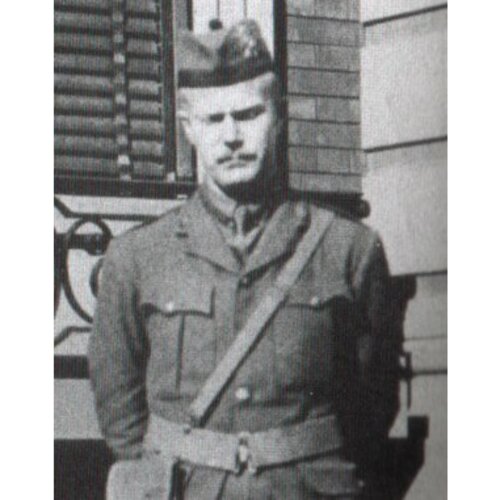
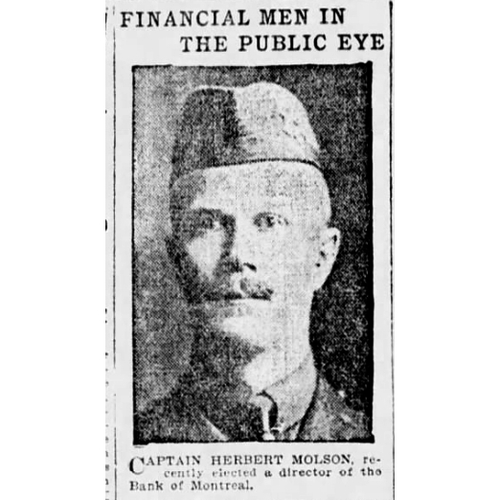
When the First World War broke out, Herbert Molson enlisted in the 42nd Infantry Battalion of the Canadian Expeditionary Force. After officer training in Halifax, he qualified as a captain and sailed for Europe in June 1915. The following November he arrived in Belgium as a company commander and quickly developed a strong paternal interest in his troops. In a New Year’s Day letter to Bessie, he wrote: “I have really become attached to them as if they were my children. They are like children, to be taught, cared for, and punished and with power such as I have to use or abuse they are so dependent on me & my officers.”
In April 1916 Herbert and his men were transferred to the Ypres salient [see Sir Arthur William Currie]. During a German assault on 2 June, shrapnel fractured Herbert’s skull. After having his wound dressed, he continued to lead his troops, relieving the Princess Patricia’s Canadian Light Infantry, in which his younger brother Percival (Percy) served. That day Percy also sustained a serious wound when a bullet pierced his cheeks, smashing his jawbone. Both brothers were awarded the Military Cross for gallantry in this engagement and were sent home.
This medical leave was the only opportunity Herbert had during the war to attend to the business of the brewery. The rest of the time Fred and his son Herbert (Bert) William managed the operation. With war came increased business and full employment. Molson’s was doing so well that by September 1916 it had accumulated a $476,000 reserve on top of a record annual net profit of $448,000. With the high cost of the war fuelling calls for the conscription of wealth, and the 20 per cent business profits war tax already in place, Herbert immediately distributed a special dividend bonus of $450,000 in addition to the regular 30 per cent dividend. His own share of this exceptional payout was $420,000. The firm’s business profits war tax that year amounted to $90,895.
There is a tale told and retold by the Molsons about the memorable Christmas dinner of 1916. With all three of Jennie Molson’s soldier sons on leave, the family gathering was to be a grand occasion in her home on University Avenue in Montreal. The time to sit down for the meal came and went with no sign of Percy. Finally, Jennie decided to start without him. When everyone had taken their seat, one of the servants, who had been in the room the whole time, slipped into Percy’s place, to the surprise of all at the table. At that moment the servant revealed himself to be Percy and asked, “What, you don’t recognize me out of uniform?” This story, recounted in print by a Molson descendant as recently as 2001, is offered by the family as proof of Percy’s great sense of humour, but it also underscores a fundamental fact of class relations within Molson households: servants served but were rarely seen.
Deemed medically unfit for active duty, Herbert accepted a staff position in England in the winter of 1917 and was promoted to the rank of major. Following his recuperation after the successful removal of shrapnel from his skull in June, he returned to France the following March and rose to the position of chief Canadian staff officer at the general headquarters of the British Expeditionary Force. After the armistice, he was promoted lieutenant-colonel and mentioned in dispatches. He was made a cmg in June 1919.
When Herbert returned home in the spring of 1919, his first order of business was to organize a fitting tribute for Percy, who had been killed in July 1917 by shellfire well behind the lines. In 1913 a group of McGill alumni, including Percy, who had been an outstanding varsity athlete, had started fund-raising for a university stadium. Aided by a $75,000 bequest from Percy’s estate and a $100,000 donation from the brewery, Herbert convinced his fellow McGill governors that it should be named the Percival Molson Memorial Stadium. Opened in 1919, it had a capacity of 8,000 and may well be the largest war memorial in the country.
Molson’s in the 1920s
The brewery had continued to do well in Herbert’s absence. In 1918 the firm sold in excess of 2.6 million gallons of its products and paid 1.5 per cent of revenue to National Breweries for its loss of market share. Net profits stood at an enviable 17.7 per cent of gross revenue. But the best was yet to come. After it was decided in 1919 that the Quebec Prohibition Law would allow for the sale of beer, cider, and wine [see Sir Lomer Gouin*], Molson’s began a massive market expansion. By 1921 the firm was selling 5.1 million gallons and net profits had skyrocketed to $1.4 million, or 29 per cent of revenue. So too had costs, however. Breweries measure expenditures in terms of gallons of beer. Throughout the war years it had cost Molson’s 60 to 68 cents to produce a gallon of beer. This figure ballooned to 92 cents by 1921. Faster production and cost-cutting measures, particularly in bottling, were instituted by Fred’s son Bert, who was the hands-on manager at the time. Thanks to his changes, along with continued expansion, by 1925 the company had reduced the cost to 65 cents a gallon for the 7.2 million produced.
The restructuring in 1911 had established a capital stock of only $600,000 for a firm with assets of approximately $1.5 million. This low capitalization was what had permitted Fred to purchase a third of the shares of the business and Herbert to set aside funds for investment, but it would also cause future problems. The 1921 profits represented a return on investment of 230 per cent, an indefensible level of profiteering, which prompted Molson’s to restructure using creative accounting. It introduced a $1.5 million entry in the books for goodwill, representing the value of its brand name, and a $900,000 appreciation in the value of its buildings, which financed an increase of the firm’s capital to $3 million.
Throughout the 1920s Molson’s built a substantial contingency fund and a capital reserve. These accumulated profits were not reinvested in the brewery but in the bond and equity markets. Among the many investments, a small one stands out; in 1924 the brewery invested $15,000 in the Canadian Arena Company, future owner of the Montreal Canadiens hockey club. By 1929 more funds were invested in outside activities than were being spent on brewing beer.
Income taxes
This embarrassment of riches posed a problem for Herbert. How to access these funds without having to pay substantial income taxes? In the early 1920s he had resumed an extravagant life of leisure with purchases that included Villa Medea, the new country home at Metis Beach; Ivry, a large familial estate in the Laurentians; Curlew, a 117-foot, 189-ton yacht with a crew of ten; two Rolls-Royces; and a Packard. Over the decade his household expenses almost doubled. Furthermore, his four children were coming of age, which raised the issue of estate planning.
When he turned 50 in 1925, Herbert withdrew $1 million from the brewery. By 1929 he had borrowed a further $500,000. Following Fred’s death in February that year, he withdrew $4.8 million, and in 1930 an additional $4.56 million. These large transfers were made possible because of a corporate restructuring: Herbert created a new company with the same name, which purchased only the physical assets of the original firm by issuing 30,000 redeemable 7.5 per cent preferred shares with a par value of $100 each – equal to the original company’s capital of $3 million. At the same time a further 30,000 common shares with no par value were distributed to Herbert and to Fred’s estate. This legerdemain left all the old firm’s retained earnings in the hands of Herbert and Bert, as executors of Fred’s estate. It is not clear how Herbert managed to avoid incurring a heavy tax bill on these appropriations. His private ledgers show that in 1928 he paid 25 per cent in taxes on a net income of $311,812, but in 1929 he paid only 2.8 per cent on a revenue of $5,187,519, and in 1930 a mere 1.8 per cent on $4,877,352.
The new company redeemed the preferred shares over the course of the next seven years. This meant a further tax-free transfer of $3 million. After all the preferred shares were redeemed, the once valueless common shares were now worth $116 each. As this rapid appreciation suggests, the brewery managed to do relatively well in the 1930s under Bert’s supervision. Sales did decline by one-third between 1931 and 1933, to 5.1 million gallons, and the firm recorded assets of $2,763,401 in 1934. Molson’s remained lucrative, however. In its worst year, 1933, the firm had posted an operating profit of $514,180 and paid Herbert $165,000 in salary and dividends. By 1938 sales had climbed to a new high of 9.2 million gallons and profits stood at $1,497,381.
Personal investments
During the 1920s Herbert had become a relatively significant investor in his own right. Between 1921 and 1925 his portfolio almost doubled in value, to $6.3 million. He invested in the darlings of the 1920s Canadian stock market: power companies and pulp and paper manufacturers. He also held substantial interests in established monopolies such as Dominion Textile and the Canadian Pacific Railway. He was an early and major investor in businesses developed by Edward Samuel Rogers and Joseph Emm Seagram*. His only non-Canadian holdings of any size were American: National City Bank of New York and General Motors.
Herbert mistimed his withdrawal of funds from the brewery; they entered his portfolio in the wake of the stock-market crash. In the 1930s he lost $220,000 on Shawinigan Water and Power, and lesser amounts on Abitibi Power and Paper and Duke-Price Power. Just once, in 1932, he posted a loss from his capital account, but that amounted to only slightly more than 1 per cent of his portfolio. He was a cautious investor and chose to place the bulk of his new wealth in tax-free war bonds; by 1935 they accounted for half of his portfolio’s income. He ended 1937 with a portfolio worth $12.3 million.
Corporate directorships and consolidation
Aside from his wartime service, very few, if any, of these details about Herbert would have been public knowledge during his lifetime. His public persona was based on quite different activities. Upon his return to civilian life in 1919, he had become a company director. Within two years he was sitting on the boards of nine corporations completely unrelated to the brewery. The most important were the Bank of Montreal and its associated Royal Trust Company. Over the course of the decade, he joined the boards of Bell Telephone, Canadian Industries Limited (the country’s largest chemical producer), the Montreal City and District Savings Bank, and several firms associated with what would become Domtar.
The role of company director was a new one, not just for Herbert but for Canadian businesses generally. Prior to 1900 only banks, insurance companies, and railways had large boards of directors. As was the case with Molson’s, almost all businesses in Canada were family owned, and their owner-managers constituted the small boards of directors. The rise of corporations in the first quarter of the 20th century changed all that. Large Canadian corporations developed close relationships with the three leading chartered banks (Canadian Bank of Commerce, Royal Bank of Canada, and Bank of Montreal), for banks provided medium-term financing, while their associated trust companies and brokerage houses offered access to the equity markets. Many firms also ensured longer-term financing by developing a relationship with the leading life-insurance companies.
During the 1920s Herbert joined the elite of company directors, those who served on the boards of at least five dominant corporations in Canada. By 1930 these 40 businessmen (for they were all men) held a fifth of the 1,496 directorships in dominant corporations. Directors received honoraria for serving, and in 1926 Herbert had earned $17,000, which was more than his Molson’s salary. Yet it was the power and influence that mattered more.
As early as 1913, when the Grain Grower’s Guide published the exposé “Who owns Canada?”, the interlocking directorships in this closely knit world of high finance had become the subject of public debate. Scandals over wartime profiteering by Sir Joseph Wesley Flavelle of the Commerce group and Sir Charles Blair Gordon of the Bank of Montreal group, who together ran the Imperial Munitions Board, further poisoned the atmosphere. Oligopolistic control of markets threatened the survival of family farms. Popular revolt arising after the Great War had already prompted the Winnipeg General Strike [see Mike Sokolowiski*], the election of United Farmer governments in Ontario and Alberta, and the massive Progressive Party breakthrough federally, and now this new corporate order was the subject of sharp criticism. By 1930 corporations dominated every major sector of the economy. Canada’s level of corporate concentration was exceeded only by that of Germany and Japan, and the resulting threat to democracy stimulated wide-ranging calls for reform. These calls came to a head when Edward Wentworth Beatty* of the Canadian Pacific Railway attempted to engineer a “national” government, which William Lyon Mackenzie King* characterized in a July 1935 radio broadcast as a plan to “sacrifice democracy to serve the ends of plutocracy.”
Although he supported Beatty’s campaign, Herbert Molson generally appeared to stand above the fray. A comparison of his many directorships with his investment portfolio reveals that he was not a leading shareholder in any of the firms for which he was a board member. He was what would later become known as an outside director. He brought to these boards key intangibles, starting with his war record, of which there was an ever-present reminder given his insistence on being called Colonel Molson – even at the brewery, where before the war he had been known as Mr Herbert. He was not perceived as a slippery financier, or a widely despised middleman, or an oft-maligned lawyer. It was clear to everyone where his money came from. This legitimate wealth meant that many saw him as a disinterested party, offering sage and reasoned advice based on generations of business acumen. No one outside of Herbert’s small circle of acquaintances would have known anything about his business ethics. Despite his many corporate connections, his work schedule was leisurely. He was unsullied by any talk of the market-share agreements, price fixing, creative accounting, and tax avoidance that actually characterized his business practices and were key to his success. All everyone knew was that he was the fourth-generation head of one of Canada’s most successful business families. A satirical column in Maclean’s (1 March 1934) described Herbert as “undoubtedly the most completely respectable citizen east of Toronto,” and remarked that “he speaks French with a Bank of Montreal accent,” and “he practices moderation to excess.”
Leader of English Montreal
Herbert was not only a leader in social and business circles, but also a prominent community member thanks to his governorship of McGill University (which also awarded him an honorary lld) and chairmanship of the Montreal General Hospital. In the 1930s he led the campaign to finance a new building for the hospital. He had McGill hire his son Hartland de Montarville to assess their dire financial situation and then instituted cuts and tuition increases, which the principal later credited with saving the school. His well-publicized donations to worthy causes meant that, as his accountant George MacDonald would write to Bessie following Herbert’s death, “he has given to Canada a standard of good citizenship that few may achieve, but I believe that his example will inspire others to try harder.” Admittedly, this was somewhat disingenuous, for MacDonald would have been among the few to know how parsimonious Herbert really was. Throughout the 1930s he donated only 1.56 per cent of his $17.1 million income to charitable causes.
Death
Late in 1936 Herbert was diagnosed with cancer. It is a mark of the man that he kept the news to himself and continued to fulfill his responsibilities almost to the very end. It is also revealing that he immediately ordered a complete appraisal of his mansion on Ontario Avenue. At 130 pages, it details furnishings worth $119,523.35 and offers glimpses into his personal life. From the entrance hall, with its oak reproductions of English antiques, to the Anatolian-carpeted drawing room, and from the library, music room, and conservatory into the dining room, with its 12-place Sheraton mahogany table, the decor was sober, perhaps even stolid. All 12 paintings in the dining room were portraits of Molsons. A single mahogany bookcase was appraised at twice the value of the 317 books on the library shelves. Upstairs, Herbert’s sparsely furnished bedroom contrasted sharply with Bessie’s sumptuously decorated sitting room and bedroom. But the greatest contrast was in the servants’ quarters: the furniture for their nine bedrooms had a combined value of only $778. The mansion, including almost all of its furnishings, would later be sold to the Union of Soviet Socialist Republics to serve as its Montreal consulate.
In his carefully crafted last will and testament, Herbert Molson bequeathed his wife a tax-free annuity of $40,000 and use of the family home on Mountain Street. His sons inherited majority control of Molson’s, but they continued to have Bert manage it. McGill and the Montreal General each received $250,000, while lesser amounts went to the Boys’ Farm and Training School in Shawbridge (Prévost) and the Verdun Protestant Hospital [see Thomas Joseph Workman Burgess*]. Herbert’s son Thomas was provided with a sealed list of friends, former brewery employees, and servants, detailing the exact amounts each was to receive; these gifts totalled $55,000. The remainder was divided into seven shares, with Thomas receiving three, Hartland two, and daughters Mary Dorothy and Naomi Elizabeth one each – but as women, they were denied access to the principal; they received only the revenue it generated.
Assessment
Herbert Molson lived and died as a man of his class, but also very much of his time. Clearly, he both benefited from and substantially enhanced his inheritance, but wealth alone cannot explain the remarkable respect he was shown upon his death, an esteem unmatched by any previous member of his family. He provided more than a veneer of respectability to the new corporate order that was transforming early 20th-century Canada. His valour on the battlefields of Flanders and exemplary service to king and country evoked masculine values that, in the wake of the Great War, were mobilized as foundational components of a new national identity and corporate order. Amid these formidable changes he embodied historical continuity and bourgeois respectability. His self-assurance and quiet authority reaffirmed that, despite everything, all was right with the world.
Ancestry.com, “Quebec, Canada, vital and church records (Drouin coll.), 1621–1968,” Herbert Molson, Christ Church Anglican Cathedral (Montreal), 23 March 1938 (burial); Herbert Molson and Elizabeth Zoe Pentland, Cathedral of the Holy Trinity (Quebec City), 11 April 1899 (marriage); Hubert Neilson [Herbert Molson], Christ Church Anglican Cathedral (Montreal), 4 June 1875 (baptism). LAC, MG28-III57 (Molson fonds), vols.270, 356–72, 547–56, 606, 609–13; R233-37-6, Que., dist. Montreal (175), subdist. St Antoine Ward (A): 1. McCord Museum (Montreal), P046 (Molson family fonds). McGill Univ. Arch. (Montreal), RG 4, minutes of Board of Governors meetings, 1919–1938. Daily Telegraph (Quebec City), 11 April 1899. Gazette (Montreal), 22, 23 March 1938. “Who owns Canada?,” Grain Growers’ Guide (Winnipeg), 25 June 1913: 11–13, 28–34. Michael Bliss, A Canadian millionaire: the life and business times of Sir Joseph Flavelle, bart., 1858–1939 (Toronto, 1978). Can., Parl., Sessional papers, 1916 (List of shareholders in the chartered banks of the Dominion of Canada, as of December 31, 1915); Royal commission on dominion–provincial relations, Report (3v., Ottawa, 1940), app. 1–5; Royal commission on price spreads, Report (Ottawa, 1935). Merrill Denison, The barley and the stream: the Molson story, a footnote to Canadian history (Toronto, 1955). Leslie Hannah, “A global corporate census: publicly traded and close companies in 1910,” Economic Hist. Rev. (London), 68 (2015): 548–73. Karen Molson, The Molsons: their lives & times, 1780–2000 (Willowdale, Ont., 2001). Montreal City Council, Valuation and assessment roll of immoveables of the city of Montreal, 1903–04 (Montreal, 1904). Don Nerbas, Dominion of capital: the politics of big business and the crisis of the Canadian bourgeoisie, 1914–1947 (Toronto and Buffalo, N.Y., 2013). Gilles Piédalue, “La bourgeoisie canadienne et le problème de la réalisation du profit au Canada, 1900–1930” (thèse de phd, Univ. de Montréal, 1976). Prominent men of Canada, 1931–32, ed. Ross Hamilton (Montreal, [1932?]). Prominent people of the province of Quebec, 1923–24 (Montreal, n.d.). R. T. L., “Colonel Molson,” Maclean’s, 1 March 1934: 8. R. C. H. Sweeny, “Banking as class action: social and national struggles in the history of Canadian banking,” in Banking, trade and industry: Europe, America and Asia from the thirteenth to the twentieth century, ed. Alice Teichova et al. (Cambridge, Eng., 1997), 315–38; “Internal dynamics and the international cycle: questions of the transition in Montreal, 1821–1828” (phd thesis, McGill Univ., Montreal, 1985). Who’s who and why, 1914, 1921. Who’s who in Canada, 1924, 1927, 1929, 1937. S. E. Woods, The Molson saga: 1763–1983 (Toronto and Garden City, N.Y., 1983).
Image Gallery

Cite This Article
Robert C. H. Sweeny, “MOLSON, HERBERT,” in Dictionary of Canadian Biography, vol. 16, University of Toronto/Université Laval, 2003–, accessed May 19, 2026, https://www.biographi.ca/en/bio/molson_herbert_16E.html.
The citation above shows the format for footnotes and endnotes according to the Chicago manual of style (16th edition). Information to be used in other citation formats:
| Permalink: | https://www.biographi.ca/en/bio/molson_herbert_16E.html |
| Author of Article: | Robert C. H. Sweeny |
| Title of Article: | MOLSON, HERBERT |
| Publication Name: | Dictionary of Canadian Biography, vol. 16 |
| Publisher: | University of Toronto/Université Laval |
| Year of publication: | 2026 |
| Year of revision: | 2026 |
| Access Date: | May 19, 2026 |